
We read your photo as:
A) i) The coefficient of friction between the block and the turn table. ii) The linear speed of the block
ScanSolve AI Answer
Step-by-step solution
9 stepsHere's the solution to question 16:
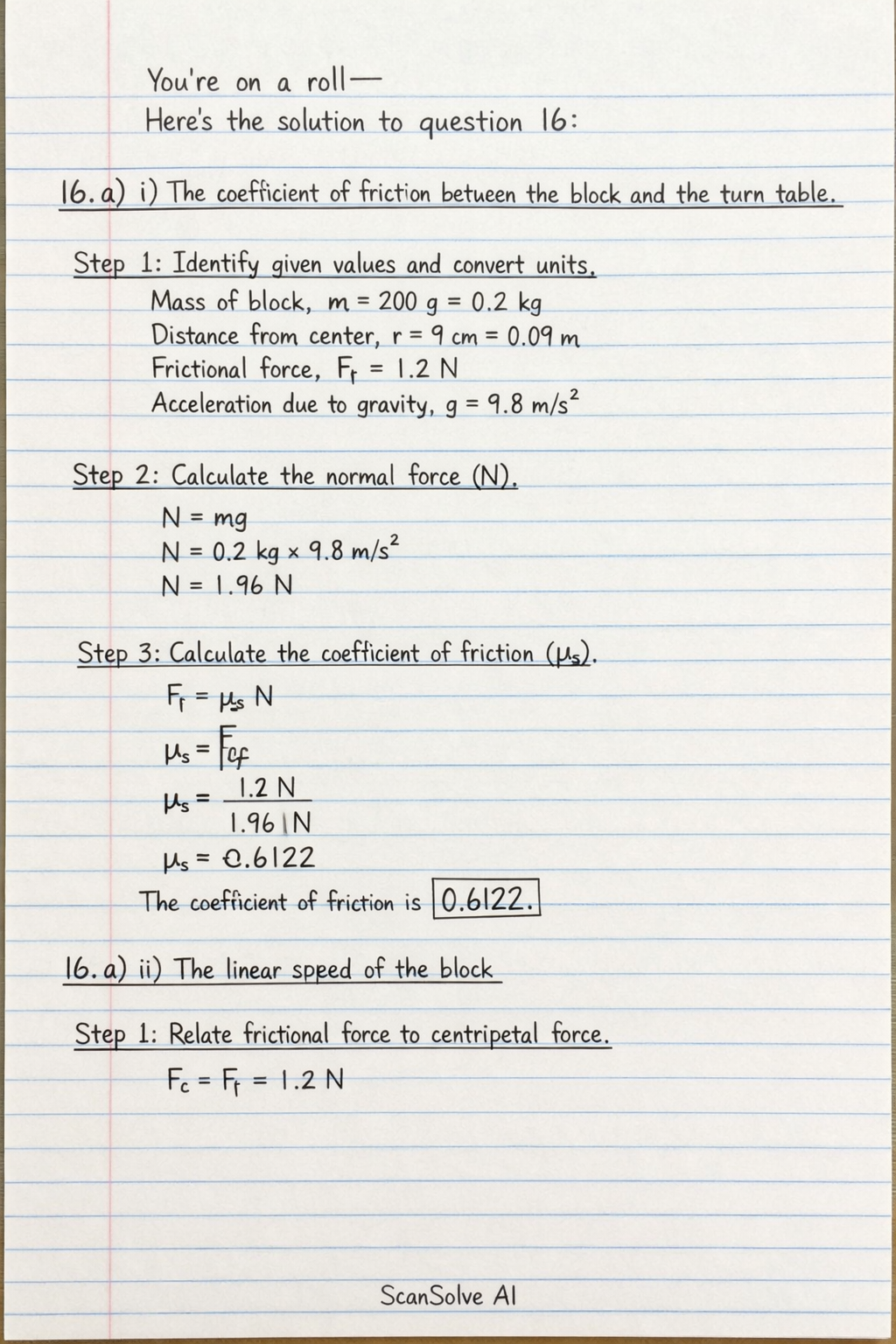
16. a) i) The coefficient of friction between the block and the turn table
Identify given values and convert units.
Mass of block,
Distance from center,
Frictional force,
Acceleration due to gravity,Calculate the normal force ().
The normal force on a horizontal surface is equal to the gravitational force.
Calculate the coefficient of friction ().
The maximum static frictional force is given by .
The coefficient of friction is .
16. a) ii) The linear speed of the block
Relate frictional force to centripetal force.
When the block begins to slide, the frictional force provides the centripetal force ().
Use the formula for centripetal force in terms of linear speed.
Solve for the linear speed ().
The linear speed of the block is .
16. a) iii) If the angular velocity is increased by rad/s, what would be the force required to hold the block at the same place?
Calculate the initial angular velocity () when the block begins to slide.
The centripetal force is also given by .
Calculate the new angular velocity ().
The angular velocity is increased by rad/s.
Calculate the new force required () to hold the block at the same place.
The force required to hold the block at the same place is .
16. c) What is meant by the term "Banking" in roads?
Banking in roads refers to the practice of raising the outer edge of a curved road or track relative to the inner edge. This tilt provides a component of the normal force that acts as a centripetal force, helping vehicles to negotiate turns safely at higher speeds without relying solely on friction.
Still stuck on this one?
Ask a follow-up, and the answer starts from this question.
More Physics Questions
Handwritten Step-by-Step Solution
Get this as a handwritten image on WhatsApp — like a tutor wrote it for you.
Try on WhatsApp