
We read your photo as:
A marine survey ship sends a sound wave straight to the seabed. It receives an echo 1.5 s later. The speed of sound in sea water is 150p ms⁻¹. Find the depth of the sea at this position. An electric b
ScanSolve AI Answer
This answer stops before the end.
It was cut off when it was first written. Ask ScanSolve this question again for the full working.
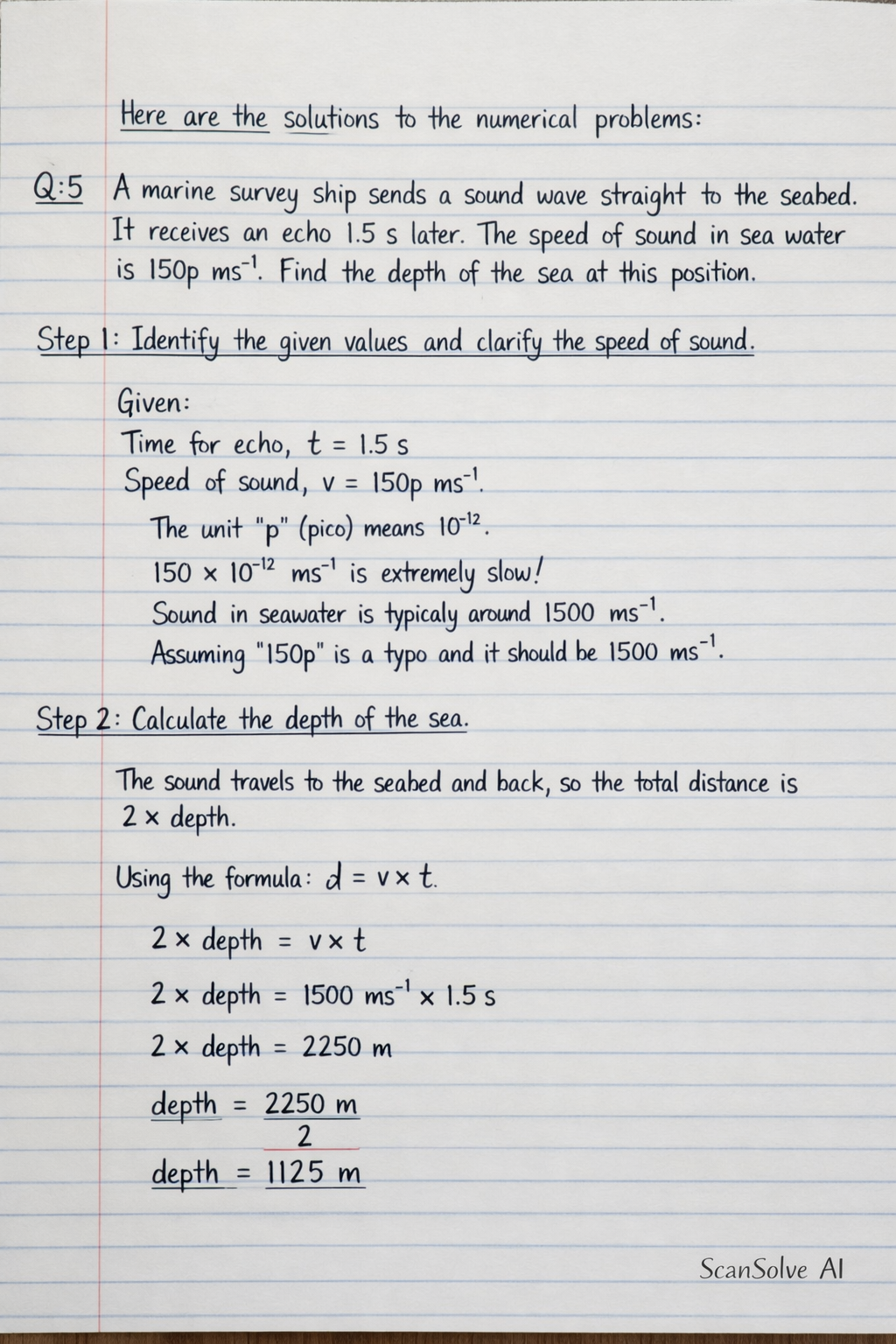
Here are the solutions to the numerical problems:
Q:5 A marine survey ship sends a sound wave straight to the seabed. It receives an echo 1.5 s later. The speed of sound in sea water is 150p ms⁻¹. Find the depth of the sea at this position.
Step 1: Identify the given values and clarify the speed of sound.
Given:
Time for echo,
Speed of sound, . The unit "p" (pico) means . A speed of is extremely slow and unrealistic for sound in seawater. Sound in seawater is typically around . Assuming "150p" is a typo and it should be .
Step 2: Calculate the depth of the sea.
The sound travels to the seabed and back, so the total distance covered is .
The formula for distance is .
So, .
Substitute the values:
The depth of the sea at this position is .
Q:6 An electric bulb is marked with 220V, 100W. Find the resistance of the filament of the bulb. If the bulb is used 5 hours daily, find the energy in Kilowatt hour consumed by the bulb in one month ( 30 Days)
Step 1: Find the resistance of the filament.
Given:
Voltage,
Power,
The formula relating power, voltage, and resistance is .
Rearrange to solve for :
Substitute the values:
Step 2: Find the energy consumed in one month (30 days).
Given:
Power,
Daily usage,
Number of days,
First, convert power to kilowatts:
Next, calculate the total time of usage in hours for one month:
The formula for energy consumed is .
Substitute the values:
The resistance of the filament is .
The energy consumed by the bulb in one month is .
Q:7 A sound waves has frequency of 2 kHz and wavelength 35 cm. How long will it take to travel 1.5 km?
Step 1: Convert given values to standard units.
Given:
Frequency,
Wavelength,
Distance,
Step 2: Calculate the speed of the sound wave.
The relationship between speed (), frequency (), and wavelength () is .
Substitute the values:
Step 3: Calculate the time taken to travel the given distance.
The formula for time () is .
Substitute the values:
It will take approximately to travel 1.5 km.
Q:8 A current of 3mA is flowing through a wire for 1 minutes. What is the charge flowing through the wire?
Step 1: Convert given values to standard units.
Given:
Current,
Time,
Step 2: Calculate the charge flowing through the wire.
The formula for charge () is .
Substitute the values:
The charge flowing through the wire is .
Q:9 If at Anarkali Bazar Lahore, the intensity level of sound is 80 dB, what will be the intensity of sound there?
Step 1: Identify the given values and the formula for intensity.
Given:
Sound intensity level,
Reference intensity, (standard value)
The formula for sound intensity level is .
To find , rearrange the formula:
Step 2: Substitute the values and calculate .
The intensity of sound at Anarkali Bazar Lahore is .
Q:10 The resistance of a conductor wire is 10 M . Is a potential Difference of 100 volts is applied across its ends , then find the value of current passing through it in mA.
Step 1: Convert given values to standard units.
Given:
Resistance,
Potential Difference,
Step 2: Calculate the current using Ohm's Law.
The formula for current () is .
Substitute the values:
Step 3: Convert the current to milliamperes (mA).
The value of current passing through the wire is .
Q:11 A doctor counts 72 heartbeats in 1 min. Calculate the frequency and period of the heartbeats.
Step 1: Convert time to seconds.
Given:
Number of heartbeats = 72
Time,
Step 2: Calculate the frequency ().
Frequency is the number of events per unit time.
Step 3: Calculate the period ().
Period is the reciprocal of frequency.
The frequency of the heartbeats is .
The period of the heartbeats is .
Q:12 A concave lens has focal length of 15 cm. At what distance should the object from the lens be placed so that it forms an image at 10 cm from the lens? Also find the magnification of the lens.
Step 1: Identify the given values and apply sign conventions for a concave lens.
Given:
Focal length of concave lens, (focal length is negative for concave lenses)
Image distance, (image formed by a concave lens is always virtual and on the same side as the object, so is negative)
Step 2: Calculate the object distance () using the lens formula.
The lens formula is:
Rearrange to solve for :
Substitute the values:
Still stuck on this one?
Ask a follow-up, and the answer starts from this question.
More Physics Questions
Handwritten Step-by-Step Solution
Get this as a handwritten image on WhatsApp — like a tutor wrote it for you.
Try on WhatsApp