We read your photo as:

A mild Steel bar 20cm long and 8cm x 6cm in cross section is subjected to a long longitudinal axial compression of 72 kN. Determine the value of the lateral force necesary to prevent any transverse strain in length and poisson ratio.

Physics

ScanSolve AI Answer

Answer

60 KN (on 20cm x 6cm face) and 80 KN (on 20cm x 8cm face)\text{60 KN (on 20cm x 6cm face) and 80 KN (on 20cm x 8cm face)}

-0.125 cm (reduction)\text{-0.125 cm (reduction)}

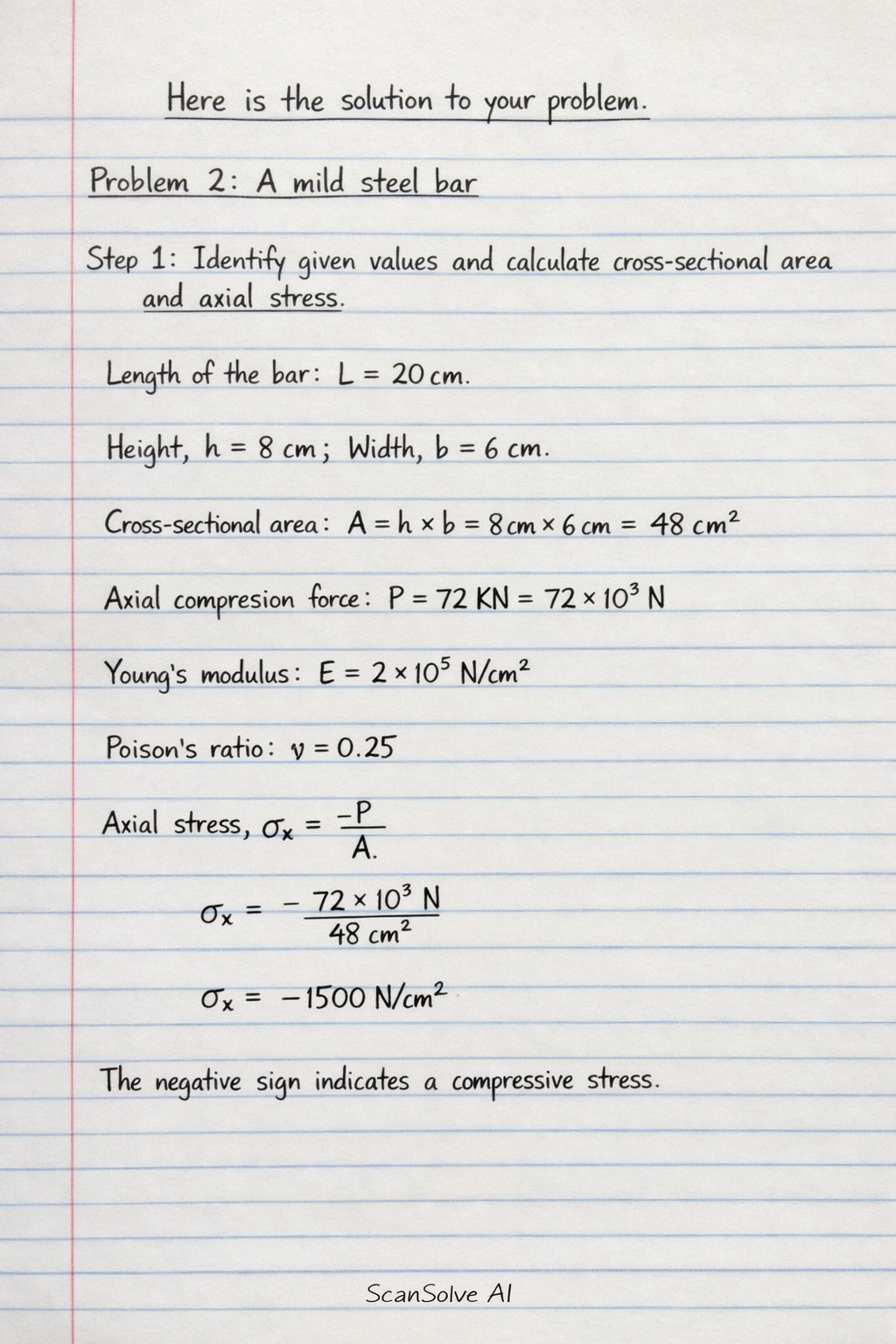
Here is the solution to your problem.

: A mild steel bar

  • Step 1: Identify given values and calculate cross-sectional area and axial stress. The length of the bar is L=20 cmL = 20 \, \text{cm}. The cross-section dimensions are 8 cm8 \, \text{cm} (height, let's call this hh) and 6 cm6 \, \text{cm} (width, let's call this bb). The cross-sectional area A=h×b=8 cm×6 cm=48 cm2A = h \times b = 8 \, \text{cm} \times 6 \, \text{cm} = 48 \, \text{cm}^2. The axial compression force is P=72 KN=72×103 NP = 72 \, \text{KN} = 72 \times 10^3 \, \text{N}. Young's modulus is E=2×10⁵ N/cm2E = 2 \times 10^5 \, \text{N/cm}^2. Poisson's ratio is ν=0.25\nu = 0.25. The axial stress σx\sigma_x (in the longitudinal direction, along the 20 cm length) is:

    σx=−PA=−72×103 N48 cm2=−1500 N/cm2\sigma_x = -\frac{P}{A} = -\frac{72 \times 10^3 \, \text{N}}{48 \, \text{cm}^2} = -1500 \, \text{N/cm}^2

    The negative sign indicates a compressive stress.

  • Step 2: Determine the lateral forces necessary to prevent any transverse strain. To prevent transverse strain, we set ϵy=0\epsilon_y = 0 and ϵz=0\epsilon_z = 0. Using the generalized Hooke's Law for strains:

    ϵy=1E[σy−ν(σx+σz)]=0\epsilon_y = \frac{1}{E} [\sigma_y - \nu(\sigma_x + \sigma_z)] = 0

    This simplifies to:

    σy−νσx−νσz=0  ⟹  σy−νσz=νσx(1)\sigma_y - \nu\sigma_x - \nu\sigma_z = 0 \implies \sigma_y - \nu\sigma_z = \nu\sigma_x \quad (1)

    Similarly for ϵz\epsilon_z:

    ϵz=1E[σz−ν(σx+σy)]=0\epsilon_z = \frac{1}{E} [\sigma_z - \nu(\sigma_x + \sigma_y)] = 0

    This simplifies to:

    σz−νσx−νσy=0  ⟹  σz−νσy=νσx(2)\sigma_z - \nu\sigma_x - \nu\sigma_y = 0 \implies \sigma_z - \nu\sigma_y = \nu\sigma_x \quad (2)

    From equations (1) and (2), we can deduce that σy=σz\sigma_y = \sigma_z. Substitute σz=σy\sigma_z = \sigma_y into equation (1):

    σy−νσy=νσx\sigma_y - \nu\sigma_y = \nu\sigma_x σy(1−ν)=νσx\sigma_y(1-\nu) = \nu\sigma_x σy=ν1−νσx\sigma_y = \frac{\nu}{1-\nu} \sigma_x

    Now, substitute the given values ν=0.25\nu = 0.25 and σx=−1500 N/cm2\sigma_x = -1500 \, \text{N/cm}^2:

    σy=0.251−0.25(−1500 N/cm2)=0.250.75(−1500 N/cm2)=13(−1500 N/cm2)=−500 N/cm2\sigma_y = \frac{0.25}{1-0.25} (-1500 \, \text{N/cm}^2) = \frac{0.25}{0.75} (-1500 \, \text{N/cm}^2) = \frac{1}{3} (-1500 \, \text{N/cm}^2) = -500 \, \text{N/cm}^2

    Therefore, σy=σz=−500 N/cm2\sigma_y = \sigma_z = -500 \, \text{N/cm}^2. Now, we calculate the lateral forces. The force in the y-direction (FyF_y) acts on the face with area L×b=20 cm×6 cm=120 cm2L \times b = 20 \, \text{cm} \times 6 \, \text{cm} = 120 \, \text{cm}^2.

    Fy=σy×(L×b)=(−500 N/cm2)×(120 cm2)=−60000 N=−60 KNF_y = \sigma_y \times (L \times b) = (-500 \, \text{N/cm}^2) \times (120 \, \text{cm}^2) = -60000 \, \text{N} = -60 \, \text{KN}

    The force in the z-direction (FzF_z) acts on the face with area L×h=20 cm×8 cm=160 cm2L \times h = 20 \, \text{cm} \times 8 \, \text{cm} = 160 \, \text{cm}^2.

    Fz=σz×(L×h)=(−500 N/cm2)×(160 cm2)=−80000 N=−80 KNF_z = \sigma_z \times (L \times h) = (-500 \, \text{N/cm}^2) \times (160 \, \text{cm}^2) = -80000 \, \text{N} = -80 \, \text{KN}

    The negative signs indicate that these are compressive forces.

  • Step 3: Evaluate the resultant alteration in length. The alteration in length ΔL\Delta L is given by ΔL=Lϵx\Delta L = L \epsilon_x. We need to find the longitudinal strain ϵx\epsilon_x under the condition that ϵy=ϵz=0\epsilon_y = \epsilon_z = 0. Using the generalized Hooke's Law for longitudinal strain:

    ϵx=1E[σx−ν(σy+σz)]\epsilon_x = \frac{1}{E} [\sigma_x - \nu(\sigma_y + \sigma_z)]

    Substitute σy=σz=ν1−νσx\sigma_y = \sigma_z = \frac{\nu}{1-\nu} \sigma_x:

    ϵx=1E[σx−ν(ν1−νσx+ν1−νσx)]\epsilon_x = \frac{1}{E} \left[ \sigma_x - \nu \left( \frac{\nu}{1-\nu} \sigma_x + \frac{\nu}{1-\nu} \sigma_x \right) \right] ϵx=1E[σx−2ν21−νσx]=σxE[1−2ν21−ν]\epsilon_x = \frac{1}{E} \left[ \sigma_x - \frac{2\nu^2}{1-\nu} \sigma_x \right] = \frac{\sigma_x}{E} \left[ 1 - \frac{2\nu^2}{1-\nu} \right] ϵx=σxE[1−ν−2ν21−ν]\epsilon_x = \frac{\sigma_x}{E} \left[ \frac{1-\nu-2\nu^2}{1-\nu} \right]

    Substitute σx=−1500 N/cm2\sigma_x = -1500 \, \text{N/cm}^2, E=2×10⁵ N/cm2E = 2 \times 10^5 \, \text{N/cm}^2, and ν=0.25\nu = 0.25:

    ϵx=−1500 N/cm22×105 N/cm2[1−0.25−2(0.25)21−0.25]\epsilon_x = \frac{-1500 \, \text{N/cm}^2}{2 \times 10^5 \, \text{N/cm}^2} \left[ \frac{1-0.25-2(0.25)^2}{1-0.25} \right] ϵx=−0.0075[0.75−2(0.0625)0.75]=−0.0075[0.75−0.1250.75]\epsilon_x = -0.0075 \left[ \frac{0.75 - 2(0.0625)}{0.75} \right] = -0.0075 \left[ \frac{0.75 - 0.125}{0.75} \right] ϵx=−0.0075[0.6250.75]=−0.0075×56=−0.00625\epsilon_x = -0.0075 \left[ \frac{0.625}{0.75} \right] = -0.0075 \times \frac{5}{6} = -0.00625

    Now, calculate the alteration in length:

    ΔL=Lϵx=20 cm×(−0.00625)=−0.125 cm\Delta L = L \epsilon_x = 20 \, \text{cm} \times (-0.00625) = -0.125 \, \text{cm}

    The negative sign indicates a reduction in length.

The lateral forces necessary to prevent any transverse strain are 60 KN (on 20cm x 6cm face) and 80 KN (on 20cm x 8cm face)\boxed{\text{60 KN (on 20cm x 6cm face) and 80 KN (on 20cm x 8cm face)}}.
The resultant alteration in length is -0.125 cm (reduction)\boxed{\text{-0.125 cm (reduction)}}.

Was this helpful?

Try one yourself

A new problem that tests the same skill.

Still stuck on this one?

Ask a follow-up, and the answer starts from this question.

Got a different question?Ask your own question
Handwritten step-by-step solution preview

Handwritten Step-by-Step Solution

Get this as a handwritten image on WhatsApp — like a tutor wrote it for you.

Try on WhatsApp