
We read your photo as:
A pole of length 1.7m and mass 15kg is supported by two people. A boy of mass 65kg sits 0.75m from one end and a girl of mass 49kg sits 0.5m from the other end. Calculate the forces exerted by the sup
ScanSolve AI Answer
Step-by-step solution
4 steps8. a) i.
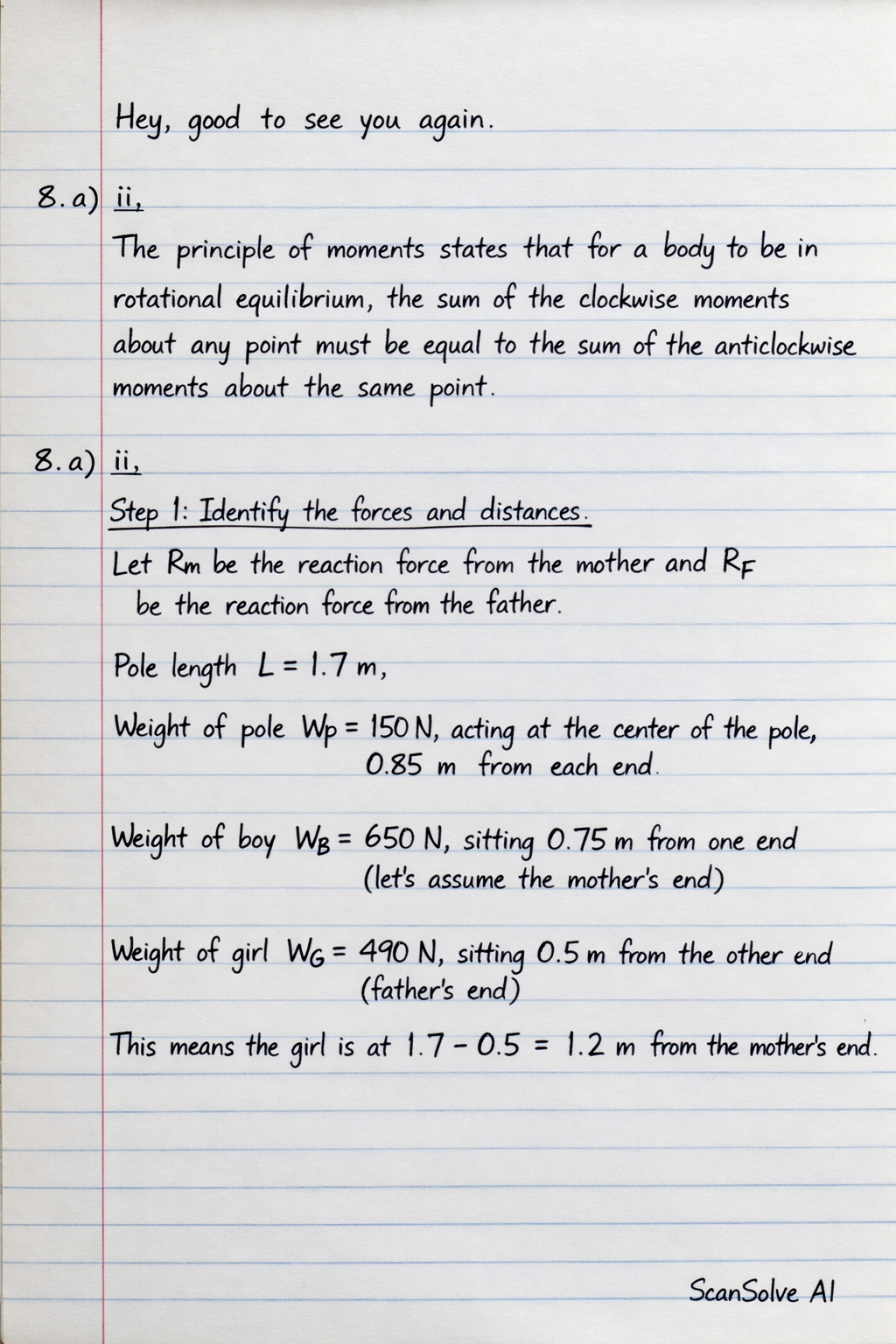
The principle of moments states that for a body to be in rotational equilibrium, the sum of the clockwise moments about any point must be equal to the sum of the anticlockwise moments about the same point.
8. a) ii.
Identify the forces and distances.
Let be the reaction force from the mother and be the reaction force from the father.
Pole length m.
Weight of pole N, acting at the center of the pole, 0.85 m from each end.
Weight of boy N, sitting 0.75 m from one end (let's assume the mother's end).
Weight of girl N, sitting 0.5 m from the other end (father's end). This means the girl is at m from the mother's end.Apply the principle of moments about the mother's support ().
Clockwise moments:
Moment due to boy =
Moment due to pole =
Moment due to girl =
Anticlockwise moment:
Moment due to father's support =Sum of clockwise moments = Sum of anticlockwise moments
Apply the condition for translational equilibrium (sum of upward forces = sum of downward forces).
Upward forces:
Downward forces:Substitute :
State the reactions.
The reaction of the mother is and the reaction of the father is .
8. b) i.
Relative motion describes the motion of an object with respect to another object or a specific frame of reference. It means that the observed velocity or position of an object depends on the motion of the observer.8. b) ii.
Given: Velocity of car A, . Velocity of car B, .α. If the two cars are travelling in the same direction:
The relative velocity of car A with respect to car B is the difference between their velocities.β. If the two cars are travelling in opposite directions:
The relative velocity of car A with respect to car B is the sum of their magnitudes of velocities.8. c)
Given: Mass kg. Initial velocity . Final velocity . Time s.i. Acceleration of the body:
Using the equation of motion :ii. Work done by the body:
Work done is equal to the change in kinetic energy.iii. Change in momentum of the body:
Change in momentum .9. a)
Two factors that determine the quantity of heat in a body are:- The mass of the body.
- The specific heat capacity of the material of the body.
- The change in temperature of the body. (Any two of these are sufficient)
9. b)
Given: Mass of lead kg. Initial temperature . Melting point . Power of furnace kW W. Specific heat capacity of lead . Specific latent heat of fusion of lead .i. Quantity of heat required to heat the lead to its melting point:
The change in temperature .
Since change is equal to change, .ii. Additional heat required to melt the lead:
This is the latent heat of fusion.iii. Time taken to supply this additional energy:
The power of the furnace is . We need to find .
Still stuck on this one?
Ask a follow-up, and the answer starts from this question.
More Physics Questions
Handwritten Step-by-Step Solution
Get this as a handwritten image on WhatsApp — like a tutor wrote it for you.
Try on WhatsApp