
We read your photo as:
A potentiometer wire AB is 100 cm long. The EMF of the test cell is 1.5 V. At a balance length of 60 cm, calculate the potential difference across the entire wire AB.
ScanSolve AI Answer
Answer
Step-by-step solution
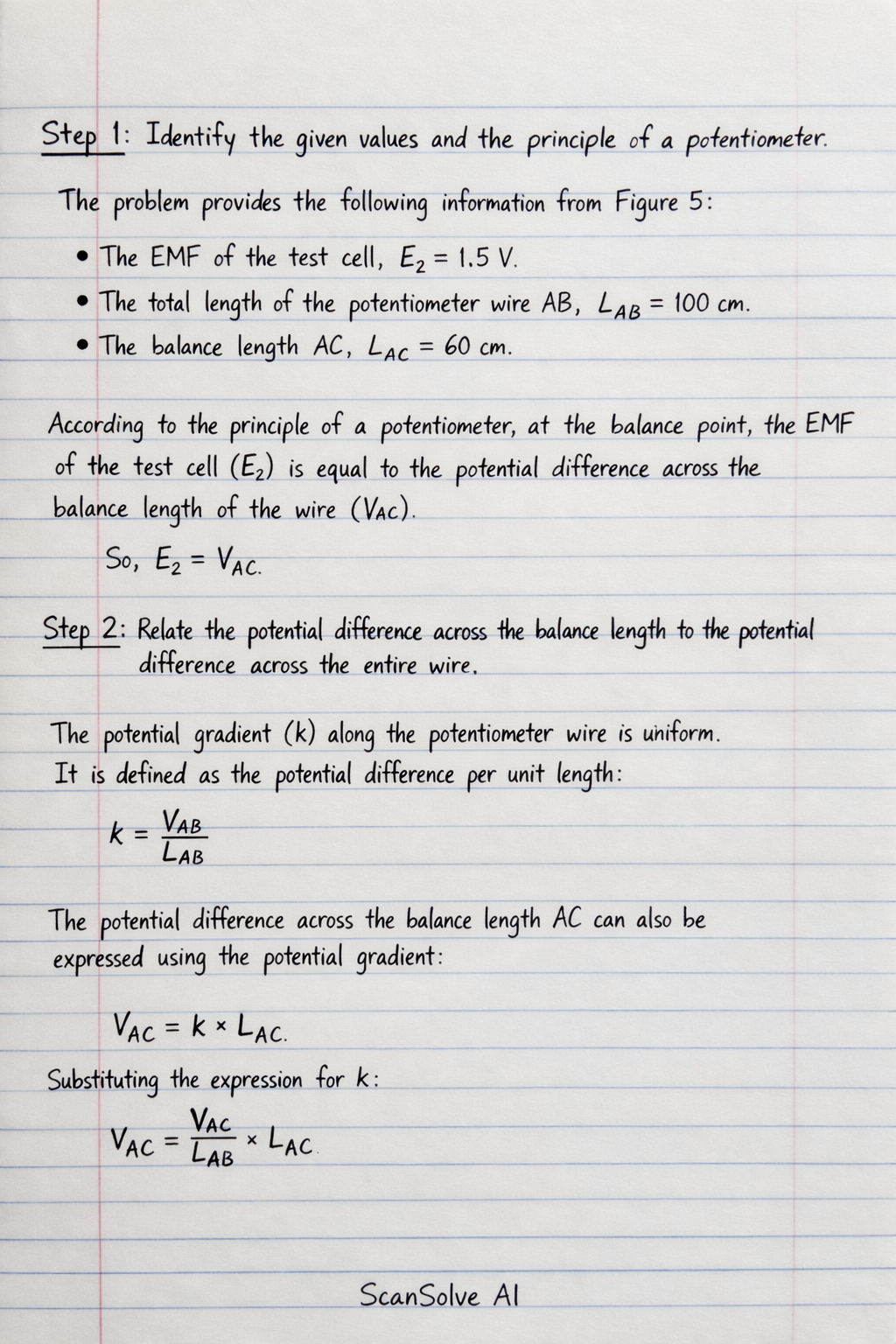
3 stepsIdentify the given values and the principle of a potentiometer.
The problem provides the following information from Figure 5:
- The EMF of the test cell, .
- The total length of the potentiometer wire AB, .
- The balance length AC, .
According to the principle of a potentiometer, at the balance point, the EMF of the test cell () is equal to the potential difference across the balance length of the wire ().
So, .Relate the potential difference across the balance length to the potential difference across the entire wire.
The potential gradient () along the potentiometer wire is uniform. It is defined as the potential difference per unit length:
The potential difference across the balance length can also be expressed using the potential gradient:
Substituting the expression for :
Substitute the known values and solve for .
Since , we can write:
Now, plug in the given values:
To find , rearrange the equation:
The potential difference between the ends A and B of the potentiometer is .
Comparing this result with the given options:
A 1.5 V
B 3.75 V
C 2.5 V
D 4 VThe calculated value matches option C.
Try one yourself
A new problem that tests the same skill.
Still stuck on this one?
Ask a follow-up, and the answer starts from this question.
More Physics Questions
Handwritten Step-by-Step Solution
Get this as a handwritten image on WhatsApp — like a tutor wrote it for you.
Try on WhatsApp