
We read your photo as:
You are provided a cell of emf, E, a key, K, an ammeter, A, a voltmeter, V, a standard resistor, R, a jockey, J, a potentiometer PF and connecting wires. Use the diagram below as a guide to carry out the following instructions.
ScanSolve AI Answer
Step-by-step solution
9 stepsHere's the solution to your question:
3(a)
-
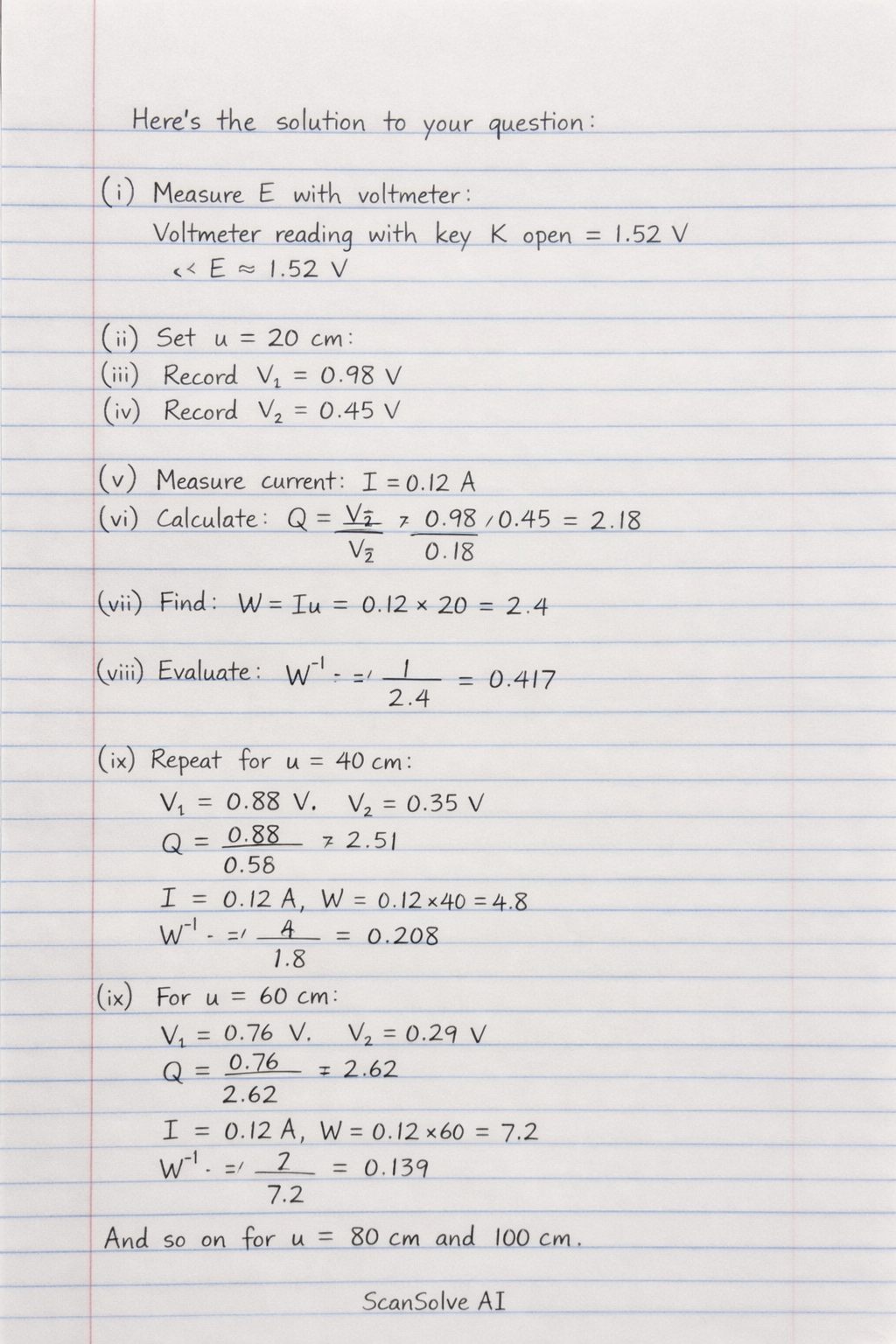
(i) Determine the approximate value of E using the voltmeter. Connect the voltmeter directly across the terminals of the cell E with the key K open. The reading on the voltmeter will give the approximate electromotive force (EMF), E, of the cell.
-
(ii) - (viii) Procedure for experiment. These are instructions for performing the experiment and recording data.
-
(ix) Evaluate , and . These are calculations to be performed for each set of readings.
-
(x) Repeat the experiment for . For each case, record . This is an instruction for data collection.
-
(xi) Tabulate the results. The table should have the following columns:
(cm) (V) (V) (A) (A cm) (A cm) 20 40 60 80 100 -
(xii) Plot a graph of on the vertical axis and on the horizontal axis. This is an instruction for you to perform.
-
(xiii) Calculate the slope, , of the graph. This is an instruction for you to perform.
-
(xiv) Given that , calculate the value .
The quantities and are defined as and .
From the circuit, and , where is the resistance per unit length of the potentiometer wire.
Substitute these into the expression for
$$ Q = \frac{IR}{I \rho u} = \frac{R}{\rho u} $$Rearrange to find
$$ u = \frac{R}{\rho Q} $$Substitute this expression for into
$$ W^{-1} = \frac{1}{I \left(\frac{R}{\rho Q}\right)} = \frac{\rho Q}{IR} $$This shows a linear relationship .
The slope of the graph of vs is:
Substitute into the given formula for
$$ \sigma = Es = E \left(\frac{\rho}{IR}\right) $$ The unit of $Q$ is dimensionless. The unit of $W^{-1}$ is $\text{A}^{-1}\text{cm}^{-1}$. Therefore, the unit of the slope $s$ is $\text{A}^{-1}\text{cm}^{-1}$. The unit of $\sigma = Es$ is $\text{V} \cdot \text{A}^{-1}\text{cm}^{-1} = \frac{\text{V}}{\text{A}} \cdot \text{cm}^{-1} = \Omega \cdot \text{cm}^{-1}$. The unit of $\sigma$ is $\boxed{\Omega \text{ cm}^{-1}}$.-
(xv) Use the graph to determine W when Q = 5. Hence, determine I if u = 50 cm.
- Locate on the horizontal axis of your graph.
- Read the corresponding value of from the vertical axis.
- Calculate .
- Using the formula , and given , calculate .
-
(xvi) State two precautions taken to ensure accurate results when performing this experiment.
- Ensure clean terminals and tight connections throughout the circuit to minimize contact resistance.
- Avoid prolonged current flow by opening the key K between readings to prevent heating of the potentiometer wire and the cell, which could alter their resistance and EMF respectively.
3(b)
-
(i) State two reasons why Manganin is used for making potentiometer wire.
- Manganin has a very low temperature coefficient of resistance, meaning its resistance changes minimally with temperature fluctuations, ensuring a stable potential gradient.
- Manganin has a high resistivity, allowing a long wire with significant resistance to be made compact, which is ideal for a potentiometer.
-
(ii) The current drawn by an electric device is 1.2 A when it is connected to a potential difference of 240.0 V. Calculate the current drawn by the same device if it is connected to a 110.0 V source.
-
Calculate the resistance of the device using Ohm's Law.
$$ R = \frac{V_1}{I_1} $$ $$ R = \frac{240.0 \text{ V}}{1.2 \text{ A}} $$ $$ R = 200 \text{ } \Omega $$Calculate the current drawn when connected to a 110.0 V source.
$$
I_2 = \frac{V_2}{R}
$$
$$
I_2 = \frac{110.0 \text{ V}}{200 \text{ } \Omega}
$$
$$
I_2 = 0.55 \text{ A}
$$
The current drawn by the device is $\boxed{0.55 \text{ A}}$.
Still stuck on this one?
Ask a follow-up, and the answer starts from this question.
More Physics Questions
Handwritten Step-by-Step Solution
Get this as a handwritten image on WhatsApp — like a tutor wrote it for you.
Try on WhatsApp