
We read your photo as:
A sample of a radioactive isotope initially weighs 200 g. After 100 years, 18.5 g remains. What is the half-life of the isotope?
Physics
ScanSolve AI Answer
Answer
Step-by-step solution
2 stepsCalculate the number of half-lives ().
The formula for radioactive decay is , where is the final mass, is the initial mass, and is the number of half-lives.
To solve for , take the logarithm of both sides:
Calculate the half-life ().
The total time () is related to the number of half-lives () and the half-life () by the formula .
Was this helpful?
Try one yourself
A new problem that tests the same skill.
Still stuck on this one?
Ask a follow-up, and the answer starts from this question.
Got a different question?Ask your own question
More Physics Questions
QA sample of a radioactive substance has an initial mass of 320 g. If its half-life is 2 minutes, how…QA radioactive substance has an initial mass of 64 g and decays to 2 g in 24 days. What is its…QA radioactive substance has a half-life of 80 days. If you start with 6.0 × 10¹⁰ atoms, how many…QA radioactive isotope has a decay constant of 10⁻⁸ s⁻¹. Calculate its half-life.QA radioactive sample contains 1020 atoms. Its half-life is 20 seconds. How many disintegrations…
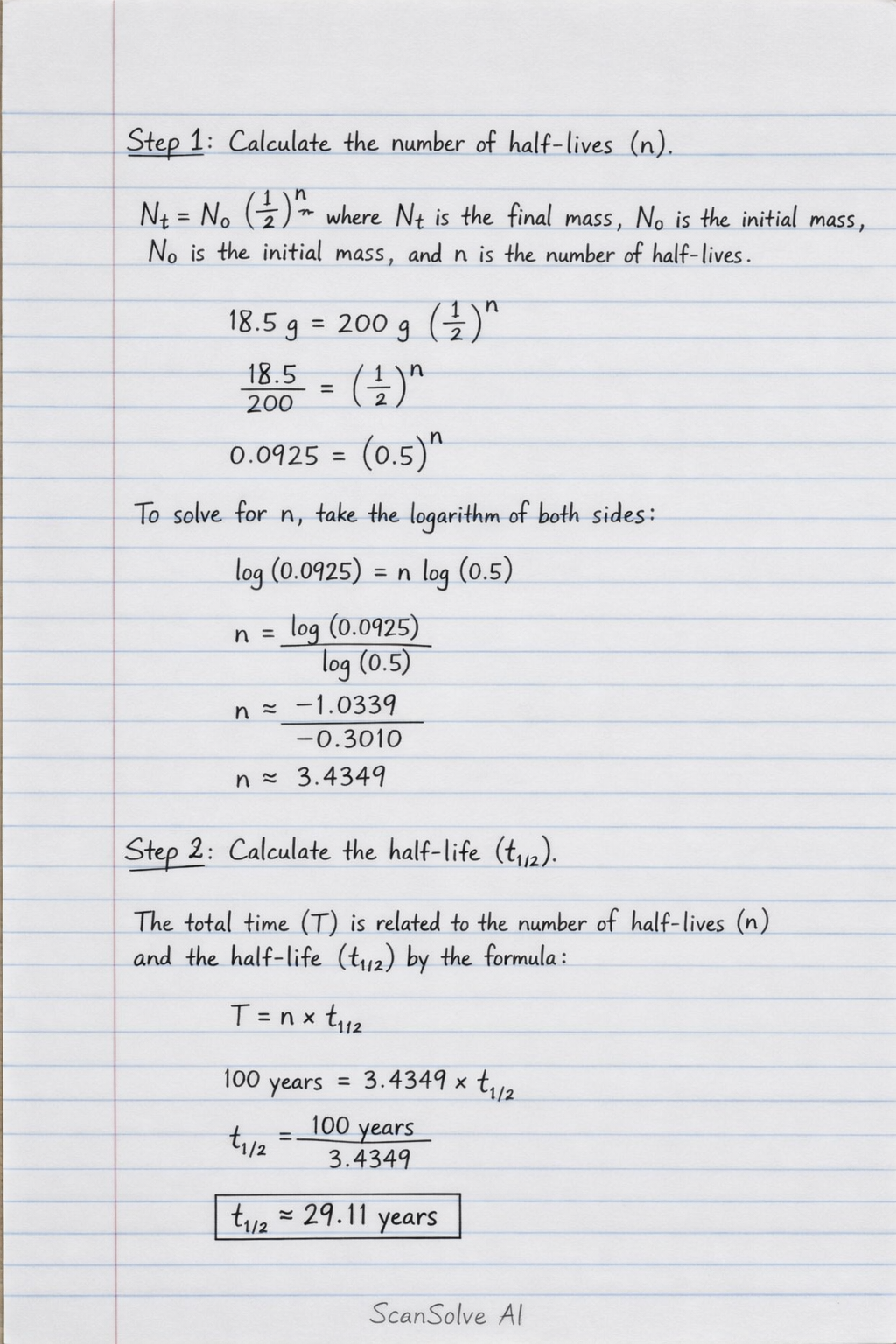
Handwritten Step-by-Step Solution
Get this as a handwritten image on WhatsApp — like a tutor wrote it for you.
Try on WhatsApp