
We read your photo as:
A sample of Uranium-238 has a half-life of 4.5 imes 109 years. (a) What is the half-life of Uranium-238? (b) Write the nuclear equation for its alpha decay. (c) If you start with 5 g of Uranium-238, h
ScanSolve AI Answer
Step-by-step solution
11 stepsHere are the solutions to the questions:
a) i) The half-life of years means that it takes years for half of the initial amount of a radioactive sample of Uranium-238 to decay.
a) ii) The radioactive decay equation for Uranium-238 by alpha emission is:
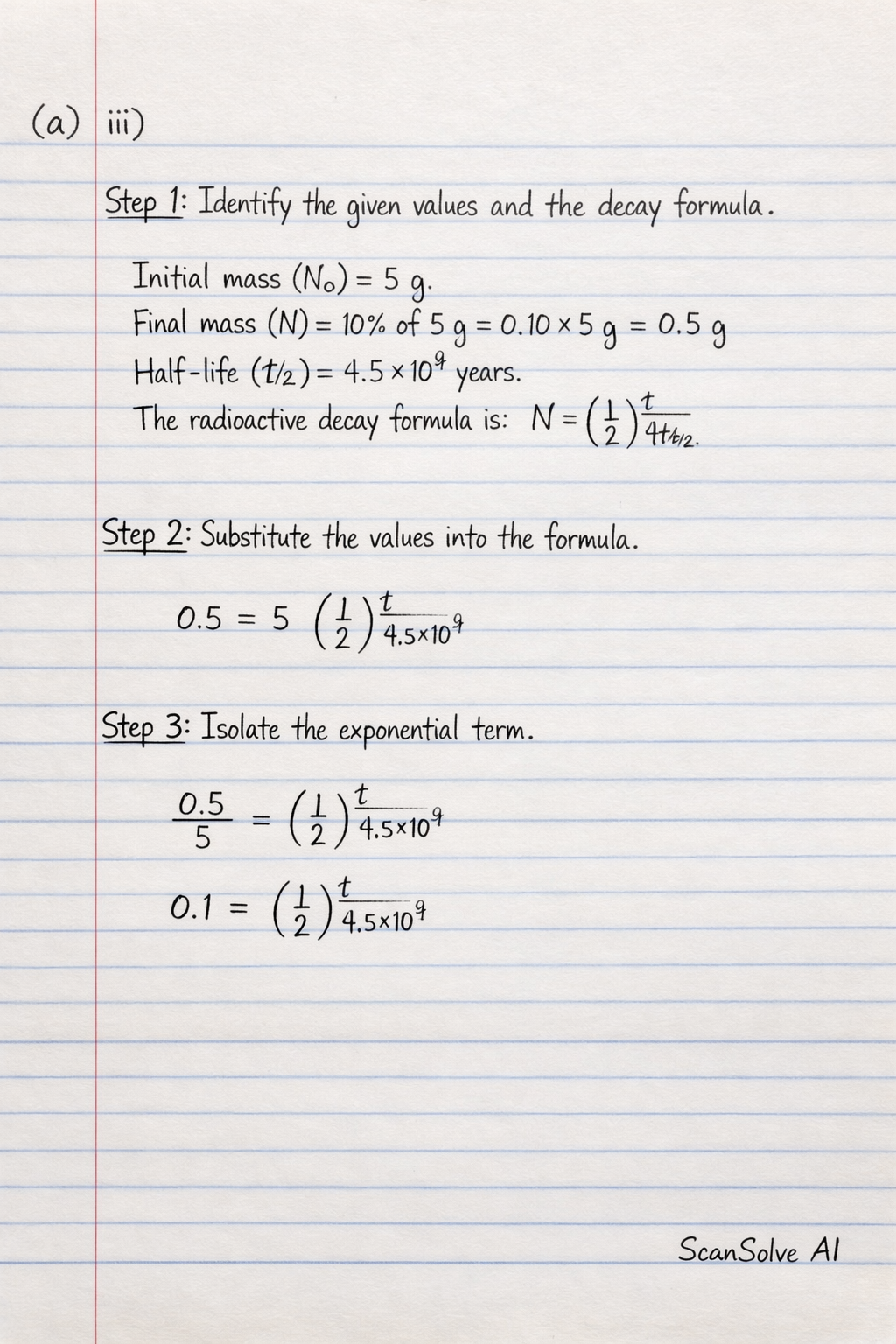
a) iii)
Identify the given values and the decay formula.
Initial mass () =
Final mass () = of
Half-life () =
The radioactive decay formula is .Substitute the values into the formula.
Isolate the exponential term.
Take the natural logarithm of both sides.
Solve for .
a) iv) A. The same element can have different atomic masses because of the existence of isotopes. Isotopes are atoms of the same element that have the same number of protons (and thus the same atomic number) but different numbers of neutrons, leading to different mass numbers.
a) iv) B.
Use the formula for relative atomic mass (RAM).
Substitute the given data for Barium.
Calculate the sum of the products.
Calculate the relative atomic mass.
b) i) A rate law is an equation that expresses the relationship between the rate of a chemical reaction and the concentrations of the reactants, raised to appropriate powers (reaction orders), at a specific temperature.
b) ii)
Determine the order with respect to each reactant based on the given information.
- Doubling the concentration of doubles the reaction rate, so the reaction is first order with respect to . ()
- Tripling the concentration of triples the reaction rate, so the reaction is first order with respect to . ()
- Doubling the concentration of has no effect on the rate, so the reaction is zero order with respect to . ()
Combine the orders to write the rate law.
b) iii) A mechanism consistent with the rate law would have the slowest (rate-determining) step involving one molecule of and one molecule of . Reactant is not involved in the rate-determining step.
Proposed Mechanism:
Step 1 (Slow): (Rate-determining step)
Step 2 (Fast):
Overall Reaction:
Still stuck on this one?
Ask a follow-up, and the answer starts from this question.
More Physics Questions
Handwritten Step-by-Step Solution
Get this as a handwritten image on WhatsApp — like a tutor wrote it for you.
Try on WhatsApp