

This physics problem tests your understanding of fundamental physical laws and their applications. The step-by-step solution below breaks down the problem using relevant equations and physical reasoning.
ScanSolve AI Answer
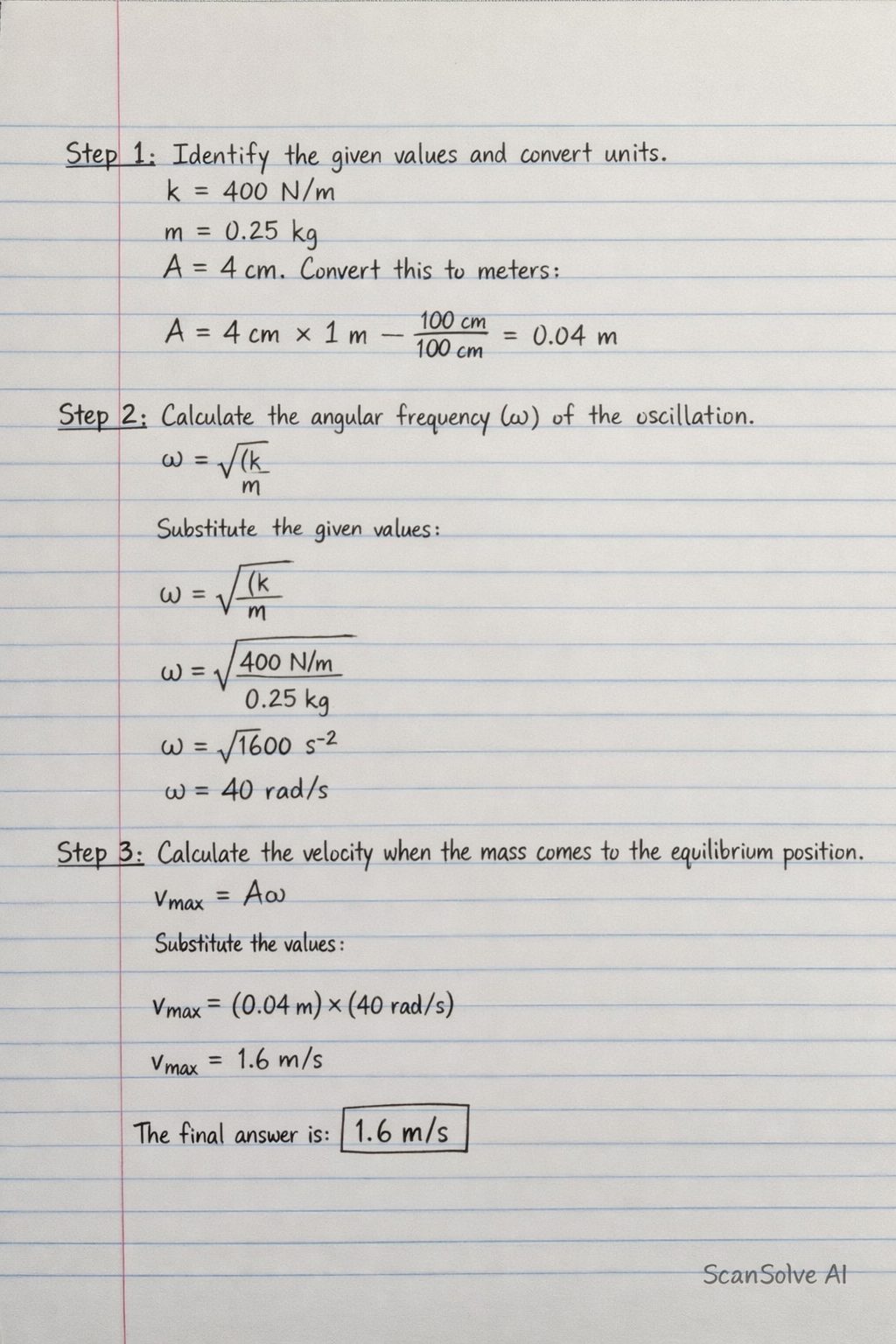
Step 1: Identify the given values and convert units. The force constant of the spring is k = 400 N/m. The mass is m = 0.25 kg. The amplitude of oscillations is A = 4 cm. Convert this to meters: A = 4 cm × 1 m100 cm = 0.04 m Step 2: Calculate the angular frequency () of the oscillation. For a mass-spring system, the angular frequency is given by the formula: = sqrt((k)/(m)) Substitute the given values: = sqrt(400 N/m)0.25 kg = sqrt(1600 s)^-2 = 40 rad/s Step 3: Calculate the velocity when the mass comes to the equilibrium position. The velocity at the equilibrium position is the maximum velocity (v_max) in Simple Harmonic Motion (SHM). The formula for maximum velocity is: v_max = A Substitute the values for amplitude and angular frequency: v_max = (0.04 m) × (40 rad/s) v_max = 1.6 m/s The final answer is 1.6 m/s.