
We read your photo as:
A. State Kirchhoff's law of voltage and law of current. ii. Using Kirchhoff's law, calculate the current in each branch of the circuit.
ScanSolve AI Answer
Step-by-step solution
11 stepsHere are the solutions to the questions:
9.a.i: State Kirchhoff's law of voltage and law of current
- Kirchhoff's Current Law (KCL): The algebraic sum of currents entering a node (or junction) in an electrical circuit is equal to the algebraic sum of currents leaving that node. This law is based on the principle of conservation of electric charge.
- Kirchhoff's Voltage Law (KVL): The algebraic sum of all potential differences (voltages) around any closed loop or mesh in an electrical circuit is equal to zero. This law is based on the principle of conservation of energy.
9.a.ii: Using Kirchhoff's law, calculate the current in each branch of the circuit.
We will apply Kirchhoff's Voltage Law (KVL) to the two independent loops in the circuit. Let and be the currents as defined in the diagram.
Apply KVL to the left loop (FABE) in a clockwise direction.
Apply KVL to the right loop (BCDE) in a clockwise direction.
Solve the system of linear equations for and .
From equation (2), multiply by 4:
Add equation (1) and equation (3):
Substitute into equation (2).
Calculate the current in each branch using and .
- Current in branch AB (through resistor): .
- Current in branch BC (through resistor): . A negative sign indicates the current flows in the opposite direction to the assumed (i.e., from C to B).
- Current in branch BE (through resistor): .
The currents in each branch are:
- Current through the resistor (branch AB):
- Current through the resistor (branch BC):
- Current through the resistor (branch BE):
- Current through the 140 V source (branch FA):
- Current through the 90 V source (branch CD):
9.b.i: Determine resistor R4
Given: Total voltage , , , . Power dissipated by , .
Calculate the voltage across the parallel combination ().
The power dissipated by is given by .
Calculate the voltage across .
Since is in series with the parallel combination, the voltage across is:
Calculate the equivalent resistance of the parallel combination ().
To find a common denominator (LCM of 16, 20, 32 is 160):
Calculate the total current flowing through the circuit ().
This current flows through the parallel combination and .
Calculate .
Simplifying the fraction by dividing numerator and denominator by 3:
The value of resistor R4 is .
9.b.ii: Determine total resistance of the circuit
Calculate the total resistance ().
The total resistance of the circuit is the sum of the equivalent parallel resistance () and .
To add these fractions, find a common denominator (69):
The total resistance of the circuit is .
Still stuck on this one?
Ask a follow-up, and the answer starts from this question.
More Physics Questions
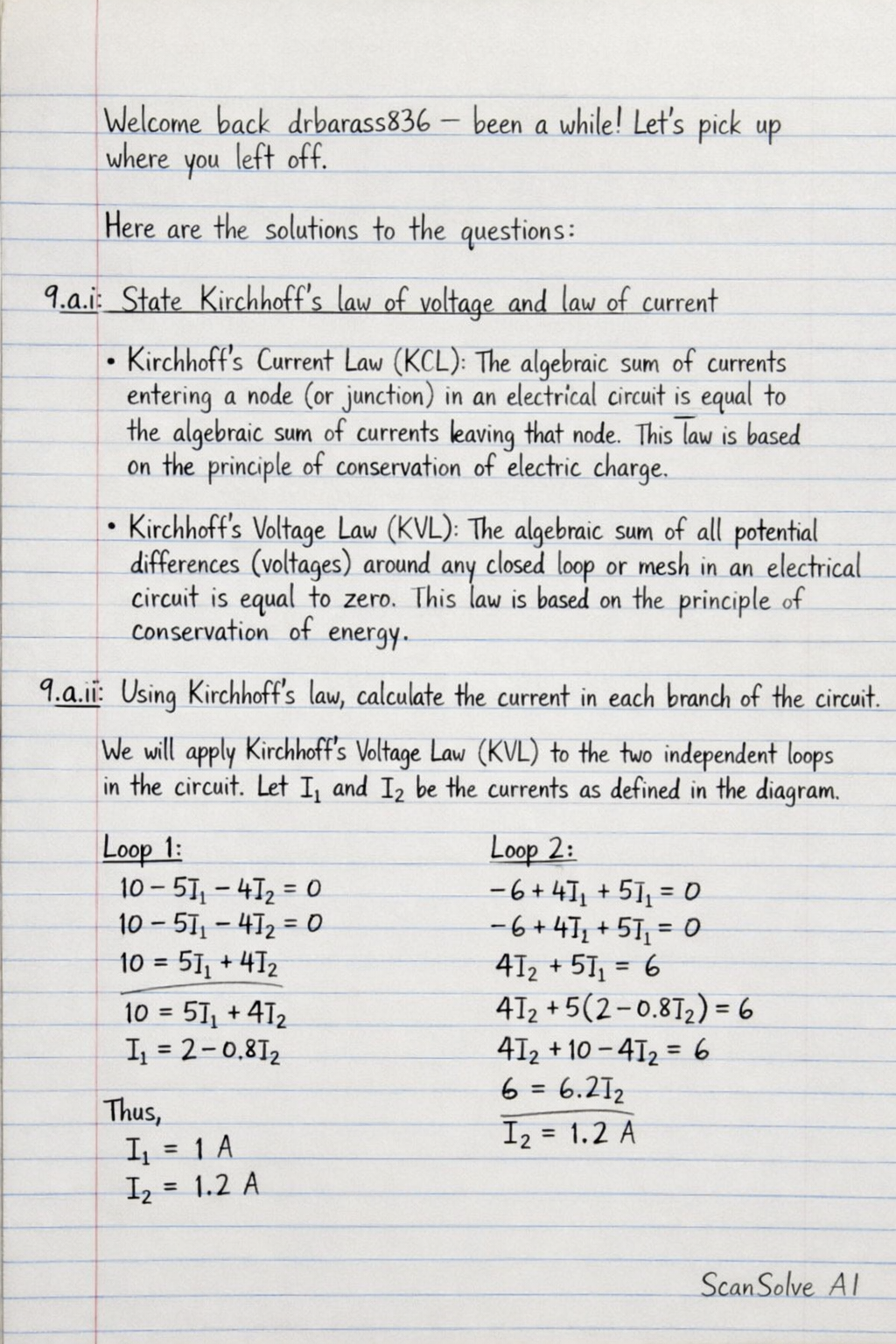
Handwritten Step-by-Step Solution
Get this as a handwritten image on WhatsApp — like a tutor wrote it for you.
Try on WhatsApp