
We read your photo as:
A steel bolt and a brass bolt are placed side-by-side with a 5.0 μm gap between them at 28.70°C. If the temperature increases, how much must the temperature increase for the bolts to touch? The coeffi
ScanSolve AI Answer
Step-by-step solution
4 stepsTo solve this problem, the initial lengths of the steel and brass bolts are required. The problem statement provides the initial gap, the initial temperature, and the coefficients of linear expansion for steel and brass, but it does not provide the initial lengths ( and ) of the bolts themselves.
Here's why this information is needed:
Identify the given values.
Initial gap,
Initial temperature,
Coefficient of linear expansion for steel,
Coefficient of linear expansion for brass,Formulate the expansion equations.
The change in length for each bolt is given by the linear thermal expansion formula:
For the steel bolt:
For the brass bolt:
where is the change in temperature.
Set up the condition for the bolts to touch.
The bolts will touch when the sum of their expansions equals the initial gap:
Substituting the expansion formulas:
Factoring out :
Solving for :
Determine the final temperature.
The final temperature would be:
a) At what temperature will the bolts touch?
As shown in Step 3, to calculate a numerical value for and thus , the initial lengths of the steel bolt () and the brass bolt () are required. Since these values are not provided in the problem statement, a numerical answer cannot be determined.b) determine respectively, the change in the length of the steel and the brass at that temperature.
Similarly, without the initial lengths ( and ) and the calculated , the individual changes in length ( and ) cannot be determined numerically.Please provide the initial lengths of the bolts if you would like a numerical solution.
Still stuck on this one?
Ask a follow-up, and the answer starts from this question.
More Physics Questions
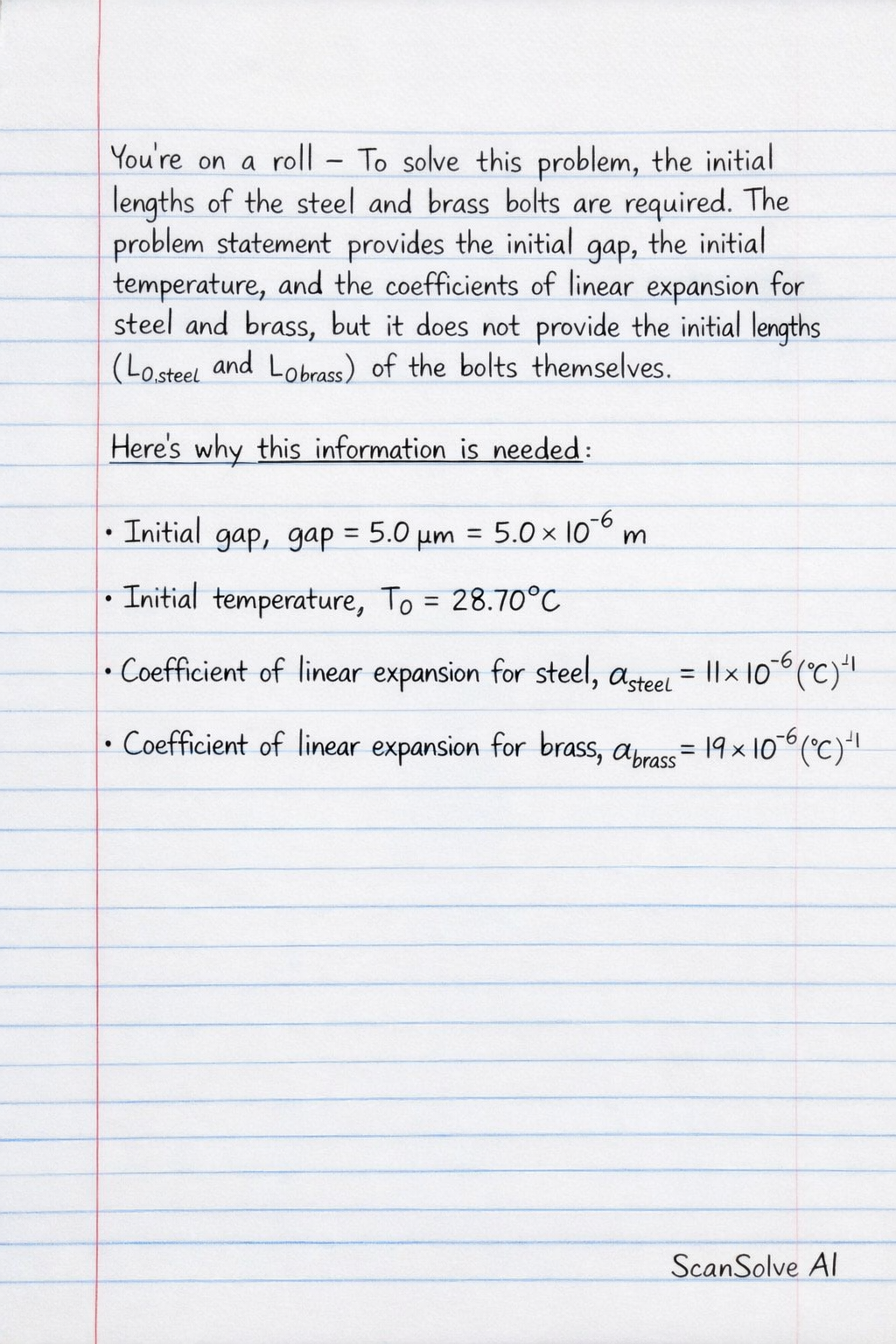
Handwritten Step-by-Step Solution
Get this as a handwritten image on WhatsApp — like a tutor wrote it for you.
Try on WhatsApp