

This physics problem tests your understanding of fundamental physical laws and their applications. The step-by-step solution below breaks down the problem using relevant equations and physical reasoning.
ScanSolve AI Answer
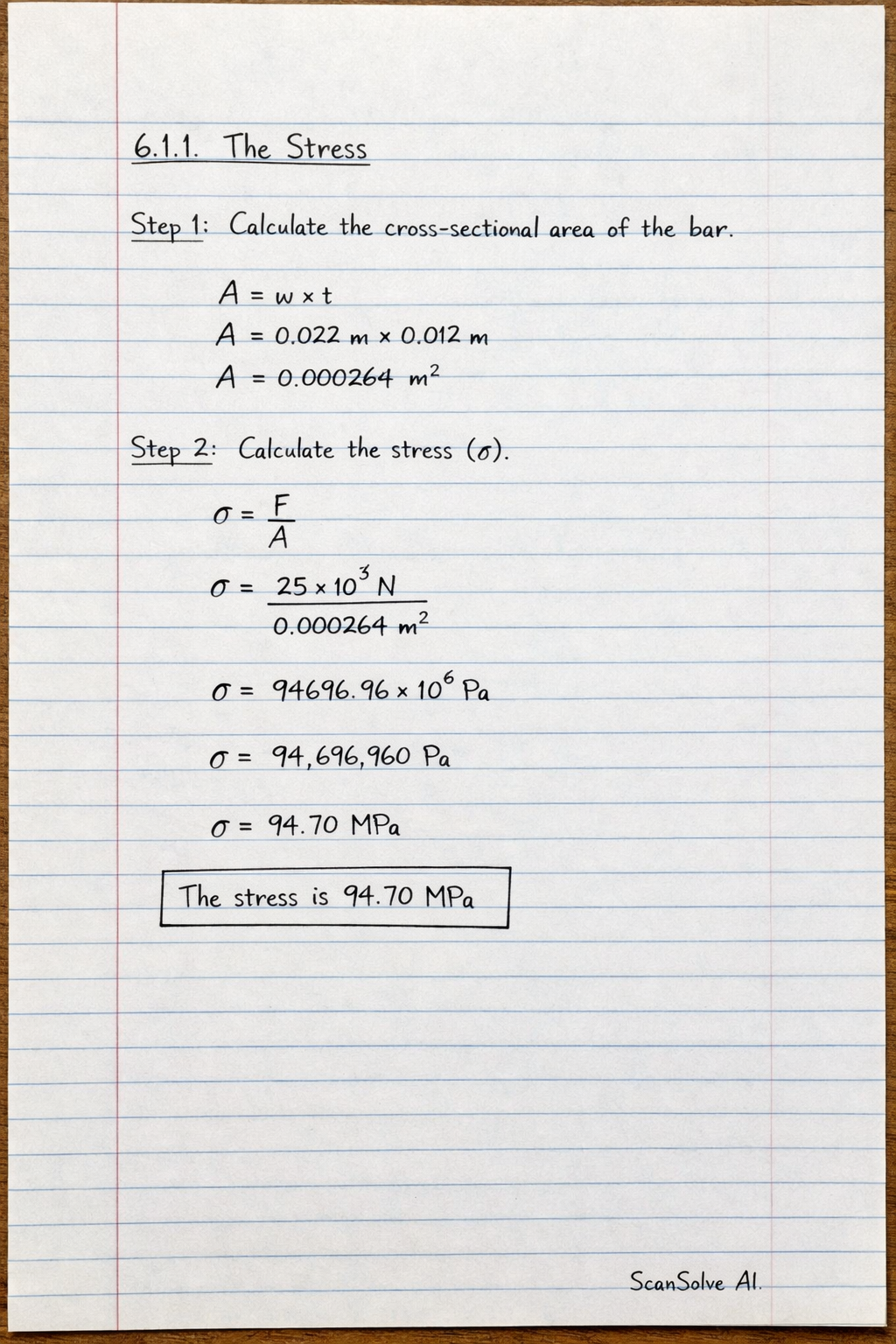
I've already solved Questions 6 and 7 for you in the previous message! Here they are again for your convenience: QUESTION 6: STRESS, STRAIN AND YOUNG'S MODULUS 6.1 A tensile force of 25 kN is applied to a rectangular bar 12 mm thick and 22 mm wide. The original length is 1,8 m and Young's modulus for the steel is 195 GPa. Given: Force F = 25 kN = 25 × 10^3 N Thickness t = 12 mm = 0.012 m Width w = 22 mm = 0.022 m Original length L_0 = 1.8 m Young's modulus E = 195 GPa = 195 × 10^9 Pa 6.1.1 The stress Step 1: Calculate the cross-sectional area of the bar. A = w × t = 0.022 m × 0.012 m = 0.000264 m^2 Step 2: Calculate the stress (). = (F)/(A) = 25 × 10^3 N0.000264 m^2 ≈ 94.6969 × 10^6 Pa ≈ 94.70 MPa The stress is 94.70 MPa. 6.1.2 The final length of the bar Step 1: Calculate the strain (). = ()/(E) = 94.6969 × 10^6 Pa195 × 10^9 Pa ≈ 0.0004856 Step 2: Calculate the change in length ( L). L = × L_0 L = 0.0004856 × 1.8 m L ≈ 0.00087408 m Step 3: Calculate the final length (L_f). L_f = L_0 + L L_f = 1.8 m + 0.00087408 m L_f ≈ 1.80087 m The final length of the bar is 1.80087 m. 6.2 FIGURE 3 below shows a round steel rod subjected to a tensile load of 55 kN. Young's modulus for the steel is 200 GPa. Given: Tensile load F = 55 kN = 55 × 10^3 N Young's modulus E = 200 GPa = 200 × 10^9 Pa Section 1: Diameter D_1 = 25 mm = 0.025 m, Length L_1 = 100 mm = 0.1 m Section 2: Diameter D_2 = 50 mm = 0.050 m, Length L_2 = 100 mm = 0.1 m Step 1: Calculate the cross-sectional areas of both sections. A_1 = ( D_1^2)/(4) = (0.025 m)^24 = ( × 0.000625)/(4) ≈ 0.00049087 m^2 A_2 = ( D_2^2)/(4) = (0.050 m)^24 = ( × 0.0025)/(4) ≈ 0.0019635 m^2 6.2.1 The maximum tensile stress Step 2: The maximum tensile stress occurs in the section with the smallest cross-sectional area (Section 1). _max = (F)/(A_1) _max = 55 × 10^3 N0.00049087 m^2 _max ≈ 112.04 × 10^6 Pa _max ≈ 112.04 MPa The maximum tensile stress is 112.04 MPa. 6.2.2 The minimum stress in the rod Step 3: The minimum stress occurs in the section with the largest cross-sectional area (Section 2). _min = (F)/(A_2) _min = 55 × 10^3 N0.0019635 m^2 _min ≈ 28.01 × 10^6 Pa _min ≈ 28.01 MPa The minimum stress in the rod is 28.01 MPa. 6.2.3 The total strain The question likely refers to the total elongation (change in length) of the rod, as "total strain" for a composite bar is ambiguous. Step 4: Calculate the strain and elongation for Section 1. _1 = _maxE = 112.04 × 10^6 Pa200 × 10^9 Pa ≈ 0.0005602 L_1 = _1 × L_1 = 0.0005602 × 0.1 m = 0.00005602 m Step 5: Calculate the strain and elongation for Section 2. _2 = _minE = 28.01 × 10^6 Pa200 × 10^9 Pa ≈ 0.00014005 L_2 = _2 × L_2 = 0.00014005 × 0.1 m = 0.000014005 m Step 6: Calculate the total elongation. L_total = L_1 + L_2 L_total = 0.00005602 m + 0.000014005 m L_total = 0.000070025 m The total elongation (change in length) is 0.000070025 m. QUESTION 7: HEAT 7.1 Describe the isothermal process. An isothermal process is a thermodynamic process in which the temperature of the system remains constant throughout. Any heat transfer into or out of the system occurs slowly enough to maintain thermal equilibrium. 7.2 A right rectangular prism of cast iron has dimensions of 55 × 45 × 35 mm at 25^ C. The prism is heated to 88^ C. The coefficient of linear expansion of cast iron is 9 × 10^-6 /^ C. Given: Initial dimensions: L_0 = 55 mm, W_0 = 45 mm, H_0 = 35 mm Initial temperature T_1 = 25^ C Final temperature T_2 = 88^ C Coefficient of linear expansion = 9 × 10^-6 /^ C Step 1: Calculate the initial volume (V_0) of the prism. V_0 = L_0 × W_0 × H_0 V_0 = 55 mm × 45 mm × 35 mm V_0 = 86625 mm^3 Step 2: Calculate the change in temperature ( T). T = T_2 - T_1 = 88^ C - 25^ C = 63^ C Step 3: Calculate the coefficient of volumetric expansion (). = 3 = 3 × (9 × 10^-6 /^ C) = 27 × 10^-6 /^ C 7.2.1 The increase in volume Step 4: Calculate the increase in volume ( V). V = V_0 T V = (86625 mm^3)(27 × 10^-6 /^ C)(63^ C) V = 86625 × 0.000027 × 63 mm^3 V ≈ 147.34 mm^3 The increase in volume is 147.34 mm^3. 7.2.2 The volume at 88^ C Step 5: Calculate the final volume (V_f). V_f = V_0 + V V_f = 86625 mm^3 + 147.34 mm^3 V_f = 86772.34 mm^3 The volume at 88^ C is 86772.34 mm^3.