
We read your photo as:
A steel wire has a length of 2.0 m and a cross-sectional area of 2 x 10⁻⁶ m2. When a force of 200 N is applied, the wire extends by 4 mm. Calculate the tensile stress, tensile strain, and Young's mod
ScanSolve AI Answer
Answers
4 partsStep-by-step solution
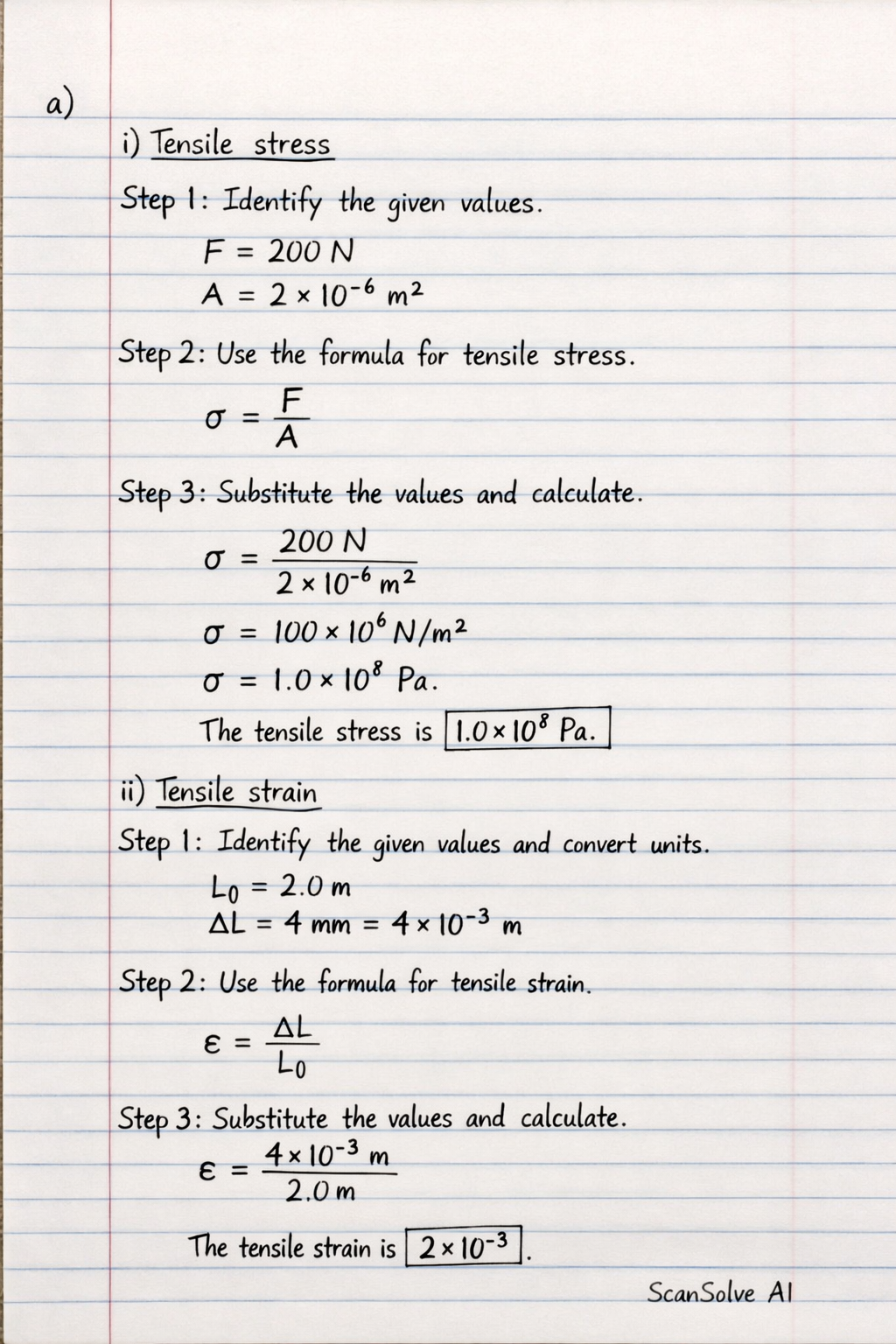
12 stepsPart a(i)· 3 steps
Tensile stress
Identify the given values.
Force
Cross-sectional areaUse the formula for tensile stress.
Substitute the values and calculate.
The tensile stress is .
Part a(ii)
Tensile strain
Identify the given values and convert units.
Original length
ExtensionUse the formula for tensile strain.
Substitute the values and calculate.
The tensile strain is .
Part a(iii)
Young's modulus
Use the calculated values for tensile stress and tensile strain.
Tensile stress
Tensile strainUse the formula for Young's modulus.
Substitute the values and calculate.
Young's modulus is .
Part a(iv)
State two applications of elasticity of materials in industry and daily life.
- Vehicle Tires
- Suspension systems
Part a(v)
Using a well labelled diagram, describe a simple experiment to demonstrate Hooke's Law using springs and weights.
To demonstrate Hooke's Law, set up a spring vertically from a rigid support. Attach a ruler alongside the spring to measure its length. Measure the initial length of the spring () when no weight is attached. Then, attach known weights (e.g., 100g, 200g, 300g) one by one to the free end of the spring. For each weight, measure the new length of the spring (). Calculate the extension () for each weight. Plot a graph of force (weight) against extension. Hooke's Law states that the extension is directly proportional to the applied force, so the graph should be a straight line passing through the origin, within the elastic limit of the spring.
5) Two springs are connected in series with spring constant of and respectively. A weight of is attached at the end of the spring, calculate total extension in cm.
Calculate the equivalent spring constant for springs connected in series.
Given spring constants: , .
For springs in series, the reciprocal of the equivalent spring constant is the sum of the reciprocals of individual spring constants:Calculate the total extension using Hooke's Law.
Force
Convert the total extension to centimeters.
The total extension is .
Try one yourself
A new problem that tests the same skill.
Still stuck on this one?
Ask a follow-up, and the answer starts from this question.
More Physics Questions
Handwritten Step-by-Step Solution
Get this as a handwritten image on WhatsApp — like a tutor wrote it for you.
Try on WhatsApp