
We read your photo as:
A toy car is pulled along a straight line. A ticker tape attached to the car passes through a timer that makes dots every 0.02s. The following is a section of the tape: (Describe and calculate the mot
ScanSolve AI Answer
Here are the solutions to your questions:
Question 5:
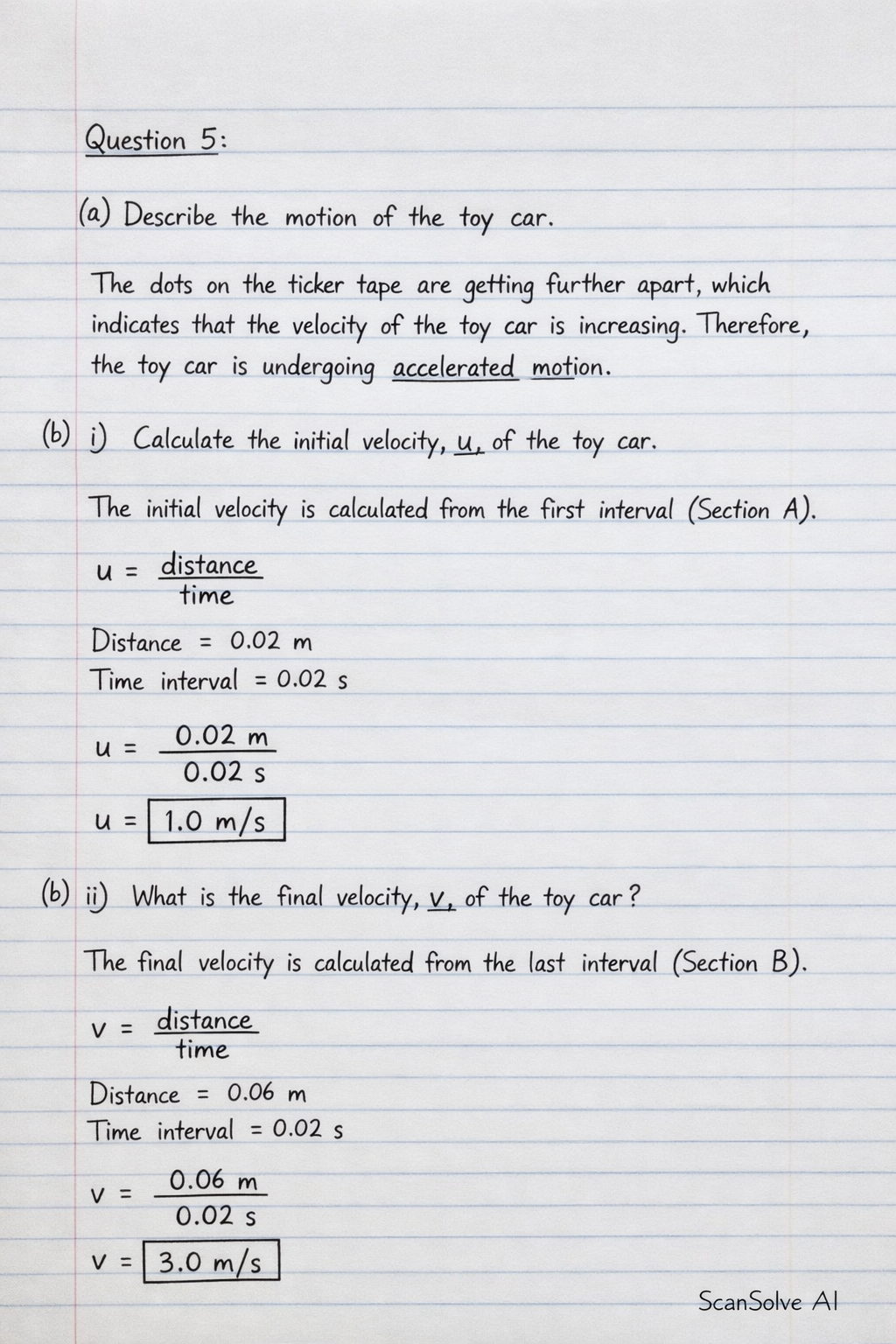
a) Describe the motion of the toy car.
The dots on the ticker tape are getting further apart, which indicates that the velocity of the toy car is increasing. Therefore, the toy car is undergoing accelerated motion.
b) i) Calculate the initial velocity, , of the toy car.
The initial velocity is calculated from the first interval (Section A).
b) ii) What is the final velocity, , of the toy car?
The final velocity is calculated from the last interval (Section B).
c) Determine the acceleration of the toy car over the measured portion.
To find the acceleration, we use the formula .
First, count the number of intervals between the start of the first interval and the start of the last interval. There are 6 intervals shown in total. The initial velocity is for the first interval, and the final velocity is for the sixth interval. The time duration for the acceleration is the time elapsed between the midpoints of these two intervals.
The time for 5 full intervals (from the start of the first to the start of the sixth) is:
Now, calculate the acceleration:
Question 6:
a) Give the name and values of the temperatures A and B in degree Celsius.
- Temperature A is the upper fixed point, which is the boiling point of pure water at standard atmospheric pressure. Its value is .
- Temperature B is the lower fixed point, which is the melting point of pure ice at standard atmospheric pressure. Its value is .
b) Explain why the bore of the capillary has to be narrow.
The bore of the capillary tube needs to be narrow to ensure that a small change in temperature causes a significant and easily observable change in the length of the mercury column. This increases the sensitivity and accuracy of the thermometer, allowing for precise temperature readings.
Still stuck on this one?
Ask a follow-up, and the answer starts from this question.
More Physics Questions
Handwritten Step-by-Step Solution
Get this as a handwritten image on WhatsApp — like a tutor wrote it for you.
Try on WhatsApp