
We read your photo as:
An object has a mass of 220.0kg. Calculate its weight [g = 10.0ms\]
ScanSolve AI Answer
Answer
there is negligible force of gravity
Step-by-step solution
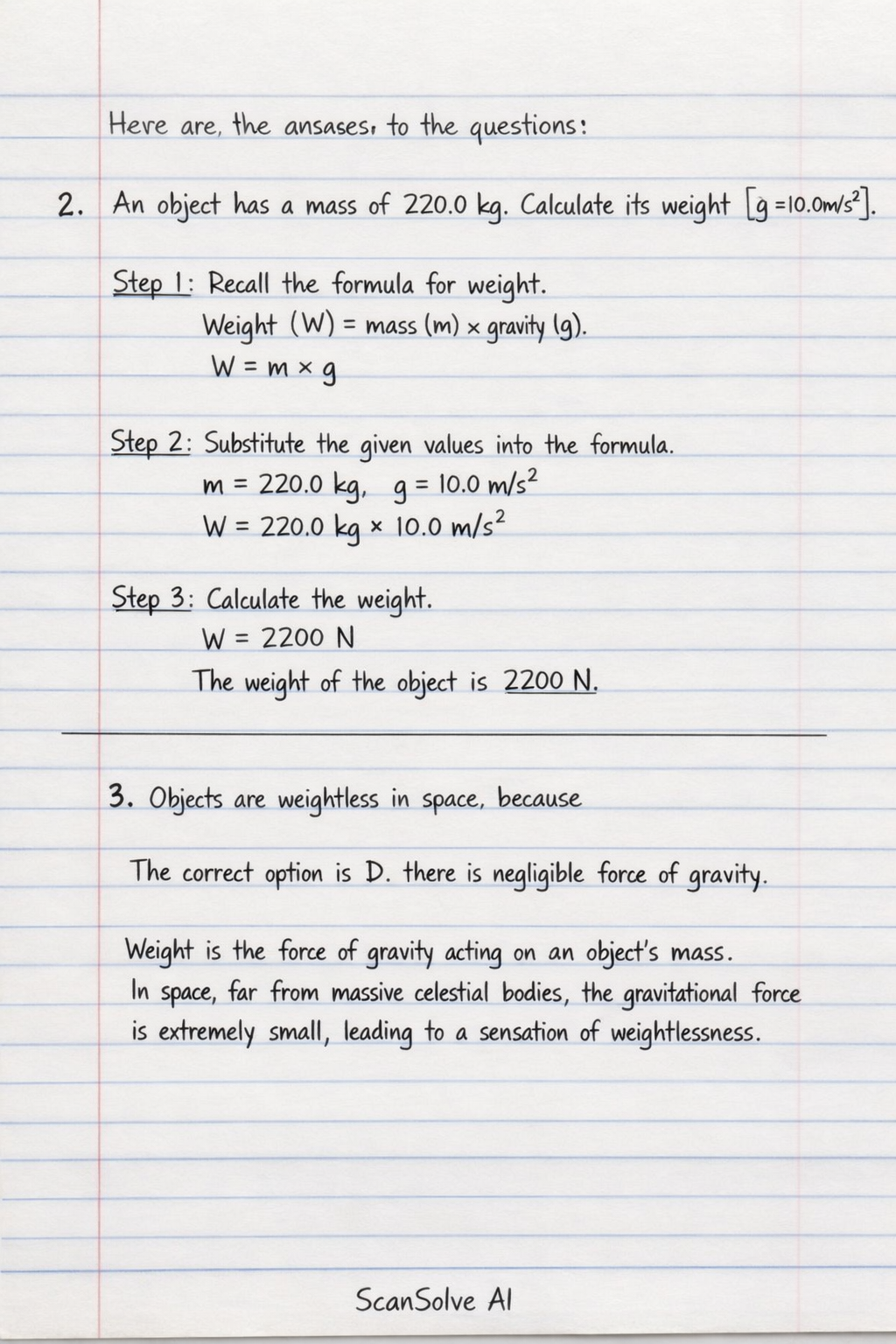
3 stepsHere are the answers to the questions:
2. An object has a mass of . Calculate its weight .
Recall the formula for weight.
Weight () is calculated as the product of mass () and acceleration due to gravity ().
Substitute the given values into the formula.
Given and .
Calculate the weight.
The weight of the object is .
3. Objects are weightless in space, because
The correct option is D. there is negligible force of gravity.
Weight is the force of gravity acting on an object's mass. In space, far from massive celestial bodies, the gravitational force is extremely small, leading to a sensation of weightlessness.4. A man pushes a stationary car. The car moves reluctantly. This is partly because the car has
The correct option is C. an inertia.
Inertia is the property of an object to resist changes in its state of motion. A stationary car has inertia, meaning it resists being set into motion.5. Distance travelled in a specific direction is known as;
The correct option is B. displacement.
Displacement is a vector quantity that refers to the overall change in position of an object, including both magnitude (distance) and direction.6. The reluctance of a body to change its state of rest or motion is called
The correct option is B. Inertia.
As explained in question 4, inertia is the fundamental property of matter that resists any change in its state of motion, whether at rest or in uniform motion.7. When a vehicle stops suddenly, passengers jerk forward. This is due to the
The correct option is D. Inability of the bodies of the passengers to stop moving.
This phenomenon is a direct consequence of inertia. The passengers' bodies tend to continue moving forward at the vehicle's original speed even when the vehicle itself stops, causing them to jerk forward.8. Which of the following forces can be generated by rubbing a glass rod with silk?
The correct option is A. Electrostatic force.
Rubbing a glass rod with silk causes a transfer of electrons, resulting in a net electric charge on both objects. This charge creates an electrostatic force.9. The force which opposes the relative motion of two surfaces in contact is .......
The correct option is B. frictional force.
Frictional force is a force that resists the relative motion or tendency of such motion of two surfaces in contact.10. A soft pad is usually used on the head when carrying a heavy load in order to reduce the
The correct option is A. pressure exerted by the load.
Pressure is defined as force per unit area (). A soft pad increases the contact area () over which the load's force () is distributed, thereby reducing the pressure on the head.11. People feel lighter when they are in a lift which is accelerating downwards because
The correct option is D. they are under the influence of a force less than that of gravity.
When a lift accelerates downwards, the apparent weight of a person (the normal force exerted by the floor on the person) is less than their actual weight. This is because the net force on the person is downwards, meaning the normal force is less than the gravitational force.12. Fast moving vehicles overturn when a negotiating curve because of
The correct option is B. centripetal force.
When a vehicle turns a curve, it requires a centripetal force to keep it moving in a circular path. If the speed is too high or the curve is too sharp, the required centripetal force might exceed the available friction or the vehicle's stability limits, causing it to skid or overturn.
Try one yourself
A new problem that tests the same skill.
Still stuck on this one?
Ask a follow-up, and the answer starts from this question.
More Physics Questions
Handwritten Step-by-Step Solution
Get this as a handwritten image on WhatsApp — like a tutor wrote it for you.
Try on WhatsApp