
We read your photo as:
An object of mass 5.0 kg is suspended by an aluminum wire of length 4.0 m and diameter, d = 2.0 × 10⁻³ m. Calculate the extension produced in the wire. [Young's modulus of aluminium = 7.0 × 10¹⁰ Nm−2, π = 3.14, g = 10.0 m s−2]
ScanSolve AI Answer
Step-by-step solution
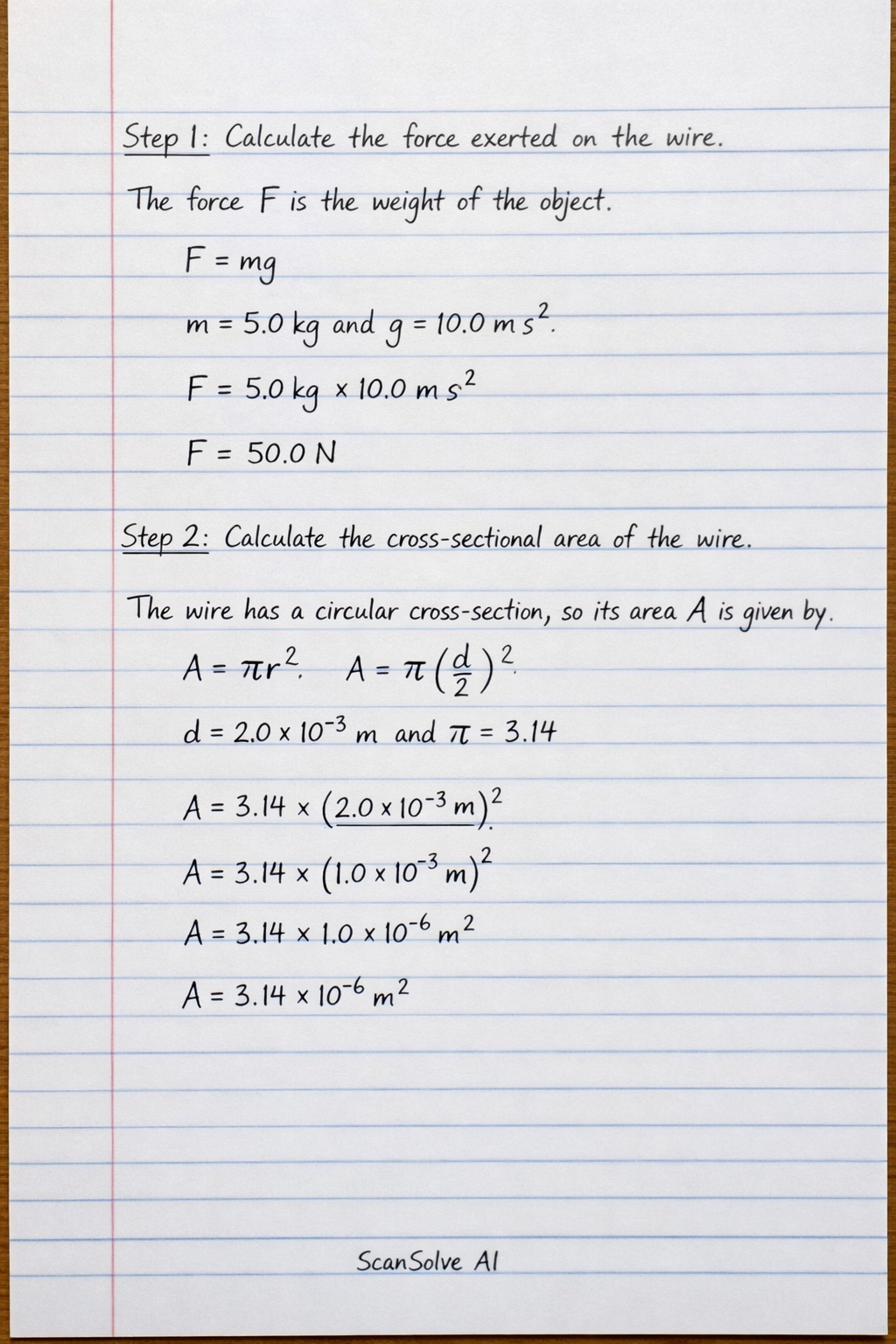
4 stepsCalculate the force exerted on the wire.
The force is the weight of the object.
Given and .
Calculate the cross-sectional area of the wire.
The wire has a circular cross-section, so its area is given by or .
Given and .Use Young's Modulus formula to find the extension.
Young's Modulus is given by the formula:
We need to find the extension . Rearrange the formula:
Substitute the calculated values and given values:
Round the answer to an appropriate number of significant figures.
Given values have 2 or 3 significant figures. Let's use 3 significant figures.
The extension produced in the wire is .
a) The waveform of the output voltage for a half-wave rectifier will show only the positive (or negative) half-cycles of the input sinusoidal voltage, with the other half-cycles being blocked, resulting in gaps between the pulses.
(A sketch would show a series of positive half-sine waves, followed by a flat line at zero, then another positive half-sine wave, and so on.)b) Two disadvantages of half-wave rectification are:
- It has a low efficiency because only half of the input AC power is converted to DC output.
- It produces a high ripple factor, meaning the output DC voltage is not smooth and contains a significant AC component, requiring extensive filtering.
a) A diamagnetic substance will orient itself perpendicular to a strong magnetic field.
b) One factor that affects the magnetism of paramagnetic substances is temperature. As temperature increases, the random thermal motion of atoms disrupts the alignment of magnetic dipoles, reducing the overall magnetism.
c) One use of ferromagnetic materials is in the cores of transformers to concentrate magnetic flux and improve efficiency.
Still stuck on this one?
Ask a follow-up, and the answer starts from this question.
More Physics Questions
Handwritten Step-by-Step Solution
Get this as a handwritten image on WhatsApp — like a tutor wrote it for you.
Try on WhatsApp