We read your photo as:

An object of mass M moving with velocity V breaks into two pieces with mass ratio 1:5. If the velocity of the smaller piece is v1, find the velocity of the larger piece v2.

Physics

ScanSolve AI Answer

Answer

(a)\text{(a)}

Step-by-step solution

8 steps
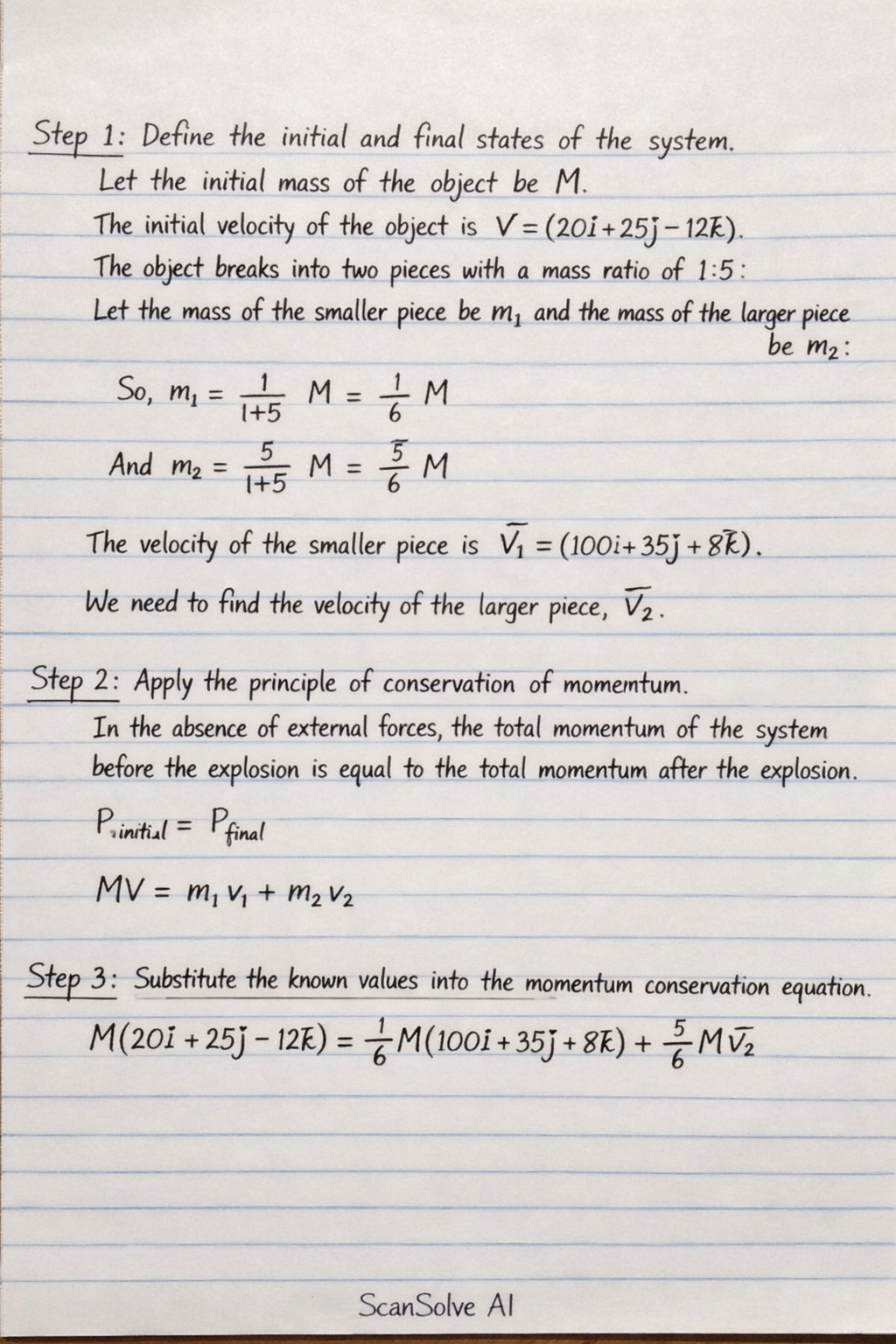
  1. Define the initial and final states of the system.

    Let the initial mass of the object be MM.
    The initial velocity of the object is V⃗=(20i^+25j^−12k^)\vec{V} = (20\hat{i} + 25\hat{j} - 12\hat{k}).
    The object breaks into two pieces with a mass ratio of 1:51:5.
    Let the mass of the smaller piece be m1m_1 and the mass of the larger piece be m2m_2.
    So, m1=11+5M=16Mm_1 = \frac{1}{1+5}M = \frac{1}{6}M.
    And m2=51+5M=56Mm_2 = \frac{5}{1+5}M = \frac{5}{6}M.

    The velocity of the smaller piece is v1⃗=(100i^+35j^+8k^)\vec{v_1} = (100\hat{i} + 35\hat{j} + 8\hat{k}).
    We need to find the velocity of the larger piece, v2⃗\vec{v_2}.

  2. Apply the principle of conservation of momentum.

    In the absence of external forces, the total momentum of the system before the explosion is equal to the total momentum after the explosion.

    Pinitial=PfinalP_{initial} = P_{final} MV⃗=m1v1⃗+m2v2⃗M\vec{V} = m_1\vec{v_1} + m_2\vec{v_2}
  3. Substitute the known values into the momentum conservation equation.

    M(20i^+25j^−12k^)=16M(100i^+35j^+8k^)+56Mv2⃗M(20\hat{i} + 25\hat{j} - 12\hat{k}) = \frac{1}{6}M(100\hat{i} + 35\hat{j} + 8\hat{k}) + \frac{5}{6}M\vec{v_2}
  4. Simplify the equation by canceling MM from all terms.

    (20i^+25j^−12k^)=16(100i^+35j^+8k^)+56v2⃗(20\hat{i} + 25\hat{j} - 12\hat{k}) = \frac{1}{6}(100\hat{i} + 35\hat{j} + 8\hat{k}) + \frac{5}{6}\vec{v_2}
  5. Multiply the entire equation by 6 to eliminate fractions.

    6(20i^+25j^−12k^)=(100i^+35j^+8k^)+5v2⃗6(20\hat{i} + 25\hat{j} - 12\hat{k}) = (100\hat{i} + 35\hat{j} + 8\hat{k}) + 5\vec{v_2} (120i^+150j^−72k^)=(100i^+35j^+8k^)+5v2⃗(120\hat{i} + 150\hat{j} - 72\hat{k}) = (100\hat{i} + 35\hat{j} + 8\hat{k}) + 5\vec{v_2}
  6. Solve for 5v2⃗5\vec{v_2}.

    5v2⃗=(120i^+150j^−72k^)−(100i^+35j^+8k^)5\vec{v_2} = (120\hat{i} + 150\hat{j} - 72\hat{k}) - (100\hat{i} + 35\hat{j} + 8\hat{k}) 5v2⃗=(120−100)i^+(150−35)j^+(−72−8)k^5\vec{v_2} = (120 - 100)\hat{i} + (150 - 35)\hat{j} + (-72 - 8)\hat{k} 5v2⃗=20i^+115j^−80k^5\vec{v_2} = 20\hat{i} + 115\hat{j} - 80\hat{k}
  7. Solve for v2⃗\vec{v_2}.

    v2⃗=15(20i^+115j^−80k^)\vec{v_2} = \frac{1}{5}(20\hat{i} + 115\hat{j} - 80\hat{k}) v2⃗=(205)i^+(1155)j^−(805)k^\vec{v_2} = \left(\frac{20}{5}\right)\hat{i} + \left(\frac{115}{5}\right)\hat{j} - \left(\frac{80}{5}\right)\hat{k} v2⃗=4i^+23j^−16k^\vec{v_2} = 4\hat{i} + 23\hat{j} - 16\hat{k}
  8. Compare the result with the given options.

    The calculated velocity v2⃗=4i^+23j^−16k^\vec{v_2} = 4\hat{i} + 23\hat{j} - 16\hat{k} matches option (a).

    The final answer is (a)\text{(a)}.

Was this helpful?

Try one yourself

A new problem that tests the same skill.

Still stuck on this one?

Ask a follow-up, and the answer starts from this question.

Got a different question?Ask your own question
Handwritten step-by-step solution preview

Handwritten Step-by-Step Solution

Get this as a handwritten image on WhatsApp — like a tutor wrote it for you.

Try on WhatsApp