Analyse the given electric circuit and answer the network: i) The equivalent resistance of the network T ii) The total electric current I in the circuit

Physics
Analyse the given electric circuit and answer the network: i) The equivalent resistance of the network T ii) The total electric current I in the circuit

ScanSolve AI Answer

Answer

C) 20 \Omega

Here's the analysis of the given electric circuit:

i) The equivalent resistance of the network:

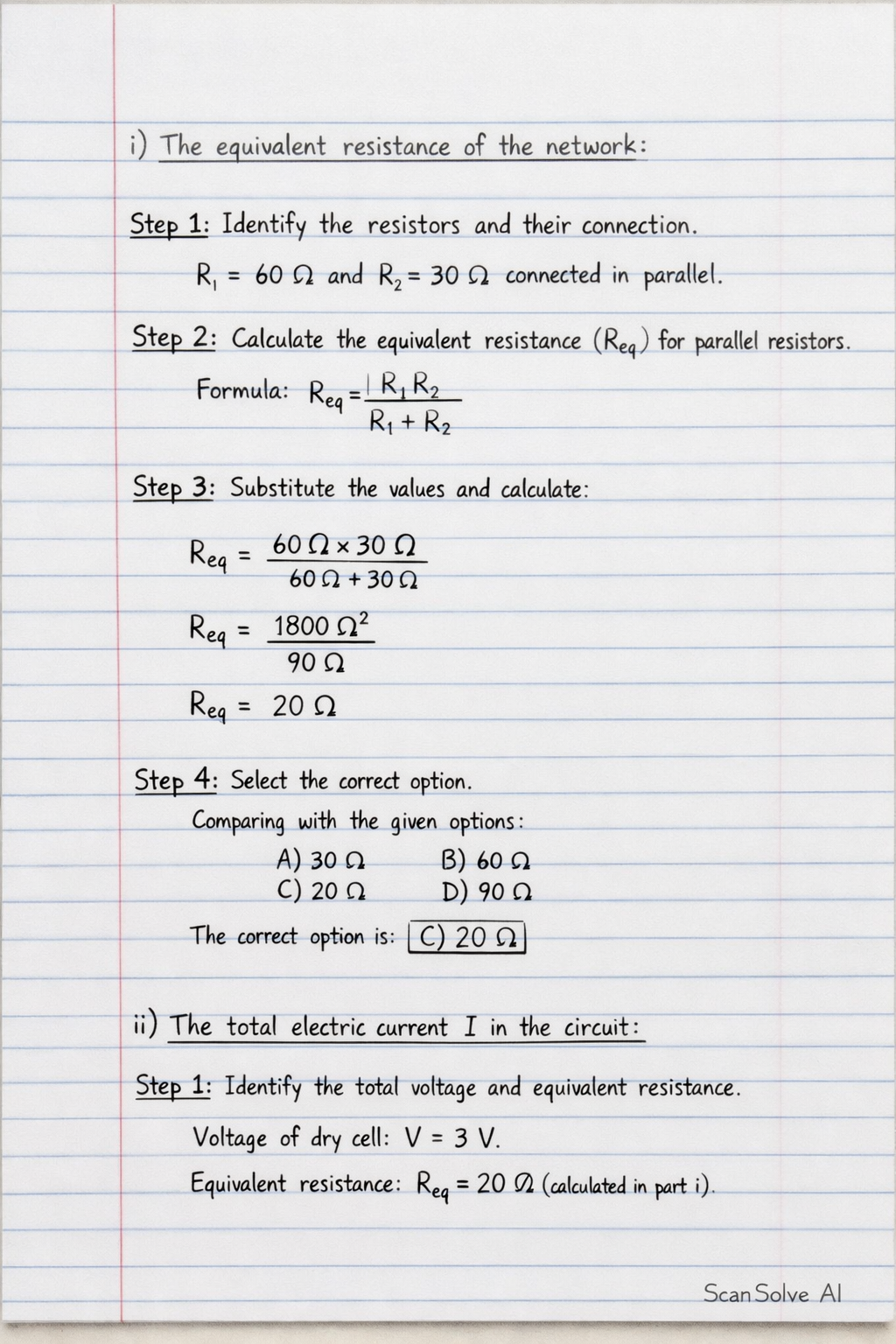
Step 1: Identify the resistors and their connection. The circuit shows two resistors, R1=60ΩR_1 = 60 \Omega and R2=30ΩR_2 = 30 \Omega, connected in parallel.

Step 2: Calculate the equivalent resistance (ReqR_{eq}) for parallel resistors. The formula for two resistors in parallel is: Req=R1R2R1+R2R_{eq} = \frac{R_1 R_2}{R_1 + R_2}

Step 3: Substitute the values and calculate the equivalent resistance. Req=60Ω×30Ω60Ω+30ΩR_{eq} = \frac{60 \Omega \times 30 \Omega}{60 \Omega + 30 \Omega} Req=1800Ω290ΩR_{eq} = \frac{1800 \Omega^2}{90 \Omega} Req=20ΩR_{eq} = 20 \Omega

Step 4: Select the correct option. Comparing with the given options: A) 30Ω30 \Omega, B) 60Ω60 \Omega, C) 20Ω20 \Omega, D) 90Ω90 \Omega. The correct option is C)20Ω\boxed{C) 20 \Omega}.

ii) The total electric current I in the circuit:

Step 1: Identify the total voltage and equivalent resistance. The dry cell provides a voltage V=3 VV = 3 \text{ V}. The equivalent resistance of the circuit is Req=20ΩR_{eq} = 20 \Omega (calculated in part i).

Step 2: Apply Ohm's Law to find the total current. Ohm's Law states I=VReqI = \frac{V}{R_{eq}}.

Step 3: Substitute the values and calculate the total current. I=3V20ΩI = \frac{3 V}{20 \Omega} I=0.15 AI = 0.15 \text{ A}

Step 4: Select the correct option. Comparing with the given options: A) 0.1 A0.1 \text{ A}, B) 0.05 A0.05 \text{ A}, C) 0.15 A0.15 \text{ A}, D) 0.00 A0.00 \text{ A}. The correct option is C)0.15A\boxed{C) 0.15 A}.

That's 2 down. 3 left today — send the next one.

Was this helpful?

Need help with your own homework?

Get instant step-by-step solutions to any question. Free to start.

Ask Your Question
Handwritten step-by-step solution preview

Handwritten Step-by-Step Solution

Get this as a handwritten image on WhatsApp — like a tutor wrote it for you.

Try on WhatsApp

Still have questions?

Quick Answer

Here's the analysis of the given electric circuit: i) The equivalent resistance of the network: Step 1: Identify the resistors and their connection.

Analyse the given electric circuit and answer the network: i) The equivalent resistance of the network T ii) The total electric current I in the circuit
Physics

This physics problem tests your understanding of fundamental physical laws and their applications. The step-by-step solution below breaks down the problem using relevant equations and physical reasoning.

ScanSolve AI Answer
Here's the analysis of the given electric circuit: i) The equivalent resistance of the network: Step 1: Identify the resistors and their connection. The circuit shows two resistors, R_1 = 60 and R_2 = 30 , connected in parallel. Step 2: Calculate the equivalent resistance (R_eq) for parallel resistors. The formula for two resistors in parallel is: R_eq = (R_1 R_2)/(R_1 + R_2) Step 3: Substitute the values and calculate the equivalent resistance. R_eq = (60 × 30 )/(60 + 30 ) R_eq = (1800 ^2)/(90 ) R_eq = 20 Step 4: Select the correct option. Comparing with the given options: A) 30 , B) 60 , C) 20 , D) 90 . The correct option is C) 20 . ii) The total electric current I in the circuit: Step 1: Identify the total voltage and equivalent resistance. The dry cell provides a voltage V = 3 V. The equivalent resistance of the circuit is R_eq = 20 (calculated in part i). Step 2: Apply Ohm's Law to find the total current. Ohm's Law states I = (V)/(R_eq). Step 3: Substitute the values and calculate the total current. I = 3 V20 I = 0.15 A Step 4: Select the correct option. Comparing with the given options: A) 0.1 A, B) 0.05 A, C) 0.15 A, D) 0.00 A. The correct option is C) 0.15 A. That's 2 down. 3 left today — send the next one.