
We read your photo as:
Auto-Electrics Any Five Questions: Q1a. Calculate P1, P2, P3 enter the values in the table. Q1b. Find all the unknown values of E, I, R and P for the parallel circuit above.
ScanSolve AI Answer
Step-by-step solution
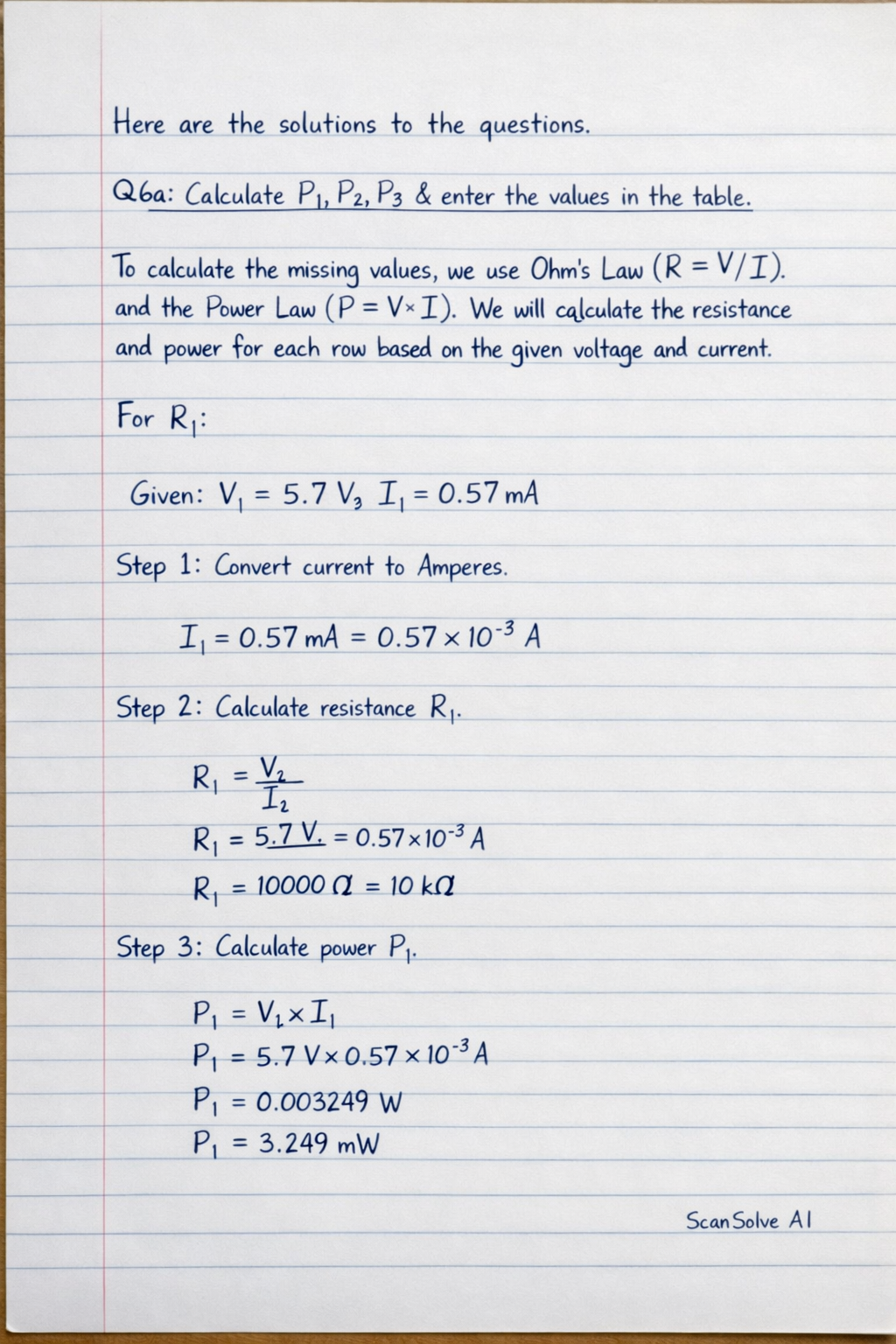
12 stepsHere are the solutions to the questions.
Q6a: Calculate & enter the values in the table.
To calculate the missing values, we use Ohm's Law () and the Power Law (). We will calculate the resistance and power for each row based on the given voltage and current.
- For R1:
- Given: ,
Convert current to Amperes.
$$ I_1 = 0.57 \text{ mA} = 0.57 \times 10^{-3} \text{ A} $$Calculate resistance .
$$ R_1 = \frac{V_1}{I_1} = \frac{5.7 \text{ V}}{0.57 \times 10^{-3} \text{ A}} = 10000 \Omega = 10 \text{ k}\Omega $$Calculate power .
$$ P_1 = V_1 \times I_1 = 5.7 \text{ V} \times 0.57 \times 10^{-3} \text{ A} = 0.003249 \text{ W} = 3.249 \text{ mW} $$- For R2:
- Given: ,
- For R2:
Convert current to Amperes.
$$ I_2 = 2.63 \text{ mA} = 2.63 \times 10^{-3} \text{ A} $$Calculate resistance .
$$ R_2 = \frac{V_2}{I_2} = \frac{0.74 \text{ V}}{2.63 \times 10^{-3} \text{ A}} \approx 281.37 \Omega \approx 0.281 \text{ k}\Omega $$Calculate power .
$$ P_2 = V_2 \times I_2 = 0.74 \text{ V} \times 2.63 \times 10^{-3} \text{ A} = 0.0019462 \text{ W} = 1.946 \text{ mW} $$- For R3:
- Given: ,
- For R3:
Convert current to Amperes.
$$ I_3 = 3.21 \text{ mA} = 3.21 \times 10^{-3} \text{ A} $$Calculate resistance .
$$ R_3 = \frac{V_3}{I_3} = \frac{3.21 \text{ V}}{3.21 \times 10^{-3} \text{ A}} = 1000 \Omega = 1 \text{ k}\Omega $$Calculate power .
$$ P_3 = V_3 \times I_3 = 3.21 \text{ V} \times 3.21 \times 10^{-3} \text{ A} = 0.0103041 \text{ W} = 10.304 \text{ mW} $$- For Total:
- Given: ,
- For Total:
Convert current to Amperes.
$$ I_T = 3.21 \text{ mA} = 3.21 \times 10^{-3} \text{ A} $$Calculate total resistance .
$$ R_T = \frac{V_T}{I_T} = \frac{9 \text{ V}}{3.21 \times 10^{-3} \text{ A}} \approx 2803.74 \Omega \approx 2.804 \text{ k}\Omega $$Calculate total power .
$$ P_T = V_T \times I_T = 9 \text{ V} \times 3.21 \times 10^{-3} \text{ A} = 0.02889 \text{ W} = 28.89 \text{ mW} $$Filled Table for Q6a:
Voltage (V) Current (mA) Resistance (kΩ) Power (mW) R1 5.7 0.57 10 3.249 R2 0.74 2.63 0.281 1.946 R3 3.21 3.21 1 10.304 Total 9 3.21 2.804 28.89 Q6b: Find all the unknown values of E, I, R and P for the Parallel Circuit above.
Given a parallel circuit with:
- Total Voltage
- Resistor
- Resistor
For a parallel circuit, the voltage across each component is the same as the total voltage.
-
Step 1: Determine voltages.
-
Step 2: Calculate individual currents.
-
Step 3: Calculate total current.
-
Step 4: Calculate total resistance.
-
Step 5: Calculate individual powers.
-
Step 6: Calculate total power.
Filled Table for Q6b:
V (V) I (mA) R (kΩ) P (mW) R1 9 9 1 81 R2 9 0.9 10 8.1 Total 9 9.9 0.909 89.1 Q8a: Using Simple Sketches explain the two (2) types of Stator Winding of the alternator could be connected and state the operational difference between them.
The two main types of stator winding connections in an alternator are Star (Wye) connection and Delta connection.
-
i) Star (Wye) Connection
- Sketch Description: Imagine three separate windings. One end of each winding is connected together at a common point, called the neutral point. The other three ends of the windings are connected to the output terminals of the alternator.
- Operational Difference:
- Provides a higher output voltage for a given winding, as the line voltage (output voltage) is times the phase voltage (voltage across a single winding).
- Offers a neutral point, which can be grounded, providing stability and allowing for both phase and line voltage measurements.
- Generally more efficient at lower engine speeds due to higher voltage output.
-
ii) Delta Connection
- Sketch Description: Imagine three separate windings connected end-to-end to form a closed triangular loop. The output terminals of the alternator are taken from the three connection points where the windings meet.
- Operational Difference:
- The line voltage (output voltage) is equal to the phase voltage (voltage across a single winding).
- Does not provide a neutral point.
- Can handle higher current loads for a given voltage compared to a Star connection, but typically produces a lower voltage output for the same winding design.
Q8b: State the category of Vehicle in which the two Stators windings connection in Q8ai above is applicable.
- Star (Wye) Connection: This connection is predominantly used in passenger cars and light commercial vehicles. Its ability to provide higher voltage output and better regulation at varying engine speeds makes it ideal for these applications.
- Delta Connection: While less common in modern passenger vehicles, the Delta connection can be found in some heavy-duty vehicles, commercial trucks, or specialized industrial equipment where high current output is a primary requirement, or in older alternator designs.
Still stuck on this one?
Ask a follow-up, and the answer starts from this question.
More Physics Questions
Handwritten Step-by-Step Solution
Get this as a handwritten image on WhatsApp — like a tutor wrote it for you.
Try on WhatsApp