
We read your photo as:
Calculate the average velocity and the speed of the minute hand of a clock.
ScanSolve AI Answer
Step-by-step solution
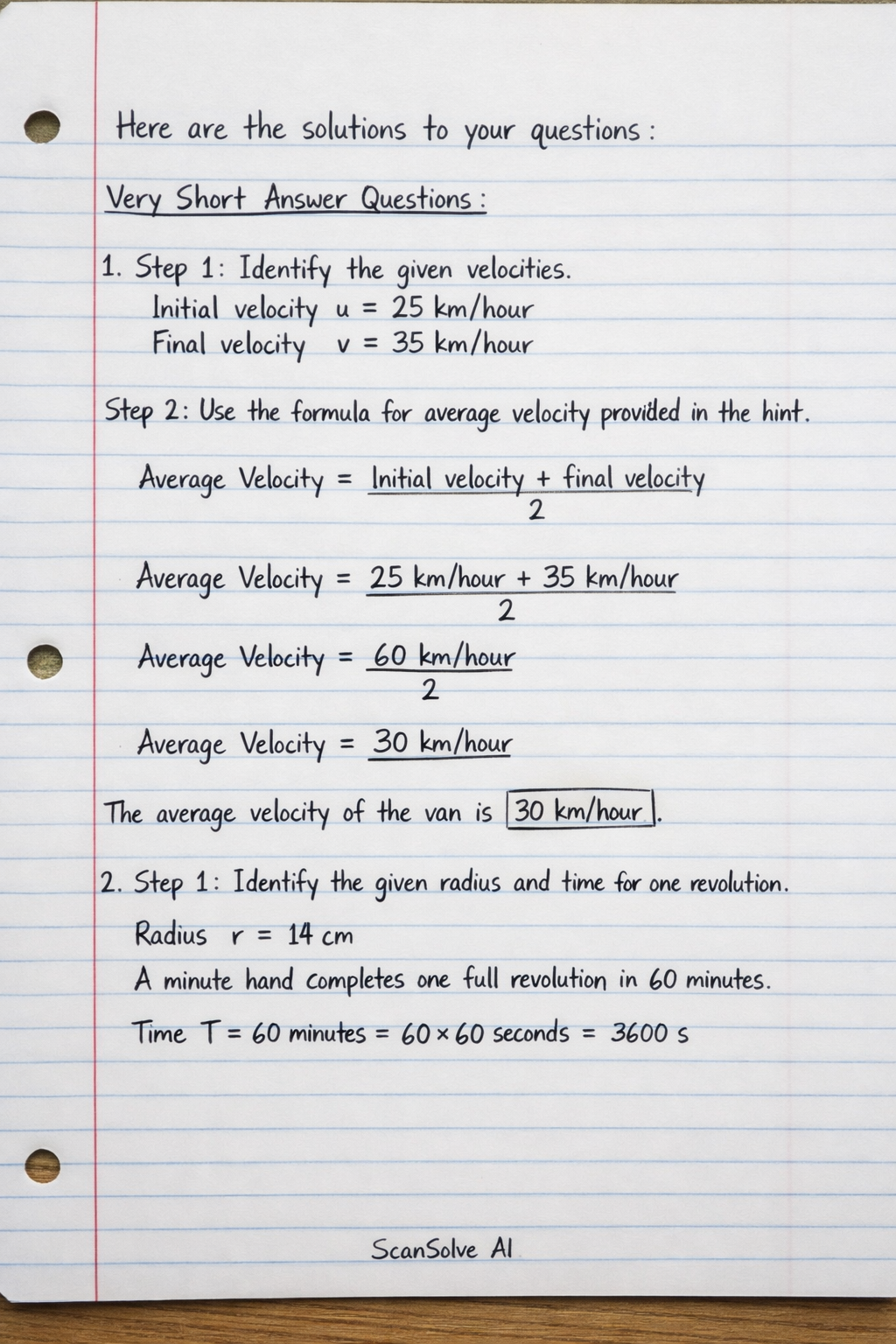
4 stepsHere are the solutions to your questions:
Very Short Answer Questions:
- Step 1: Identify the given velocities. Initial velocity Final velocity
Use the formula for average velocity provided in the hint.
$$ \text{Average Velocity} = \frac{\text{Initial velocity} + \text{final velocity}}{2} $$ $$ \text{Average Velocity} = \frac{25 \text{ km/hour} + 35 \text{ km/hour}}{2} $$ $$ \text{Average Velocity} = \frac{60 \text{ km/hour}}{2} $$ $$ \text{Average Velocity} = 30 \text{ km/hour} $$ The average velocity of the van is $\boxed{30 \text{ km/hour}}$.2. Step 1: Identify the given radius and time for one revolution. Radius A minute hand completes one full revolution in . Time
Calculate the distance covered in one revolution (circumference).
$$ \text{Distance} = 2\pi r = 2 \times \frac{22}{7} \times 14 \text{ cm} $$ $$ \text{Distance} = 2 \times 22 \times 2 \text{ cm} = 88 \text{ cm} $$Calculate the speed.
$$ \text{Speed} = \frac{\text{Distance}}{\text{Time}} = \frac{88 \text{ cm}}{3600 \text{ s}} $$ $$ \text{Speed} = \frac{22}{900} \text{ cm/s} = \frac{11}{450} \text{ cm/s} $$ $$ \text{Speed} \approx 0.0244 \text{ cm/s} $$ The speed at which the tip of the minute hand moves is $\boxed{\frac{11}{450} \text{ cm/s} \text{ or } 0.0244 \text{ cm/s}}$.3. To identify whether an object is accelerating or retarding: * An object is accelerating if its speed is increasing over time, or if its velocity's direction is changing (even if speed is constant, like in circular motion). For example, a car pressing the accelerator to go faster. * An object is retarding (decelerating) if its speed is decreasing over time. For example, a car applying brakes to slow down. This can be identified by observing changes in speed using a speedometer or by measuring distances covered in equal time intervals. If distances increase, it's accelerating; if they decrease, it's retarding.
-
Two examples of uniform circular motion from daily environment:
- A point on the edge of a rotating fan blade: The tip of the blade moves in a circle at a constant speed, but its direction of motion continuously changes.
- A satellite orbiting the Earth in a circular path: The satellite maintains a constant orbital speed, but its direction of travel is always changing as it follows the curve of its orbit. In both cases, the speed (magnitude of velocity) remains constant, but the direction of the velocity vector is continuously changing. Since velocity is a vector quantity, a change in direction means a change in velocity, which implies there is an acceleration (called centripetal acceleration) acting towards the center of the circle.
-
Step 1: Convert initial and final velocities from km/h to m/s. Initial velocity Final velocity Time
-
Use the formula for acceleration.
$$ a = \frac{v - u}{t} $$ $$ a = \frac{20 \text{ m/s} - 15 \text{ m/s}}{10 \text{ s}} $$ $$ a = \frac{5 \text{ m/s}}{10 \text{ s}} $$ $$ a = 0.5 \text{ m/s}^2 $$ The acceleration of the mini bus is $\boxed{0.5 \text{ m/s}^2}$.Short Answer Questions:
-
An odometer of an automobile measures the total distance travelled by the vehicle.
To determine which is moving faster, we need to compare their speeds in the same units.
-
a) Scooter moving with a speed of Convert to m/s:
-
b) Car moving with a speed of Convert to m/s:
Comparing the speeds:
Scooter:
Car:Since , the car is moving faster.
-
-
Still stuck on this one?
Ask a follow-up, and the answer starts from this question.
More Physics Questions
Handwritten Step-by-Step Solution
Get this as a handwritten image on WhatsApp — like a tutor wrote it for you.
Try on WhatsApp