
Change in momentum important points
Physics
ScanSolve AI Answer
Here are the important points about the change in momentum:
- Definition: The change in momentum () is the difference between an object's final momentum and its initial momentum.
- Calculation: It is calculated using the formula: where is the mass, is the final velocity, and is the initial velocity.
- Vector Quantity: Like momentum itself, the change in momentum is a vector quantity, meaning its direction is crucial.
- Impulse-Momentum Theorem: The change in momentum of an object is equal to the impulse () applied to it. This is a fundamental principle: where is the average net force and is the time over which the force acts.
- Significance: Understanding the change in momentum is critical for analyzing collisions, impacts, and any situation where a force acts on an object over time, causing its motion to change.
Was this helpful?
Still stuck on this one?
Ask a follow-up, and the answer starts from this question.
Got a different question?Ask your own question
More Physics Questions
QState Important points about Momentum and impulseQHow do you solve momentum problems?QExamples of larger momentum of an object
Browse by topic:Mechanics
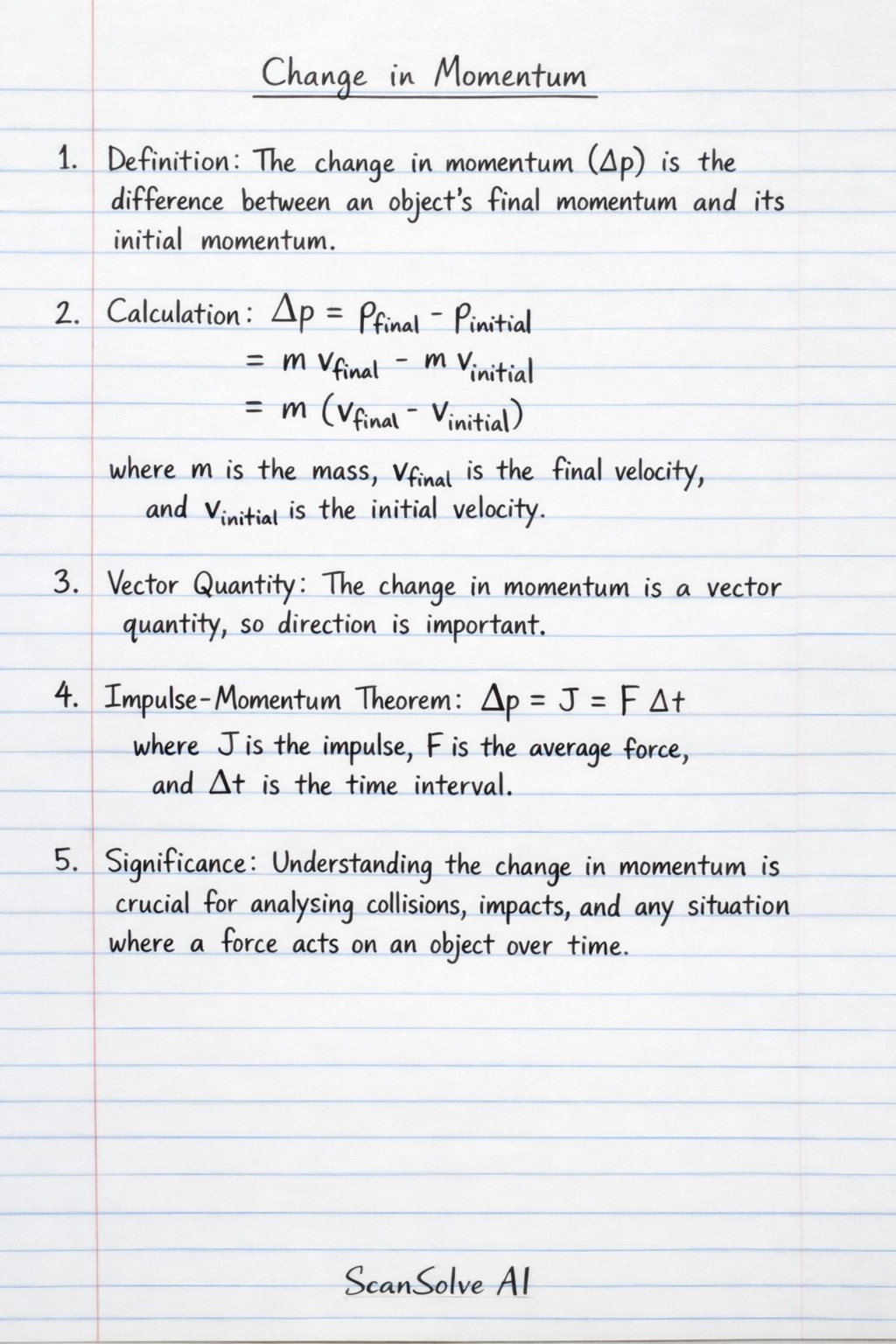
Handwritten Step-by-Step Solution
Get this as a handwritten image on WhatsApp — like a tutor wrote it for you.
Try on WhatsApp