

This physics problem tests your understanding of fundamental physical laws and their applications. The step-by-step solution below breaks down the problem using relevant equations and physical reasoning.
ScanSolve AI Answer
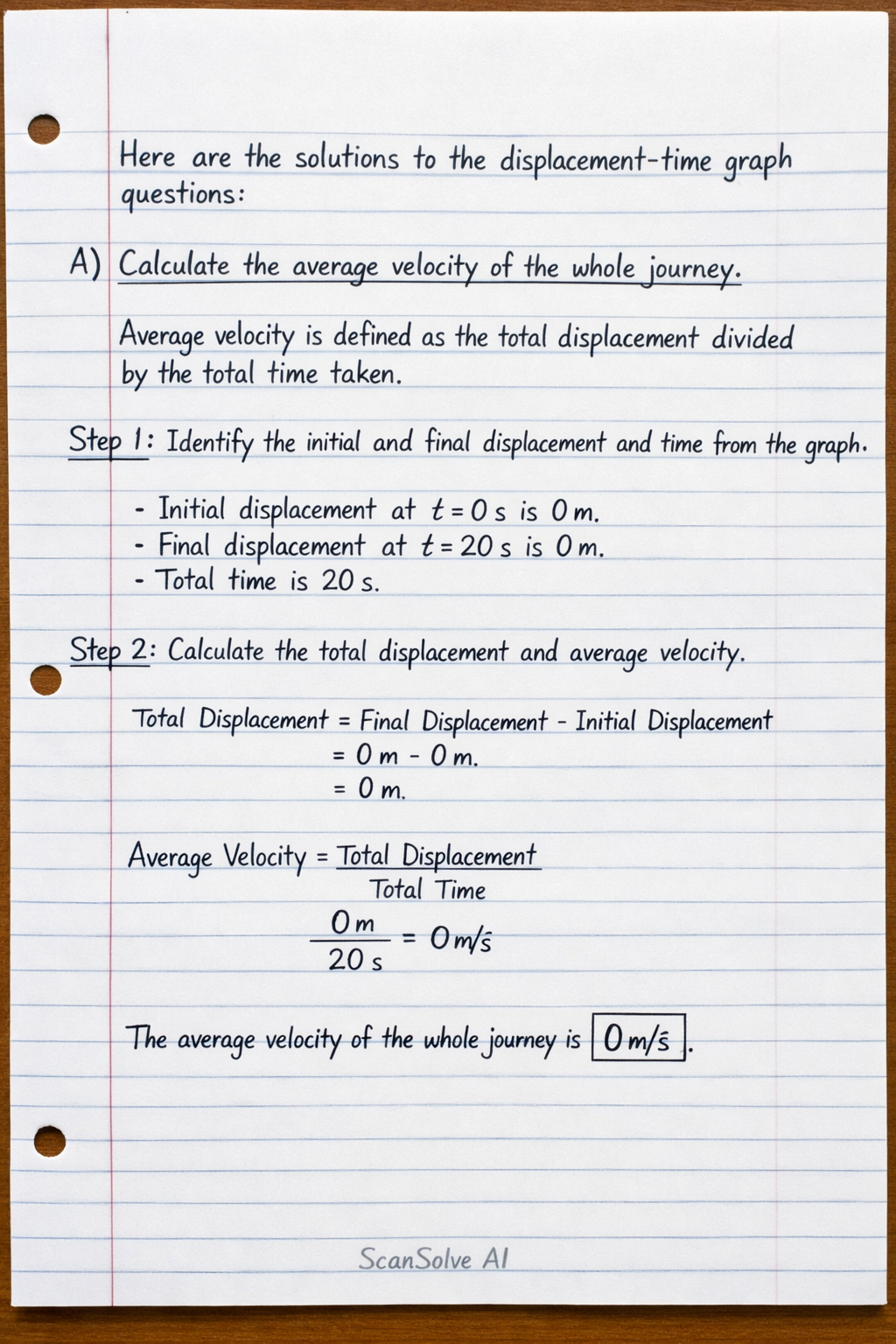
Here are the solutions to the displacement-time graph questions: A) Calculate the average velocity of the whole journey. Average velocity is defined as the total displacement divided by the total time taken. Step 1: Identify the initial and final displacement and time from the graph. • Initial displacement at t=0 s is 0 m. • Final displacement at t=20 s is 0 m. • Total time is 20 s. Step 2: Calculate the total displacement and average velocity. Total Displacement = Final Displacement - Initial Displacement = 0 m - 0 m = 0 m Average Velocity = Total DisplacementTotal Time = 0 m20 s = 0 m/s The average velocity of the whole journey is 0 m/s. B) Calculate the instantaneous velocity at point B. Instantaneous velocity on a displacement-time graph is the gradient (slope) of the graph at that specific point. Point B is located at (16 s, -20 m). This point lies on the straight line segment from t=14 s to t=20 s. Step 1: Identify two points on the straight line segment that includes point B. • Point 1: (t_1, d_1) = (14 s, -30 m) • Point 2: (t_2, d_2) = (20 s, 0 m) Step 2: Calculate the gradient (velocity) using these two points. Velocity = ( d)/( t) = (d_2 - d_1)/(t_2 - t_1) = 0 m - (-30 m)20 s - 14 s = 30 m6 s = 5 m/s The instantaneous velocity at point B is 5 m/s. C) Calculate the average velocity from t=7 s to t=15 s. Average velocity is the total displacement over the given time interval. Step 1: Find the displacement at t=7 s and t=15 s from the graph. • At t=7 s, the displacement is 20 m. • At t=15 s, the point is on the segment from (14 s, -30 m) to (20 s, 0 m). The velocity of this segment is 5 m/s (from part B). Displacement at t=15 s = Displacement at t=14 s + (velocity × t) d_15s = -30 m + (5 m/s × (15 s - 14 s)) = -30 m + (5 m/s × 1 s) = -30 m + 5 m = -25 m Step 2: Calculate the total displacement and average velocity for the interval. Total Displacement = d_15s - d_7s = -25 m - 20 m = -45 m Total Time = 15 s - 7 s = 8 s Average Velocity = Total DisplacementTotal Time = -45 m8 s = -5.625 m/s The average velocity from t=7 s to t=15 s is -5.625 m/s.