

This physics problem tests your understanding of fundamental physical laws and their applications. The step-by-step solution below breaks down the problem using relevant equations and physical reasoning.
ScanSolve AI Answer
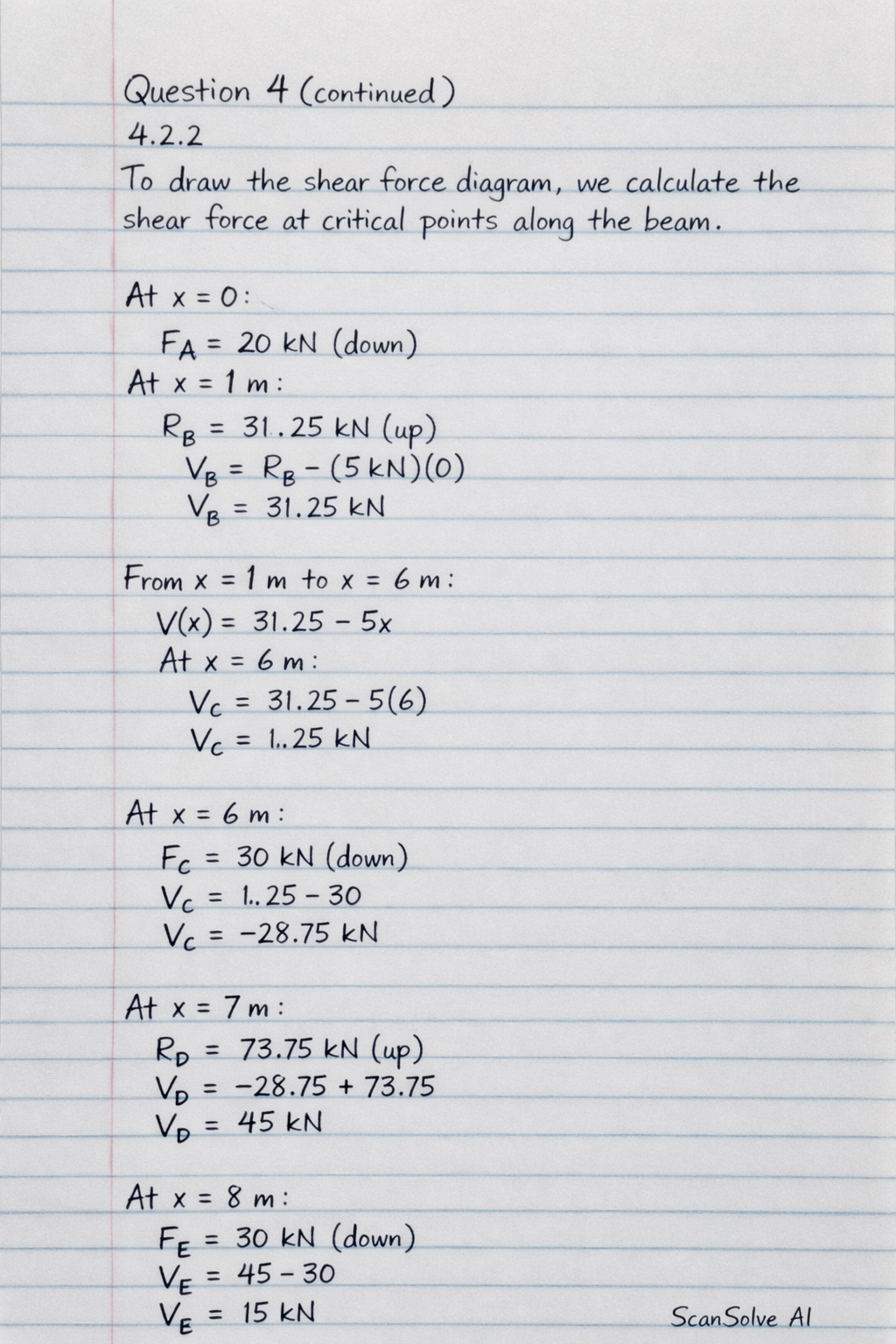
Question 4 (continued) 4.2.2 To draw the shear force diagram, we calculate the shear force at critical points along the beam. F_A = 20 kN (down) at x=0 R_B = 31.25 kN (up) at x=1 m UDL = 5 kN/m from x=1 m to x=6 m F_C = 30 kN (down) at x=6 m R_D = 73.75 kN (up) at x=7 m F_E = 30 kN (down) at x=8 m Step 1: Calculate shear forces at key points. At x=0 (just after A): V_A = -20 kN At x=1 m (just before B): V_B, left = -20 kN At x=1 m (just after B): V_B, right = -20 kN + R_B = -20 + 31.25 = 11.25 kN At x=6 m (just before C, end of UDL): V_C, left = V_B, right - (5 kN/m × 5 m) = 11.25 - 25 = -13.75 kN At x=6 m (just after C): V_C, right = V_C, left - F_C = -13.75 - 30 = -43.75 kN At x=7 m (just before D): V_D, left = -43.75 kN At x=7 m (just after D): V_D, right = V_D, left + R_D = -43.75 + 73.75 = 30 kN At x=8 m (just before E): V_E, left = 30 kN At x=8 m (just after E): V_E, right = V_E, left - F_E = 30 - 30 = 0 kN The shear force diagram starts at -20 kN at A, remains constant until B. At B, it jumps up to 11.25 kN. From B to C, it decreases linearly to -13.75 kN due to the UDL. At C, it drops to -43.75 kN. It remains constant until D. At D, it jumps up to 30 kN. It remains constant until E, where it drops to 0 kN. Question 5 5.1 The unit pascal (Pa) is the SI unit of pressure, defined as one newton per square meter (1 Pa = 1 N/m^2). 5.2 Pascal's law states that a pressure change at any point in a confined incompressible fluid is transmitted undiminished throughout the fluid such that the same change occurs everywhere. 5.3 Given: Area of plunger (A_p) = 25% of ram area (A_r) Stroke of plunger (L_p) = 0.161 m Force applied to plunger (F_p) = 560 N Area of the ram piston (A_r) = 0.524 m^2 Neglect ALL losses. Step 1: Calculate the area of the plunger. A_p = 0.25 × A_r = 0.25 × 0.524 m^2 = 0.131 m^2 5.3.1 Step 2: Calculate the volume of liquid displaced by the plunger in 12 pump strokes. Volume per stroke: V_stroke = A_p × L_p = 0.131 m^2 × 0.161 m = 0.021091 m^3 Total volume for 12 strokes: V_total = V_stroke × 12 = 0.021091 m^3 × 12 = 0.253092 m^3 The volume of liquid displaced by the plunger in 12 pump strokes is 0.253 m^3. 5.3.2 Step 1: Apply the principle of conservation of volume. Volume displaced by plunger = Volume moved by ram piston A_p × L_p = A_r × L_r 0.021091 m^3 = 0.524 m^2 × L_r Step 2: Calculate the distance moved by the ram piston (L_r). L_r = 0.021091 m^30.524 m^2 ≈ 0.04025 m Step 3: Convert to mm. L_r = 0.04025 m × 1000 mm/m = 40.25 mm The distance moved by the ram piston in 1 pump stroke is 40.25 mm. 5.3.3 Step 1: Calculate the force exerted by the ram piston (F_r). According to Pascal's law, the pressure is constant throughout the fluid: P = (F_p)/(A_p) = (F_r)/(A_r) F_r = F_p × (A_r)/(A_p) = 560 N × 0.524 m^20.131 m^2 = 560 N × 4 = 2240 N The force exerted by the ram piston is 2240 N. 5.3.4 Step 1: Calculate the mechanical advantage (MA). MA = Force on ramForce on plunger = (F_r)/(F_p) = 2240 N560 N = 4 The mechanical advantage of the press is 4. 5.3.5 Step 1: Calculate the fluid pressure in the liquid. P = (F_p)/(A_p) = 560 N0.131 m^2 ≈ 4274.81 Pa The fluid pressure in the liquid is 4274.81 Pa. 5.4 Given: Number of cylinders = 3 Plunger diameter d = 171 mm = 0.171 m Stroke length L = 300 mm = 0.300 m Speed N = 230 r/min Slip = 16% Step 1: Calculate the area of one plunger. A = ( d^2)/(4) = (0.171 m)^24 ≈ 0.02294 m^2 Step 2: Calculate the theoretical volume displaced per minute for one cylinder. V_theoretical, 1cyl = A × L × N = 0.02294 m^2 × 0.300 m × 230 r/min ≈ 1.58286 m^3/min Step 3: Calculate the theoretical volume displaced per minute for 3 cylinders. V_theoretical, 3cyl = 3 × V_theoretical, 1cyl = 3 × 1.58286 m^3/min ≈ 4.74858 m^3/min Step 4: Account for slip. Actual volume delivered = Theoretical volume × (1 - slip) V_actual = 4.74858 m^3/min × (1 - 0.16) = 4.74858 m^3/min × 0.84 ≈ 3.9888 m^3/min Step 5: Convert to litres per minute. V_actual = 3.9888 m^3/min × 1000 litres/m^3 ≈ 3988.8 litres/min The volume of water delivered is 3988.8 litres/minute. Question 6 6.1 The Kelvin scale is an absolute temperature scale where 0 K represents absolute zero, the theoretical point of no molecular motion. The Celsius scale is a relative temperature scale where 0 °C is the freezing point of water and 100 °C is its boiling point. A 1-degree change in Celsius is equivalent to a 1-Kelvin change, but their zero points differ by 273.15 (0 K = -273.15 °C). 6.2 Given: Surface temperature T_1 = 27 °C = 300.15 K Surface pressure P_1 = 101.325 kPa = 101325 Pa Bottom temperature T_2 = 10 °C = 283.15 K Diameter of bubble at bottom d_2 = 16 mm = 0.016 m Diameter of bubble at surface d_1 = 42 mm = 0.042 m Density of water = 1000 kg/m^3 Step 1: Calculate the volume of the bubble at the surface (V_1). Radius at surface r_1 = d_1/2 = 0.042 m / 2 = 0.021 m V_1 = (4)/(3) r_1^3 = (4)/(3) (0.021 m)^3 ≈ 3.879 × 10^-5 m^3 Step 2: Calculate the volume of the bubble at the bottom (V_2). Radius at bottom r_2 = d_2/2 = 0.016 m / 2 = 0.008 m V_2 = (4)/(3) r_2^3 = (4)/(3) (0.008 m)^3 ≈ 2.145 × 10^-6 m^3 Step 3: Apply the combined gas law to find the pressure at the bottom (P_2). (P_1 V_1)/(T_1) = (P_2 V_2)/(T_2) P_2 = P_1 (V_1)/(V_2) (T_2)/(T_1) P_2 = 101325 Pa × 3.879 × 10^-5 m^32.145 × 10^-6 m^3 × 283.15 K300.15 K P_2 ≈ 101325 Pa × 18.0848 × 0.9433 ≈ 1730000 Pa Step 4: Calculate the depth of the ocean (h) using the hydrostatic pressure formula. P_2 = P_1 + g h h = (P_2 - P_1)/( g) h = 1730000 Pa - 101325 Pa1000 kg/m^3 × 9.8 m/s^2 h = 1628675 Pa9800 N/m^3 ≈ 166.19 m The depth of the ocean is 166.19 m.