We read your photo as:

Consider the the table below indicating the position of the car at various time. Find displacement, average velocity and average speed.

Physics

ScanSolve AI Answer

Answer

Δx=20 m\Delta x = 20 \text{ m}

vˉ=4 m/s\bar{v} = 4 \text{ m/s}

sˉ=8.8 m/s\bar{s} = 8.8 \text{ m/s}

Step-by-step solution

5 steps

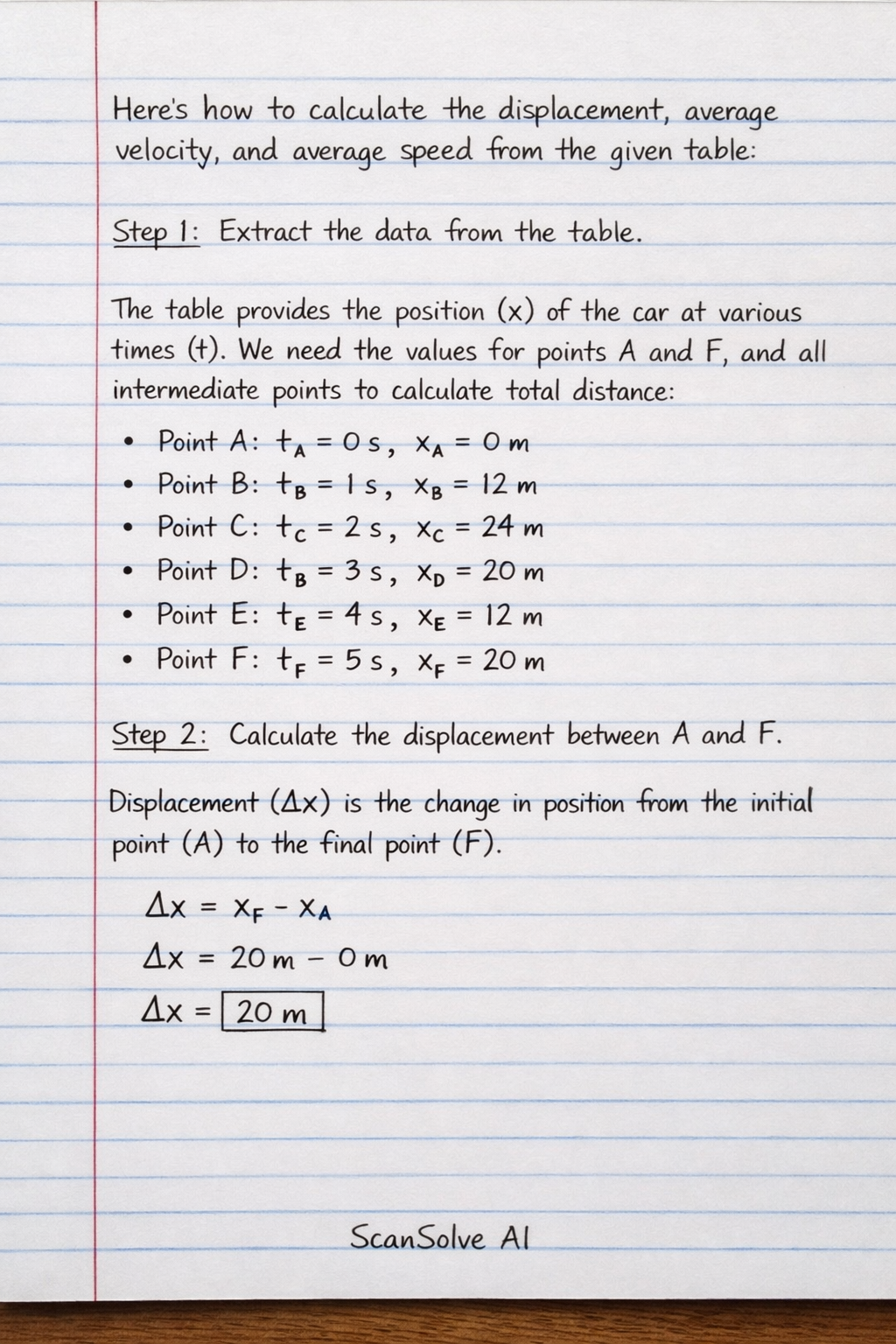
Here's how to calculate the displacement, average velocity, and average speed from the given table:

  1. Extract the data from the table.

    The table provides the position (xx) of the car at various times (tt). We need the values for points A and F, and all intermediate points to calculate total distance.

    • Point A: tA=0 st_A = 0 \text{ s}, xA=0 mx_A = 0 \text{ m}
    • Point B: tB=1 st_B = 1 \text{ s}, xB=12 mx_B = 12 \text{ m}
    • Point C: tC=2 st_C = 2 \text{ s}, xC=24 mx_C = 24 \text{ m}
    • Point D: tD=3 st_D = 3 \text{ s}, xD=20 mx_D = 20 \text{ m}
    • Point E: tE=4 st_E = 4 \text{ s}, xE=12 mx_E = 12 \text{ m}
    • Point F: tF=5 st_F = 5 \text{ s}, xF=20 mx_F = 20 \text{ m}
  2. Calculate the displacement between A and F.

    Displacement (Δx\Delta x) is the change in position from the initial point (A) to the final point (F).

    Δx=xF−xA\Delta x = x_F - x_A Δx=20 m−0 m\Delta x = 20 \text{ m} - 0 \text{ m} Δx=20 m\Delta x = \boxed{20 \text{ m}}
  3. Calculate the average velocity between A and F.

    Average velocity (vˉ\bar{v}) is the displacement divided by the total time taken.
    The total time taken is Δt=tF−tA=5 s−0 s=5 s\Delta t = t_F - t_A = 5 \text{ s} - 0 \text{ s} = 5 \text{ s}.

    vˉ=ΔxΔt\bar{v} = \frac{\Delta x}{\Delta t} vˉ=20 m5 s\bar{v} = \frac{20 \text{ m}}{5 \text{ s}} vˉ=4 m/s\bar{v} = \boxed{4 \text{ m/s}}
  4. Calculate the total distance traveled between A and F.

    Distance is the sum of the absolute changes in position between consecutive points.

    • Distance A to B: ∣xB−xA∣=∣12 m−0 m∣=12 m|x_B - x_A| = |12 \text{ m} - 0 \text{ m}| = 12 \text{ m}
    • Distance B to C: ∣xC−xB∣=∣24 m−12 m∣=12 m|x_C - x_B| = |24 \text{ m} - 12 \text{ m}| = 12 \text{ m}
    • Distance C to D: ∣xD−xC∣=∣20 m−24 m∣=∣−4 m∣=4 m|x_D - x_C| = |20 \text{ m} - 24 \text{ m}| = |-4 \text{ m}| = 4 \text{ m}
    • Distance D to E: ∣xE−xD∣=∣12 m−20 m∣=∣−8 m∣=8 m|x_E - x_D| = |12 \text{ m} - 20 \text{ m}| = |-8 \text{ m}| = 8 \text{ m}
    • Distance E to F: ∣xF−xE∣=∣20 m−12 m∣=8 m|x_F - x_E| = |20 \text{ m} - 12 \text{ m}| = 8 \text{ m} Total distance d=12 m+12 m+4 m+8 m+8 m=44 md = 12 \text{ m} + 12 \text{ m} + 4 \text{ m} + 8 \text{ m} + 8 \text{ m} = 44 \text{ m}.
  5. Calculate the average speed between A and F.

    Average speed (sˉ\bar{s}) is the total distance traveled divided by the total time taken.

    sˉ=dΔt\bar{s} = \frac{d}{\Delta t} sˉ=44 m5 s\bar{s} = \frac{44 \text{ m}}{5 \text{ s}} sˉ=8.8 m/s\bar{s} = \boxed{8.8 \text{ m/s}}
Was this helpful?

Still stuck on this one?

Ask a follow-up, and the answer starts from this question.

Got a different question?Ask your own question
Handwritten step-by-step solution preview

Handwritten Step-by-Step Solution

Get this as a handwritten image on WhatsApp — like a tutor wrote it for you.

Try on WhatsApp