
We read your photo as:
Convert the initial velocity to meters per second.
ScanSolve AI Answer
Answer
Step-by-step solution
5 stepsHere's how to determine if the bus will stop in time:
Convert the initial velocity to meters per second.
The initial velocity .
Calculate the distance covered during the reaction time.
The driver takes to react.
Calculate the distance covered while braking.
The initial velocity for braking is , the final velocity (since the bus stops), and the acceleration (negative because it's deceleration).
Using the kinematic equation :Calculate the total stopping distance.
The total stopping distance is the sum of the reaction distance and the braking distance.
Compare the total stopping distance with the obstacle distance.
The obstacle is ahead.
Since , the bus will stop before reaching the obstacle.The bus will be able to stop before reaching the obstacle.
The total stopping distance is .
Try one yourself
A new problem that tests the same skill.
Still stuck on this one?
Ask a follow-up, and the answer starts from this question.
More Physics Questions
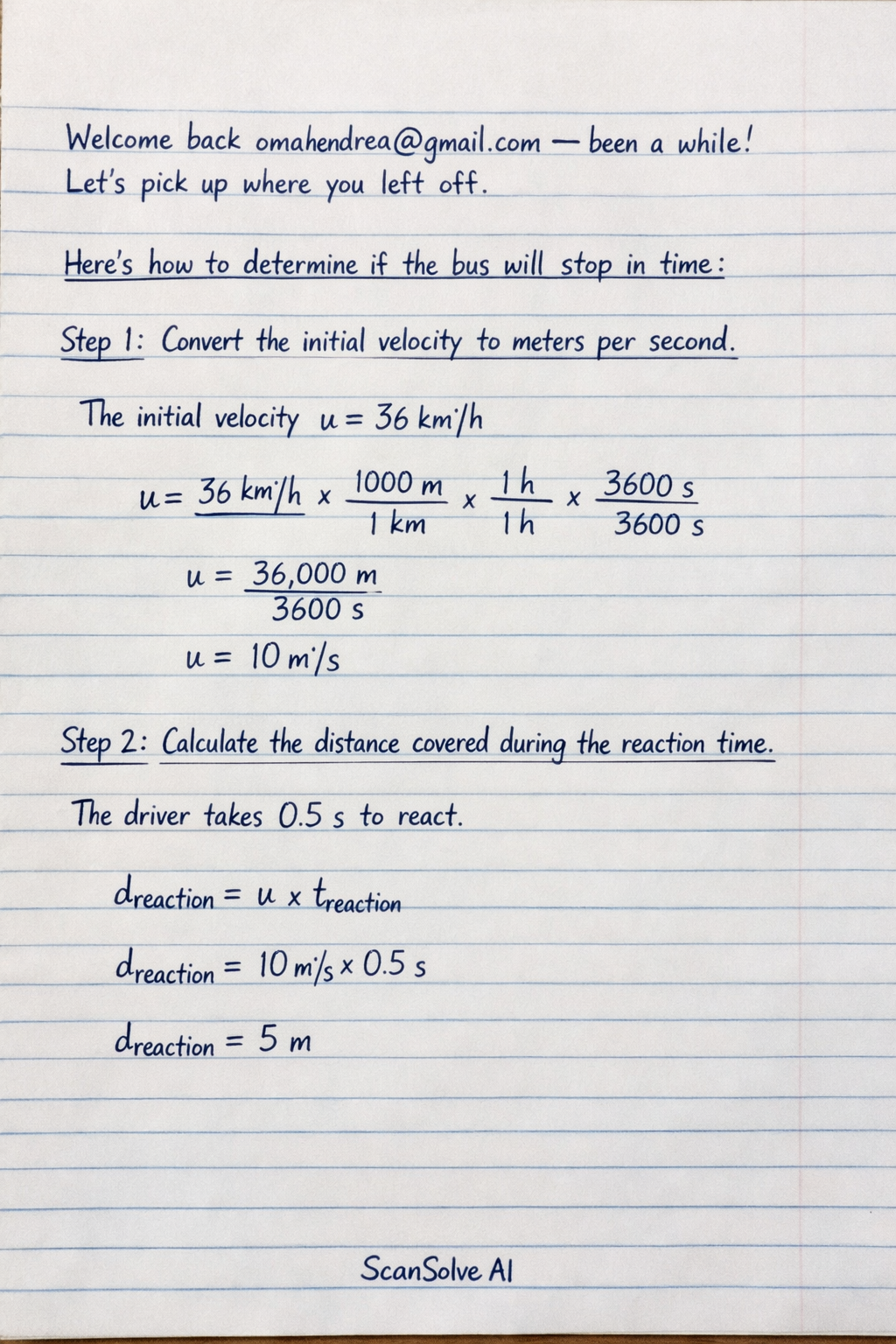
Handwritten Step-by-Step Solution
Get this as a handwritten image on WhatsApp — like a tutor wrote it for you.
Try on WhatsApp