
We read your photo as:
Define activity, state its SI unit, derive the relation between activity, decay constant, and number of undecayed nuclei, and calculate the fraction of a sample remaining after 30 days given a half-li
ScanSolve AI Answer
This answer stops before the end.
It was cut off when it was first written. Ask ScanSolve this question again for the full working.
Here are the answers to the questions, based on the best interpretation of the image:
a) What is meant by the term 'activity' of a radioactive sample?
Activity () is the rate at which unstable nuclei in a radioactive sample decay. It represents the number of nuclear disintegrations or decays occurring per unit time.
b) State the SI unit of activity.
The SI unit of activity is the Becquerel (Bq).
c) Derive the relation between activity (A), decay constant (), and number of undecayed nuclei (N).
Step 1: Define activity.
Activity () is the rate of decay of radioactive nuclei, which is proportional to the number of undecayed nuclei () present at any given time.
Step 2: Apply the decay law.
The decay law states that the rate of change of the number of nuclei is proportional to the number of nuclei present, with the decay constant () as the proportionality constant:
Step 3: Combine the definitions.
Substituting the decay law into the activity definition, we get:
This shows that the activity is directly proportional to the number of undecayed nuclei and the decay constant.
d) A radioactive sample has a half-life of 10 days. Calculate the fraction of the sample that remains after 30 days.
Step 1: Calculate the number of half-lives.
The number of half-lives () is the total time () divided by the half-life ():
Step 2: Calculate the fraction remaining.
The fraction of the sample remaining after half-lives is given by :
The fraction of the sample that remains after 30 days is .
e) What is meant by the term 'mass defect' (for a nucleus)?
Mass defect () is the difference between the sum of the masses of the individual nucleons (protons and neutrons) when they are free and the actual measured mass of the nucleus they form.
f) What is meant by the term 'binding energy' (of a nucleus)?
Binding energy () is the minimum energy required to separate a nucleus completely into its constituent protons and neutrons. It is also the energy released when these nucleons combine to form a nucleus.
g) State the relationship between mass defect and binding energy.
Binding energy () is directly related to the mass defect () by Einstein's mass-energy equivalence principle:
where is the speed of light.
h) Calculate the binding energy per nucleon for an alpha particle () given the following masses:
Mass of proton () = 1.007276 u
Mass of neutron () = 1.008665 u
Mass of alpha particle () = 4.001506 u
1 u = 931.5 MeV/c
An alpha particle () contains 2 protons and 2 neutrons.
Step 1: Calculate the total mass of individual nucleons.
Step 2: Calculate the mass defect ().
Step 3: Calculate the binding energy ().
Using the conversion factor 1 u = 931.5 MeV/c:
Still stuck on this one?
Ask a follow-up, and the answer starts from this question.
More Physics Questions
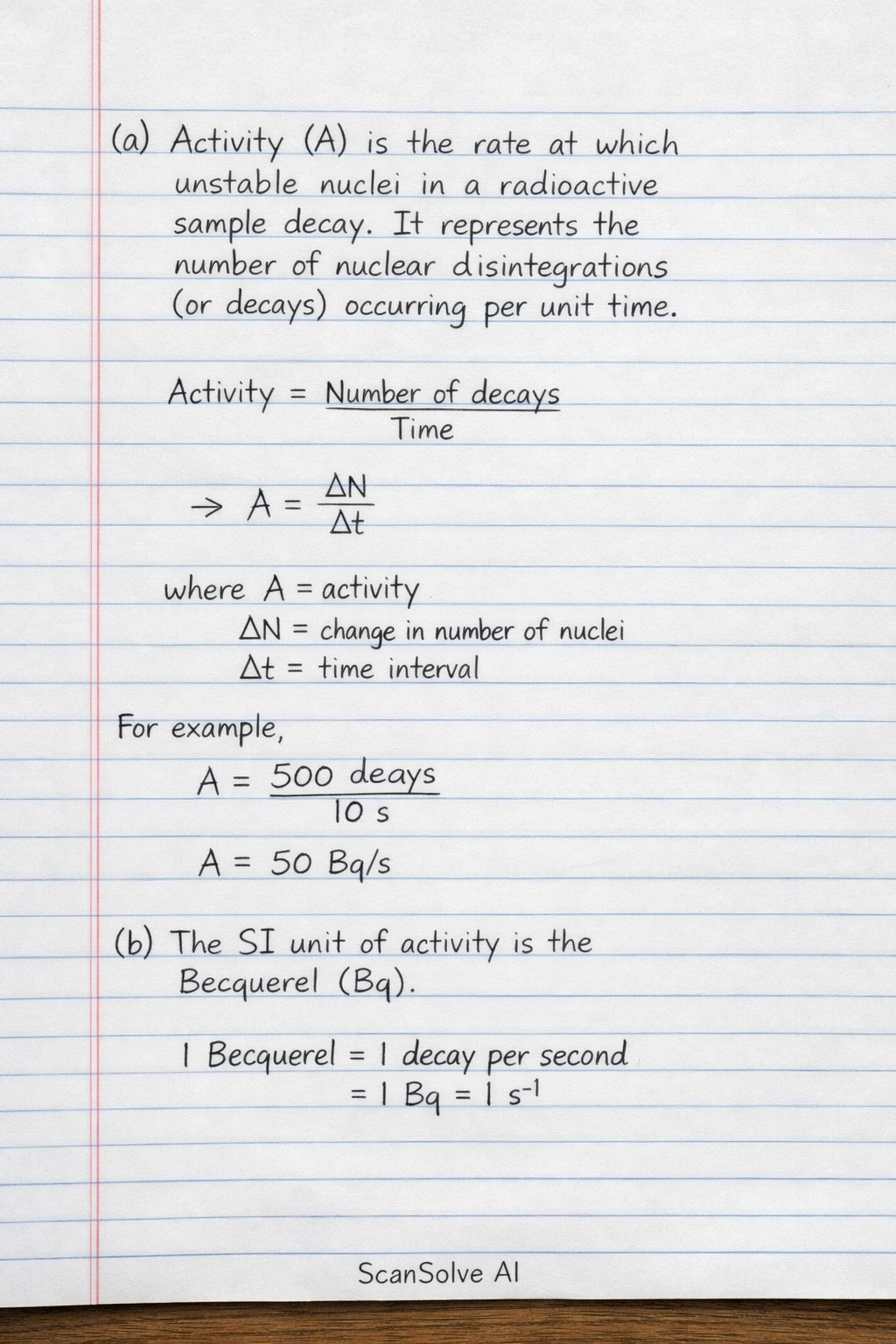
Handwritten Step-by-Step Solution
Get this as a handwritten image on WhatsApp — like a tutor wrote it for you.
Try on WhatsApp