
We read your photo as:
Describe the energy conversion process in a thermal power plant and define primary and secondary energy sources. Explain why renewable energy sources are sustainable.
ScanSolve AI Answer
Answer
Step-by-step solution
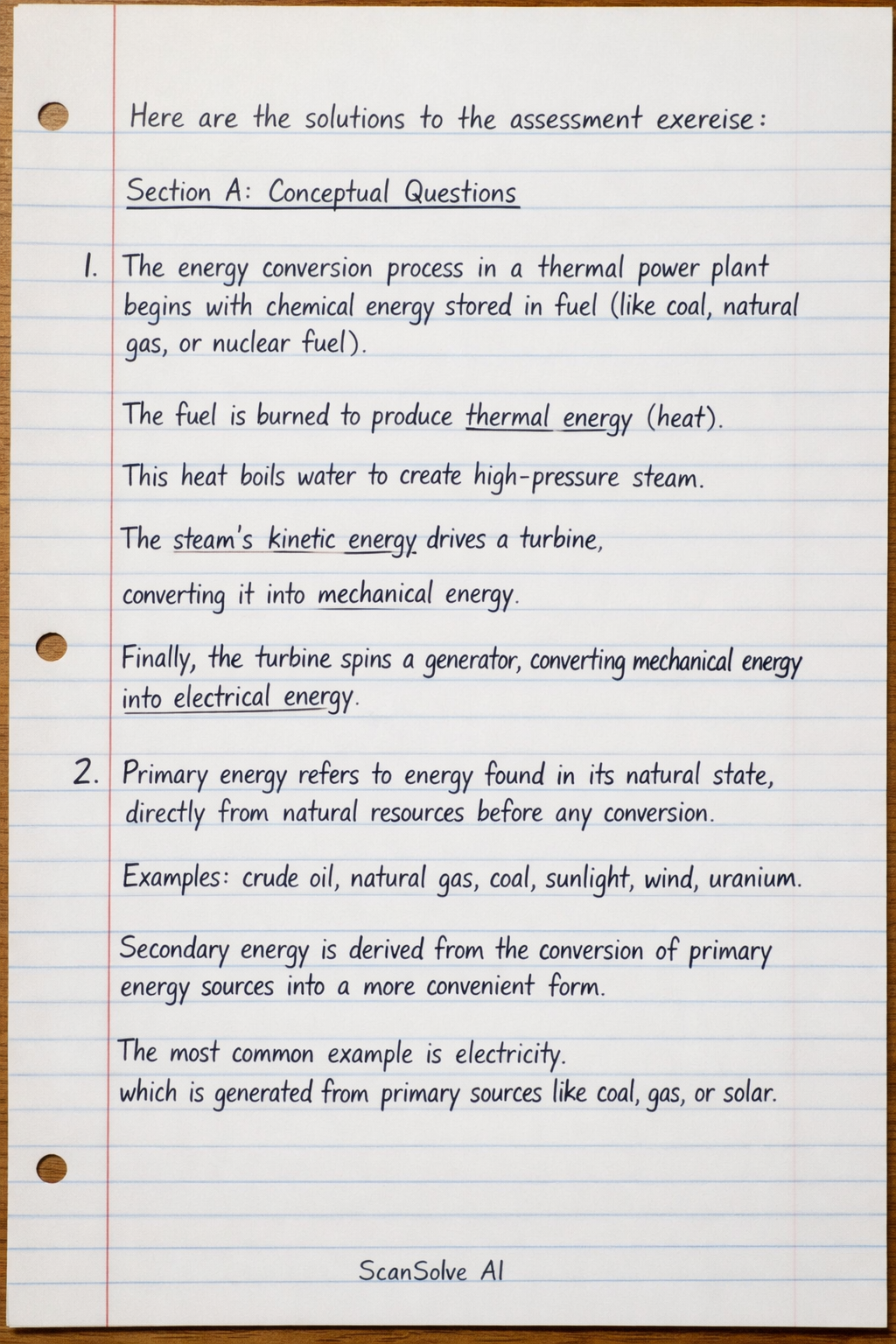
6 stepsHere are the solutions to the assessment exercise:
Section A: Conceptual Questions
-
The energy conversion process in a thermal power plant begins with chemical energy stored in fuel (like coal, natural gas, or nuclear fuel). This fuel is burned to produce thermal energy (heat), which boils water to create high-pressure steam. The steam's kinetic energy drives a turbine, converting it into mechanical energy. Finally, the turbine spins a generator, converting mechanical energy into electrical energy.
-
Primary energy refers to energy found in its natural state, directly from natural resources, before any human-made conversion. Examples include crude oil, natural gas, coal, sunlight, wind, and uranium. Secondary energy is derived from the conversion of primary energy sources into a more convenient or usable form. The most common example is electricity, which is generated from primary sources like coal, gas, or solar.
-
Renewable energy sources are considered sustainable because they are naturally replenished on a human timescale and cause minimal environmental impact compared to fossil fuels. They do not deplete finite resources, reduce greenhouse gas emissions, and contribute to long-term environmental health and energy security.
Section B: Analytical Questions
-
Solar PV systems convert sunlight directly into electricity using photovoltaic cells, producing no emissions during operation and having low maintenance. Their output is intermittent, depending on sunlight availability. Thermal power generation systems (e.g., coal, gas, nuclear) burn fuel to heat water, create steam, and drive a turbine to generate electricity. They offer dispatchable power (can be turned on/off as needed) but typically have higher operational emissions (except nuclear) and require significant fuel supply and waste management.
-
Natural gas offers several advantages over coal: it burns cleaner, producing significantly less carbon dioxide, sulfur dioxide, nitrogen oxides, and particulate matter. It is also more efficient in modern power plants and can be ramped up or down more quickly than coal plants, providing greater flexibility for grid management.
-
Limitations of renewable energy in industrial applications include intermittency (solar and wind depend on weather), requiring energy storage or backup systems. Their land footprint can be substantial for large-scale projects. High initial capital costs for installation can be a barrier, and the grid integration of variable renewable sources can be complex, requiring upgrades to existing infrastructure.
Section C: Data-Based Questions
- To estimate how many 10 MW solar plants are needed to match Nigeria's 4,300 MW capacity:
Identify the total capacity to be matched.
$$ \text{Total Capacity} = 4,300 \text{ MW} $$Identify the capacity of a single solar plant.
$$ \text{Capacity per Solar Plant} = 10 \text{ MW} $$Divide the total capacity by the capacity per plant.
$$ \text{Number of Solar Plants} = \frac{\text{Total Capacity}}{\text{Capacity per Solar Plant}} $$ $$ \text{Number of Solar Plants} = \frac{4,300 \text{ MW}}{10 \text{ MW}} $$ $$ \text{Number of Solar Plants} = 430 $$ Nigeria would need **430** 10 MW solar plants to match this capacity. $$ \boxed{\text{430 solar plants}} $$2. To calculate the useful output from a coal plant operating at 35% efficiency with a 1000 MW input:
Convert the efficiency percentage to a decimal.
$$ \text{Efficiency} = 35\% = 0.35 $$Identify the input power.
$$ \text{Input Power} = 1000 \text{ MW} $$Multiply the input power by the efficiency to find the useful output.
$$ \text{Useful Output} = \text{Input Power} \times \text{Efficiency} $$ $$ \text{Useful Output} = 1000 \text{ MW} \times 0.35 $$ $$ \text{Useful Output} = 350 \text{ MW} $$ The useful output from the coal plant is **350 MW**. $$ \boxed{\text{350 MW}} $$Section D: Critical Thinking
-
Nigeria's prioritization of gas or renewable energy for future development involves a trade-off. Natural gas offers a relatively cleaner fossil fuel option than coal, with established infrastructure and dispatchable power, which can provide immediate energy security and support industrial growth. However, it is still a finite fossil fuel contributing to climate change. Renewable energy offers long-term sustainability, reduced environmental impact, and energy independence, but requires significant initial investment, grid modernization, and solutions for intermittency. A balanced approach, leveraging gas as a transition fuel while aggressively investing in renewables, might be optimal for both short-term stability and long-term sustainability.
-
Energy security significantly affects economic growth in industrial nations by ensuring a reliable and affordable supply of energy, which is crucial for industrial operations, transportation, and daily life. When energy supplies are stable and prices predictable, businesses can plan investments, maintain production, and foster innovation. Conversely, energy insecurity—due to supply disruptions, price volatility, or over-reliance on external sources—can lead to increased operational costs, reduced competitiveness, inflation, and economic instability, hindering growth and development.
Section E: Research Assignment
-
Analyze the energy mix of one industrial country and compare it with Nigeria. For example, Germany (an industrial country) has a diverse energy mix, with a significant and growing share of renewables (wind, solar) alongside natural gas, coal (decreasing), and nuclear (phasing out). This mix reflects a strong commitment to decarbonization and energy transition. Nigeria's energy mix is heavily dominated by fossil fuels, primarily natural gas and oil, with a smaller contribution from hydropower and very limited solar/wind. The comparison highlights Germany's advanced stage in renewable integration and diversification, while Nigeria relies more on traditional fossil fuel resources, indicating a need for significant energy transition efforts.
-
Propose a hybrid energy model for Nigeria. A hybrid energy model for Nigeria could involve a strategic combination of its abundant natural gas resources as a transition fuel for base-load power, coupled with aggressive development of solar PV (given high insolation across much of the country) and hydropower (leveraging existing and potential dam sites). Small-scale decentralized renewable systems (solar mini-grids) could address rural electrification gaps. This model would prioritize grid modernization, energy storage solutions, and policies to attract investment in renewables, aiming to reduce reliance on oil, improve energy access, and lower carbon emissions while ensuring energy security.
-
Try one yourself
A new problem that tests the same skill.
Still stuck on this one?
Ask a follow-up, and the answer starts from this question.
More Physics Questions
Handwritten Step-by-Step Solution
Get this as a handwritten image on WhatsApp — like a tutor wrote it for you.
Try on WhatsApp