We read your photo as:

Figure 2 shows a spherical shell with uniform volume charge density, p = 1.84 nc/m3, inner radius a = 10 cm, and outer radius b = 2a. What is the magnitude of the electric field at radial distances?

Physics

ScanSolve AI Answer

Answer

0 V\text{0 V}

−0.805 i^ N/C-0.805 \, \hat{i} \, \text{N/C}

Step-by-step solution

4 steps
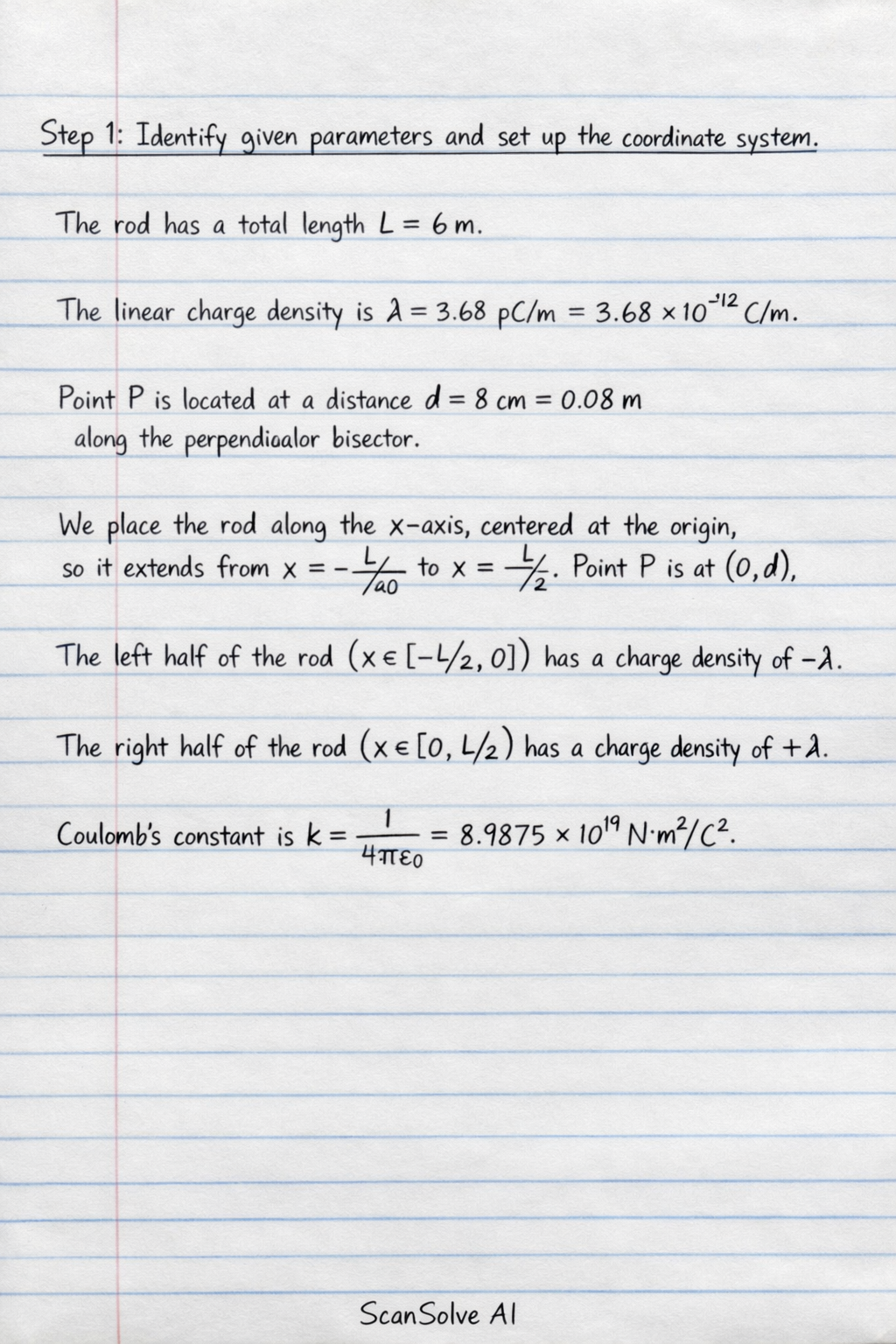
  1. Identify given parameters and set up the coordinate system.

    The rod has a total length L=6 mL = 6 \, \text{m}.
    The linear charge density is λ=3.68 pC/m=3.68×10−12 C/m\lambda = 3.68 \, \text{pC/m} = 3.68 \times 10^{-12} \, \text{C/m}.
    Point P is located at a distance d=8 cm=0.08 md = 8 \, \text{cm} = 0.08 \, \text{m} along the perpendicular bisector.
    We place the rod along the x-axis, centered at the origin, so it extends from x=−L/2x = -L/2 to x=L/2x = L/2. Point P is at (0,d)(0, d).
    From Figure 3, the left half of the rod (x∈[−L/2,0]x \in [-L/2, 0]) has a charge density of −λ-\lambda.
    The right half of the rod (x∈[0,L/2]x \in [0, L/2]) has a charge density of +λ+\lambda.
    Coulomb's constant is k=14πϵ0=8.9875×10⁹ N⋅m2/C2k = \frac{1}{4\pi\epsilon_0} = 8.9875 \times 10^9 \, \text{N}\cdot\text{m}^2/\text{C}^2.

  2. Calculate the electric potential VV at point P (Part a).

    The electric potential VV due to a continuous charge distribution is given by V=∫k dqrV = \int \frac{k \, dq}{r}.
    For a linear charge distribution, dq=λeff dxdq = \lambda_{eff} \, dx. The distance from a charge element dqdq at (x,0)(x,0) to point P at (0,d)(0,d) is r=x2+d2r = \sqrt{x^2 + d^2}.
    The total potential VPV_P is the sum of potentials from the negative and positive halves:

    VP=∫−L/20k(−λ) dxx2+d2+∫0L/2k(+λ) dxx2+d2V_P = \int_{-L/2}^{0} \frac{k (-\lambda) \, dx}{\sqrt{x^2 + d^2}} + \int_{0}^{L/2} \frac{k (+\lambda) \, dx}{\sqrt{x^2 + d^2}} VP=−kλ∫−L/20dxx2+d2+kλ∫0L/2dxx2+d2V_P = -k\lambda \int_{-L/2}^{0} \frac{dx}{\sqrt{x^2 + d^2}} + k\lambda \int_{0}^{L/2} \frac{dx}{\sqrt{x^2 + d^2}}

    The integral ∫dxx2+a2=ln⁡∣x+x2+a2∣\int \frac{dx}{\sqrt{x^2 + a^2}} = \ln|x + \sqrt{x^2 + a^2}|.
    Evaluating the integrals:

    ∫−L/20dxx2+d2=[ln⁡∣x+x2+d2∣]−L/20=ln⁡(d)−ln⁡((L/2)2+d2−L/2)\int_{-L/2}^{0} \frac{dx}{\sqrt{x^2 + d^2}} = \left[ \ln|x + \sqrt{x^2 + d^2}| \right]_{-L/2}^{0} = \ln(d) - \ln\left(\sqrt{(L/2)^2 + d^2} - L/2\right) ∫0L/2dxx2+d2=[ln⁡∣x+x2+d2∣]0L/2=ln⁡(L/2+(L/2)2+d2)−ln⁡(d)\int_{0}^{L/2} \frac{dx}{\sqrt{x^2 + d^2}} = \left[ \ln|x + \sqrt{x^2 + d^2}| \right]_{0}^{L/2} = \ln\left(L/2 + \sqrt{(L/2)^2 + d^2}\right) - \ln(d)

    Substituting these back into the expression for VPV_P:

    VP=−kλ[ln⁡(d)−ln⁡((L/2)2+d2−L/2)]+kλ[ln⁡(L/2+(L/2)2+d2)−ln⁡(d)]V_P = -k\lambda \left[ \ln(d) - \ln\left(\sqrt{(L/2)^2 + d^2} - L/2\right) \right] + k\lambda \left[ \ln\left(L/2 + \sqrt{(L/2)^2 + d^2}\right) - \ln(d) \right] VP=kλ[ln⁡(L/2+(L/2)2+d2d)−ln⁡(d(L/2)2+d2−L/2)]V_P = k\lambda \left[ \ln\left(\frac{L/2 + \sqrt{(L/2)^2 + d^2}}{d}\right) - \ln\left(\frac{d}{\sqrt{(L/2)^2 + d^2} - L/2}\right) \right]

    Using the logarithm property ln⁡(A)−ln⁡(B)=ln⁡(A/B)\ln(A) - \ln(B) = \ln(A/B):

    VP=kλln⁡(L/2+(L/2)2+d2dd(L/2)2+d2−L/2)=kλln⁡((L/2+(L/2)2+d2)((L/2)2+d2−L/2)d2)V_P = k\lambda \ln\left( \frac{\frac{L/2 + \sqrt{(L/2)^2 + d^2}}{d}}{\frac{d}{\sqrt{(L/2)^2 + d^2} - L/2}} \right) = k\lambda \ln\left( \frac{(L/2 + \sqrt{(L/2)^2 + d^2})(\sqrt{(L/2)^2 + d^2} - L/2)}{d^2} \right)

    The numerator is of the form (A+B)(A−B)=A2−B2(A+B)(A-B) = A^2 - B^2, where A=(L/2)2+d2A = \sqrt{(L/2)^2 + d^2} and B=L/2B = L/2.
    Numerator =((L/2)2+d2)−(L/2)2=d2= ((L/2)^2 + d^2) - (L/2)^2 = d^2.

    VP=kλln⁡(d2d2)=kλln⁡(1)=0V_P = k\lambda \ln\left( \frac{d^2}{d^2} \right) = k\lambda \ln(1) = 0

    The electric potential at point P is 0 V\boxed{\text{0 V}}.

  3. Calculate the electric field EE at point P (Part b).

    The electric field dE⃗d\vec{E} due to a charge element dqdq at (x,0)(x,0) at point P (0,d)(0,d) is:

    dE⃗=k dqr2r^=k dqx2+d2−xi^+dj^x2+d2=k dq(x2+d2)3/2(−xi^+dj^)d\vec{E} = \frac{k \, dq}{r^2} \hat{r} = \frac{k \, dq}{x^2 + d^2} \frac{-x\hat{i} + d\hat{j}}{\sqrt{x^2 + d^2}} = \frac{k \, dq}{(x^2 + d^2)^{3/2}} (-x\hat{i} + d\hat{j})

    The total electric field E⃗P=Exi^+Eyj^\vec{E}_P = E_x \hat{i} + E_y \hat{j}.

    For the x-component ExE_x:

    Ex=∫−L/20k(−λ)(−x) dx(x2+d2)3/2+∫0L/2k(+λ)(−x) dx(x2+d2)3/2E_x = \int_{-L/2}^{0} \frac{k(-\lambda) (-x) \, dx}{(x^2 + d^2)^{3/2}} + \int_{0}^{L/2} \frac{k(+\lambda) (-x) \, dx}{(x^2 + d^2)^{3/2}} Ex=kλ∫−L/20x dx(x2+d2)3/2−kλ∫0L/2x dx(x2+d2)3/2E_x = k\lambda \int_{-L/2}^{0} \frac{x \, dx}{(x^2 + d^2)^{3/2}} - k\lambda \int_{0}^{L/2} \frac{x \, dx}{(x^2 + d^2)^{3/2}}

    Using the integral ∫x dx(x2+a2)3/2=−1x2+a2\int \frac{x \, dx}{(x^2 + a^2)^{3/2}} = -\frac{1}{\sqrt{x^2 + a^2}}:

    Ex=kλ[−1x2+d2]−L/20−kλ[−1x2+d2]0L/2E_x = k\lambda \left[ -\frac{1}{\sqrt{x^2 + d^2}} \right]_{-L/2}^{0} - k\lambda \left[ -\frac{1}{\sqrt{x^2 + d^2}} \right]_{0}^{L/2} Ex=kλ(−1d−(−1(L/2)2+d2))−kλ(−1(L/2)2+d2−(−1d))E_x = k\lambda \left( -\frac{1}{d} - \left(-\frac{1}{\sqrt{(L/2)^2 + d^2}}\right) \right) - k\lambda \left( -\frac{1}{\sqrt{(L/2)^2 + d^2}} - \left(-\frac{1}{d}\right) \right) Ex=kλ(−1d+1(L/2)2+d2+1(L/2)2+d2−1d)E_x = k\lambda \left( -\frac{1}{d} + \frac{1}{\sqrt{(L/2)^2 + d^2}} + \frac{1}{\sqrt{(L/2)^2 + d^2}} - \frac{1}{d} \right) Ex=2kλ(1(L/2)2+d2−1d)E_x = 2k\lambda \left( \frac{1}{\sqrt{(L/2)^2 + d^2}} - \frac{1}{d} \right)

    For the y-component EyE_y:

    Ey=∫−L/20k(−λ)d dx(x2+d2)3/2+∫0L/2k(+λ)d dx(x2+d2)3/2E_y = \int_{-L/2}^{0} \frac{k(-\lambda) d \, dx}{(x^2 + d^2)^{3/2}} + \int_{0}^{L/2} \frac{k(+\lambda) d \, dx}{(x^2 + d^2)^{3/2}} Ey=−kλd∫−L/20dx(x2+d2)3/2+kλd∫0L/2dx(x2+d2)3/2E_y = -k\lambda d \int_{-L/2}^{0} \frac{dx}{(x^2 + d^2)^{3/2}} + k\lambda d \int_{0}^{L/2} \frac{dx}{(x^2 + d^2)^{3/2}}

    Using the integral ∫dx(x2+a2)3/2=xa2x2+a2\int \frac{dx}{(x^2 + a^2)^{3/2}} = \frac{x}{a^2\sqrt{x^2 + a^2}}:

    Ey=−kλd[xd2x2+d2]−L/20+kλd[xd2x2+d2]0L/2E_y = -k\lambda d \left[ \frac{x}{d^2\sqrt{x^2 + d^2}} \right]_{-L/2}^{0} + k\lambda d \left[ \frac{x}{d^2\sqrt{x^2 + d^2}} \right]_{0}^{L/2} Ey=−kλd(0−−L/2d2(L/2)2+d2)+kλd(L/2d2(L/2)2+d2−0)E_y = -k\lambda d \left( 0 - \frac{-L/2}{d^2\sqrt{(L/2)^2 + d^2}} \right) + k\lambda d \left( \frac{L/2}{d^2\sqrt{(L/2)^2 + d^2}} - 0 \right) Ey=−kλd(L/2d2(L/2)2+d2)+kλd(L/2d2(L/2)2+d2)=0E_y = -k\lambda d \left( \frac{L/2}{d^2\sqrt{(L/2)^2 + d^2}} \right) + k\lambda d \left( \frac{L/2}{d^2\sqrt{(L/2)^2 + d^2}} \right) = 0

    Due to symmetry, the y-component of the electric field is zero.

  4. Substitute numerical values into the expression for ExE_x.

    Given values: L=6 m  ⟹  L/2=3 mL = 6 \, \text{m} \implies L/2 = 3 \, \text{m}. d=0.08 md = 0.08 \, \text{m}. λ=3.68×10⁻¹² C/m\lambda = 3.68 \times 10^{-12} \, \text{C/m}. k=8.9875×10⁹ N⋅m2/C2k = 8.9875 \times 10^9 \, \text{N}\cdot\text{m}^2/\text{C}^2.
    First, calculate (L/2)2+d2\sqrt{(L/2)^2 + d^2}:

    (L/2)2=(3 m)2=9 m2(L/2)^2 = (3 \, \text{m})^2 = 9 \, \text{m}^2 d2=(0.08 m)2=0.0064 m2d^2 = (0.08 \, \text{m})^2 = 0.0064 \, \text{m}^2 (L/2)2+d2=9+0.0064=9.0064≈3.001066 m\sqrt{(L/2)^2 + d^2} = \sqrt{9 + 0.0064} = \sqrt{9.0064} \approx 3.001066 \, \text{m}

    Now substitute into the ExE_x formula:

    Ex=2(8.9875×10⁹ N⋅m2/C2)(3.68×10−12 C/m)(13.001066 m−10.08 m)E_x = 2(8.9875 \times 10^9 \, \text{N}\cdot\text{m}^2/\text{C}^2)(3.68 \times 10^{-12} \, \text{C/m}) \left( \frac{1}{3.001066 \, \text{m}} - \frac{1}{0.08 \, \text{m}} \right) Ex=(66.149×10⁻³ N/C)(0.333229 m−1−12.5 m−1)E_x = (66.149 \times 10^{-3} \, \text{N/C}) \left( 0.333229 \, \text{m}^{-1} - 12.5 \, \text{m}^{-1} \right) Ex=(66.149×10⁻³ N/C)(−12.166771 m−1)E_x = (66.149 \times 10^{-3} \, \text{N/C}) (-12.166771 \, \text{m}^{-1}) Ex≈−0.80499 N/CE_x \approx -0.80499 \, \text{N/C}

    The electric field at point P is E⃗P=Exi^+Eyj^=−0.805 i^ N/C\vec{E}_P = E_x \hat{i} + E_y \hat{j} = -0.805 \, \hat{i} \, \text{N/C}. The magnitude is 0.805 N/C0.805 \, \text{N/C} and it points in the negative x-direction.

    The electric field at point P is −0.805 i^ N/C\boxed{-0.805 \, \hat{i} \, \text{N/C}}.

Was this helpful?

Try one yourself

A new problem that tests the same skill.

Still stuck on this one?

Ask a follow-up, and the answer starts from this question.

Got a different question?Ask your own question
Handwritten step-by-step solution preview

Handwritten Step-by-Step Solution

Get this as a handwritten image on WhatsApp — like a tutor wrote it for you.

Try on WhatsApp