
We read your photo as:
Figure (3-E6) shows x-t graph of a particle. Find the time t such that the average velocity of the particle during the period 0 to t is zero.
Physics
ScanSolve AI Answer
Answer
Step-by-step solution
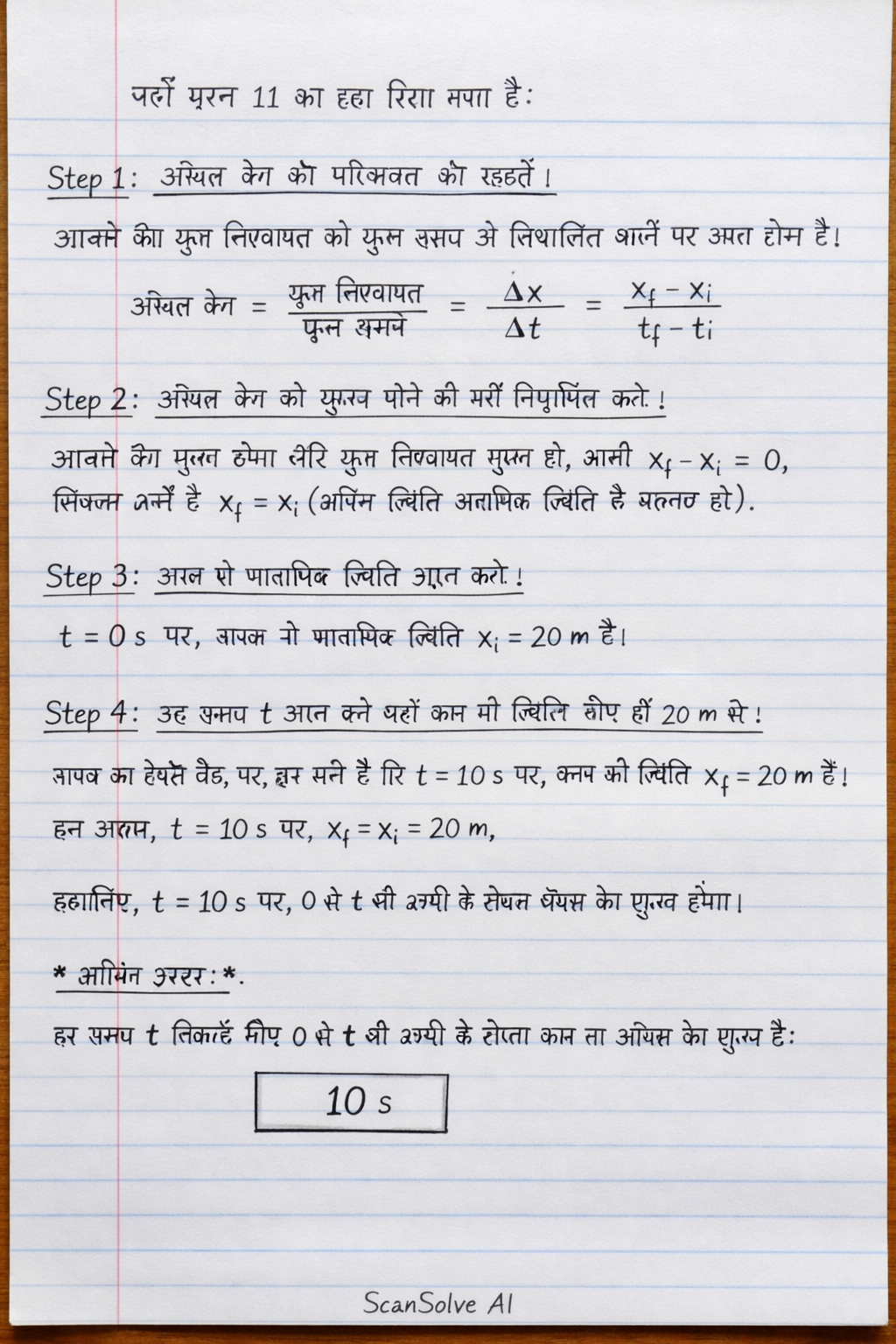
4 stepsयहाँ प्रश्न 11 का हल दिया गया है:
औसत वेग की परिभाषा को समझें।
औसत वेग कुल विस्थापन को कुल समय से विभाजित करने पर प्राप्त होता है।
औसत वेग को शून्य होने की शर्त निर्धारित करें।
औसत वेग शून्य होगा यदि कुल विस्थापन शून्य हो, यानी , जिसका अर्थ है (अंतिम स्थिति प्रारंभिक स्थिति के बराबर हो)।
ग्राफ से प्रारंभिक स्थिति ज्ञात करें।
पर, ग्राफ से प्रारंभिक स्थिति है।
वह समय ज्ञात करें जहाँ कण की स्थिति फिर से हो।
ग्राफ को देखने पर, हम पाते हैं कि पर, कण की स्थिति है।
इस प्रकार, पर, ।इसलिए, पर, 0 से की अवधि के दौरान औसत वेग शून्य होगा।
अंतिम उत्तर:
वह समय जिसके लिए 0 से की अवधि के दौरान कण का औसत वेग शून्य है:
Was this helpful?
Try one yourself
A new problem that tests the same skill.
Still stuck on this one?
Ask a follow-up, and the answer starts from this question.
Got a different question?Ask your own question
More Physics Questions
QFigure (3-E4) shows the graph of the x-coordinate of a particle going along the X-axis as a function…QThe graph shows the position of a particle as a function of time. Calculate: i) distance travelled…QA particle starts from rest at t=0 and moves in the positive x-direction. The given figure shows the…QA particle moves in a straight line so that the velocity is given by V = 1/2t2 - 3t + 7, where t is…QFor which of the following position-time (x-t) graphs is acceleration zero?
Browse by topic:Mechanics
Handwritten Step-by-Step Solution
Get this as a handwritten image on WhatsApp — like a tutor wrote it for you.
Try on WhatsApp