We read your photo as:

Figure (3-E4) shows the graph of the x-coordinate of a particle going along the X-axis as a function of time. Find (a) the average velocity during 0 to 10 s, (b) instantaneous velocity at 2, 5, 8 and 12s.

Physics

ScanSolve AI Answer

Step-by-step solution

7 steps

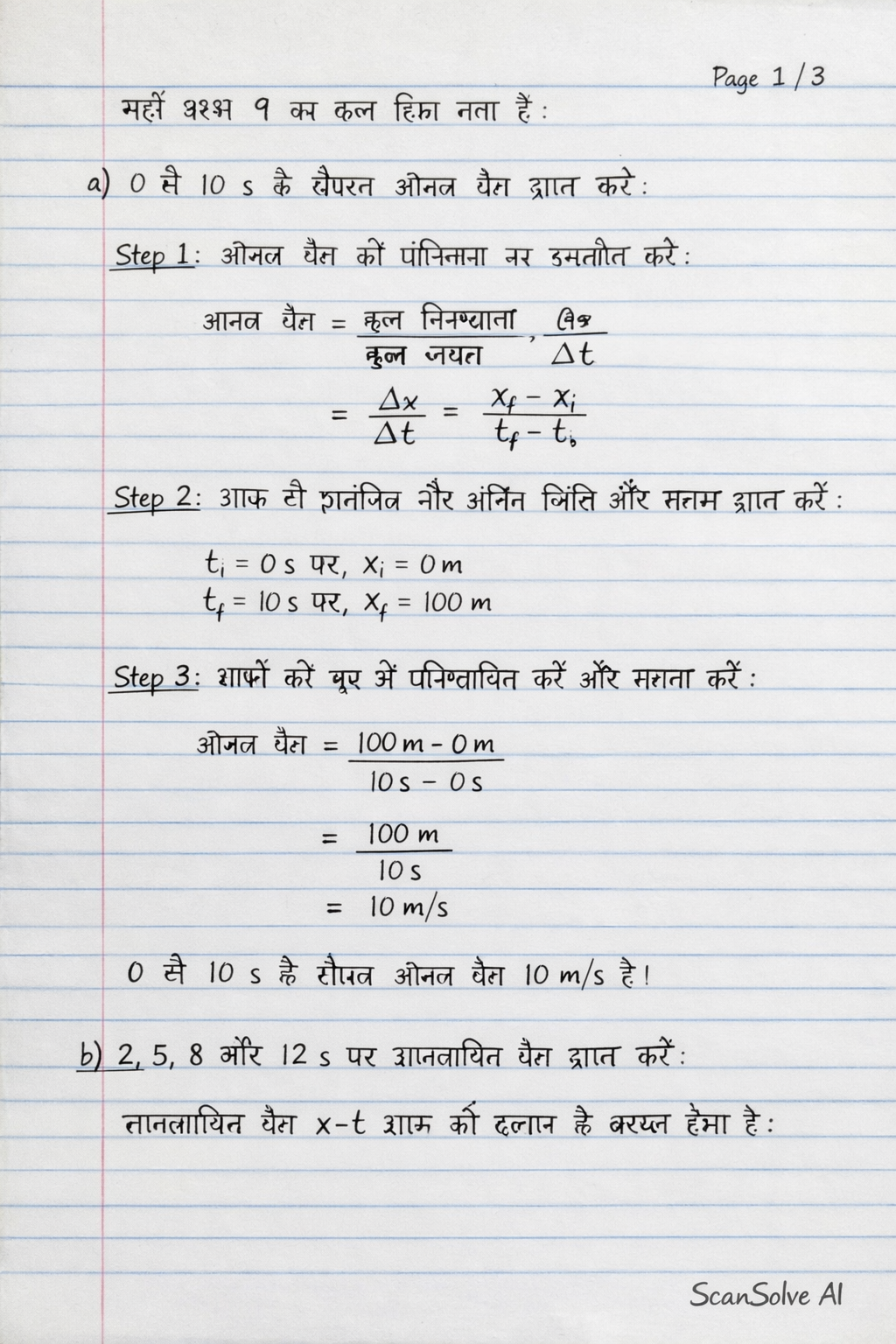
यहाँ प्रश्न 9 का हल दिया गया है:

a) 0 से 10 s के दौरान औसत वेग ज्ञात करें।

  1. औसत वेग की परिभाषा का उपयोग करें।

    औसत वेग कुल विस्थापन को कुल समय से विभाजित करने पर प्राप्त होता है।

    औसत वेग=ΔxΔt=xf−xitf−ti\text{औसत वेग} = \frac{\Delta x}{\Delta t} = \frac{x_f - x_i}{t_f - t_i}
  2. ग्राफ से प्रारंभिक और अंतिम स्थिति और समय ज्ञात करें।

    ti=0 st_i = 0\, \text{s} पर, xi=0 mx_i = 0\, \text{m}
    tf=10 st_f = 10\, \text{s} पर, xf=100 mx_f = 100\, \text{m}

  3. मानों को सूत्र में प्रतिस्थापित करें और गणना करें।

    औसत वेग=100 m−0 m10 s−0 s=100 m10 s=10 m/s\text{औसत वेग} = \frac{100\, \text{m} - 0\, \text{m}}{10\, \text{s} - 0\, \text{s}} = \frac{100\, \text{m}}{10\, \text{s}} = 10\, \text{m/s}

    0 से 10 s के दौरान औसत वेग 10 m/s है।

    b) 2, 5, 8 और 12 s पर तात्कालिक वेग ज्ञात करें।

    तात्कालिक वेग x-t ग्राफ की ढलान के बराबर होता है।

  4. t=2 st = 2\, \text{s} पर तात्कालिक वेग ज्ञात करें।

    यह बिंदु t=0 st = 0\, \text{s} से t=2.5 st = 2.5\, \text{s} तक के खंड पर स्थित है।
    इस खंड की ढलान है:

    v=50 m−0 m2.5 s−0 s=50 m2.5 s=20 m/sv = \frac{50\, \text{m} - 0\, \text{m}}{2.5\, \text{s} - 0\, \text{s}} = \frac{50\, \text{m}}{2.5\, \text{s}} = 20\, \text{m/s}

    t=2 st = 2\, \text{s} पर तात्कालिक वेग 20 m/s है।

  5. t=5 st = 5\, \text{s} पर तात्कालिक वेग ज्ञात करें।

    यह बिंदु t=2.5 st = 2.5\, \text{s} से t=7.5 st = 7.5\, \text{s} तक के खंड पर स्थित है, जहाँ स्थिति स्थिर है (x=50 mx = 50\, \text{m})।
    इस खंड की ढलान है:

    v=50 m−50 m7.5 s−2.5 s=0 m5 s=0 m/sv = \frac{50\, \text{m} - 50\, \text{m}}{7.5\, \text{s} - 2.5\, \text{s}} = \frac{0\, \text{m}}{5\, \text{s}} = 0\, \text{m/s}

    t=5 st = 5\, \text{s} पर तात्कालिक वेग 0 m/s है।

  6. t=8 st = 8\, \text{s} पर तात्कालिक वेग ज्ञात करें।

    यह बिंदु t=7.5 st = 7.5\, \text{s} से t=10.0 st = 10.0\, \text{s} तक के खंड पर स्थित है।
    इस खंड की ढलान है:

    v=100 m−50 m10.0 s−7.5 s=50 m2.5 s=20 m/sv = \frac{100\, \text{m} - 50\, \text{m}}{10.0\, \text{s} - 7.5\, \text{s}} = \frac{50\, \text{m}}{2.5\, \text{s}} = 20\, \text{m/s}

    t=8 st = 8\, \text{s} पर तात्कालिक वेग 20 m/s है।

  7. t=12 st = 12\, \text{s} पर तात्कालिक वेग ज्ञात करें।

    यह बिंदु t=10.0 st = 10.0\, \text{s} से t=15.0 st = 15.0\, \text{s} तक के खंड पर स्थित है।
    इस खंड की ढलान है:

    v=0 m−100 m15.0 s−10.0 s=−100 m5.0 s=−20 m/sv = \frac{0\, \text{m} - 100\, \text{m}}{15.0\, \text{s} - 10.0\, \text{s}} = \frac{-100\, \text{m}}{5.0\, \text{s}} = -20\, \text{m/s}

    t=12 st = 12\, \text{s} पर तात्कालिक वेग -20 m/s है।

    अंतिम उत्तर:

    a) 0 से 10 s के दौरान औसत वेग: 10 m/s\boxed{10\, \text{m/s}}

    b) तात्कालिक वेग:
    t=2 st = 2\, \text{s} पर: 20 m/s\boxed{20\, \text{m/s}}
    t=5 st = 5\, \text{s} पर: 0 m/s\boxed{0\, \text{m/s}}
    t=8 st = 8\, \text{s} पर: 20 m/s\boxed{20\, \text{m/s}}
    t=12 st = 12\, \text{s} पर: −20 m/s\boxed{-20\, \text{m/s}}

Was this helpful?

Still stuck on this one?

Ask a follow-up, and the answer starts from this question.

Got a different question?Ask your own question
Handwritten step-by-step solution preview

Handwritten Step-by-Step Solution

Get this as a handwritten image on WhatsApp — like a tutor wrote it for you.

Try on WhatsApp