
We read your photo as:
Given the circuit below. What is the potential difference between point P and the ground?
ScanSolve AI Answer
Answers
4 partsStep-by-step solution
15 stepsHere are the solutions to the questions you sent.
Part 8· 3 steps
Given the circuit below, we need to find the potential difference between point P and the ground.
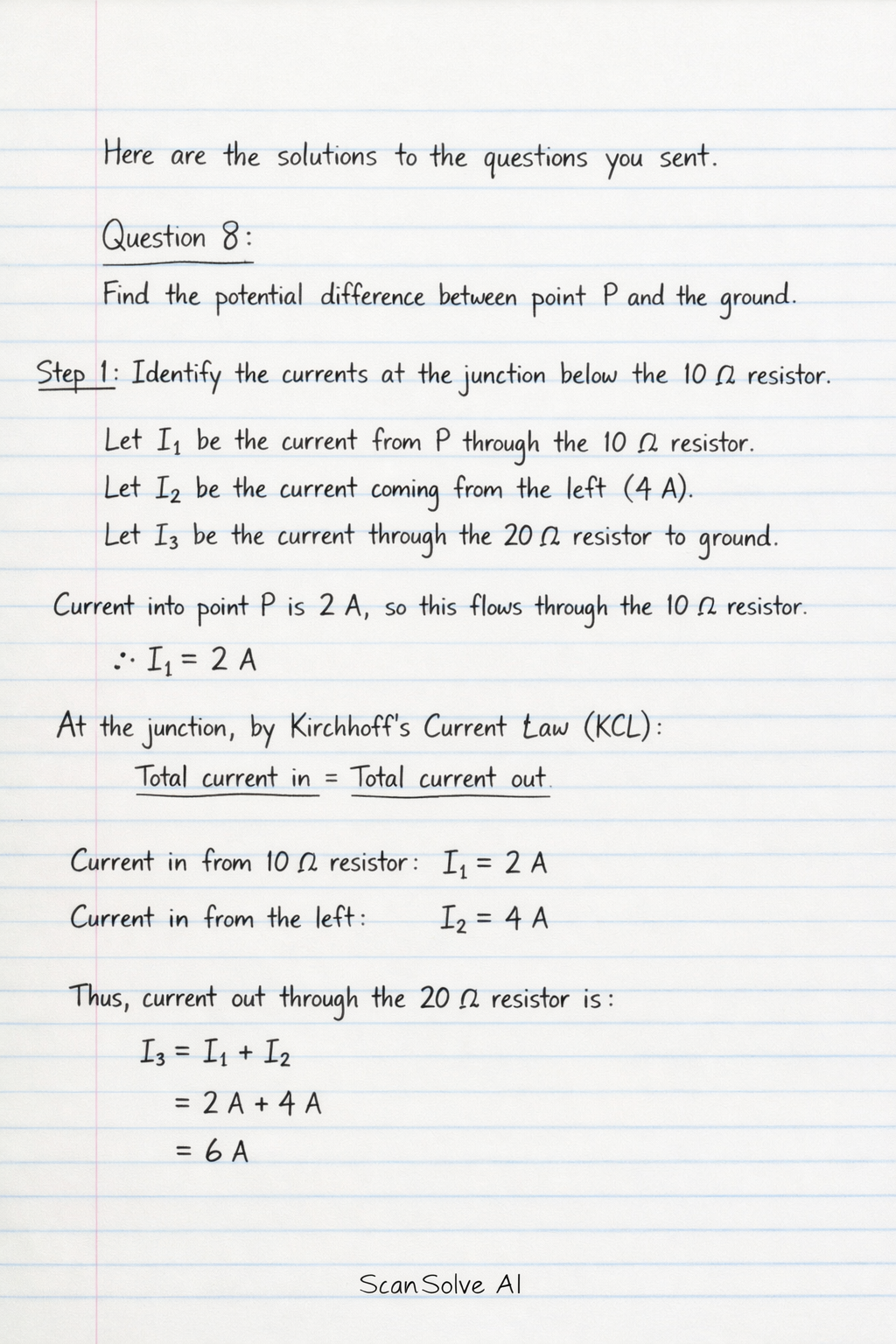
Identify the currents at the junction below the resistor.
Let be the current flowing from P through the resistor.
Let be the current flowing into the junction from the left ().
Let be the current flowing through the resistor to the ground.
According to the diagram, the current flowing into point P is . This current then flows through the resistor. So, .
At the junction, by Kirchhoff's Current Law (KCL), the sum of currents entering the junction equals the sum of currents leaving it.
Current entering the junction from the resistor is .
Current entering the junction from the left is .
So, the total current leaving the junction through the resistor is .Calculate the potential at the junction (let's call it point J).
The resistor is connected between the junction J and the ground ().
Using Ohm's Law, .Calculate the potential at point P.
Point P is connected to the junction J through the resistor. The current flows from P to J.
So, the potential at P is higher than the potential at J by the voltage drop across the resistor.The correct answer is .
Part 9
Charged plates X and Y have a potential difference of between them. Plate X is at and plate Y is at . We need to find which particle gains of kinetic energy when moving from X to Y.
Determine the change in potential.
The potential difference from X to Y is .
Relate kinetic energy gain to potential energy loss.
When a charged particle moves in an electric field, the gain in kinetic energy () is equal to the negative of the change in potential energy ().
The change in potential energy is given by , where is the charge of the particle.
So, .Substitute the given values and solve for the charge .
We are given and .
To find in terms of elementary charge , we can divide both sides by :
Identify the particle with charge .
- A proton has a charge of .
- A positron has a charge of .
- An electron has a charge of .
- An alpha particle (helium nucleus) has a charge of . None of the standard particles listed have a charge of . However, if the question implies a particle that loses of potential energy, then it would gain of kinetic energy. Let's re-evaluate the sign. If a particle gains kinetic energy, its potential energy must decrease. So, . Then . . . This still indicates a particle with charge . This is not a common fundamental particle.
Let's consider if the question meant a particle that loses of kinetic energy, or if there's a typo in the options or the question.
If the particle was an electron (charge ), .
If the particle was a proton (charge ), (meaning it loses kinetic energy).
If the particle was an alpha particle (charge ), (meaning it loses of kinetic energy).The question states "gains of kinetic energy". This means .
Our calculation consistently gives . Since this is not an option, there might be a misunderstanding of the question or a typo.
However, if the question meant "Which particle loses of kinetic energy" or "Which particle gains of potential energy", then an alpha particle would fit.
Given the options, and the commonality of such problems, it's possible the question intended to ask for a particle that loses of kinetic energy when moving from X to Y, or gains of kinetic energy when moving from Y to X.
If it moves from Y to X, .
Then .
If , then , which means .
An alpha particle has a charge of . This would make sense if the direction of motion was Y to X.Assuming the question implies a standard particle and a common scenario, and given the options, the most plausible interpretation is that an alpha particle would gain of kinetic energy if it moved from Y to X. However, the question explicitly states "moving from X to Y".
If we strictly follow "moving from X to Y" and "gains of kinetic energy", then the charge must be . Since this is not an option, there is an inconsistency.Let's consider the possibility that the question meant "Which particle loses of kinetic energy when moving from X to Y?".
If , then , which means . This would be an alpha particle.
This is a common type of error in multiple-choice questions. Given the options, an alpha particle is the only one that relates to with a potential difference.The most likely intended answer, assuming a slight misphrasing of the question, is an alpha particle.
The correct answer is .
Part 10
Two charges and are separated by a distance of in a vacuum. We need to find how far from the charge the electric potential will be zero.
Set up the problem.
Let and .
The separation distance is .
Let the charge be at the origin (). Then the charge is at .
The electric potential at a point due to these two charges is given by:where is Coulomb's constant, is the distance from , and is the distance from . We want to find such that .
Consider the region between the charges ().
In this region, and .
Substitute the charge values (we can ignore the and as they cancel out):
Cross-multiply:
This point is between the charges and is option (a).
Consider the region outside the charges.
Since the charges have opposite signs and different magnitudes, there will also be a point outside the charges where the potential is zero. This point will be closer to the charge with the smaller magnitude. In this case, , so the point will be to the left of .
Let the distance from be . So the coordinate of this point is .
The distance from is . The distance from is .Substitute the charge values:
Cross-multiply:
This point is to the left of and is option (b).
Both and are valid distances from the charge where the electric potential is zero. Since the question asks "How far from the will the electric potential be zero?" without specifying which point, and both are options, we typically choose the one that is usually considered in introductory problems or the one that is "between" the charges if it exists. In this case, is between the charges.
The correct answer is .
Part 113E
A uniform wire is stretched by a load . The elastic energy stored in the wire is . The load is increased from to . If the wire obeys Hooke's Law, we need to find the increase in elastic energy.
Recall Hooke's Law and the formula for elastic potential energy.
Hooke's Law states that the force applied to a spring or wire is proportional to its extension :
where is the spring constant (stiffness).
The elastic potential energy stored in the wire is given by:Express energy in terms of force.
From Hooke's Law, . Substitute this into the energy formula:
Calculate the initial elastic energy ().
When the load is , the initial elastic energy is:
We are given that this initial energy is . So, .
Calculate the final elastic energy ().
When the load is increased to , the final elastic energy is:
Since , we have:
Calculate the increase in elastic energy.
The increase in elastic energy is .
The correct answer is .
Try one yourself
A new problem that tests the same skill.
Still stuck on this one?
Ask a follow-up, and the answer starts from this question.
More Physics Questions
Handwritten Step-by-Step Solution
Get this as a handwritten image on WhatsApp — like a tutor wrote it for you.
Try on WhatsApp