
We read your photo as:
Here are the solutions to your questions: b) The following results were obtained in an experiment to verify Hooke's law when a spring was extended by hanging various loads on it. (I) Complete the tabl
Physics
ScanSolve AI Answer
Step-by-step solution
4 stepsHere are the solutions to your questions:
b) The following results were obtained in an experiment to verify Hooke's law when a spring was extended by hanging various loads on it.
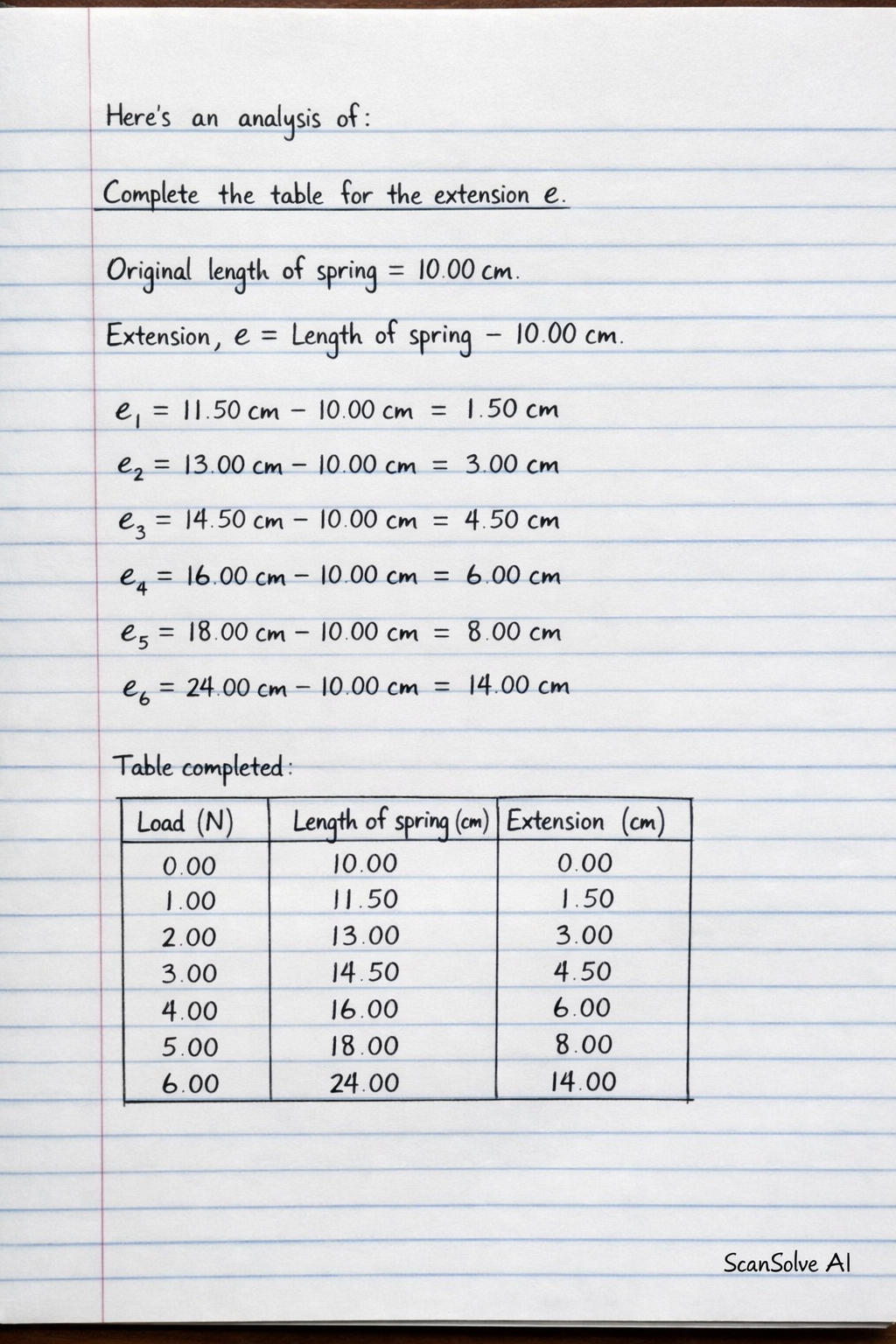
- (I) Complete the table for the extension e above. The original length of the spring (when Load = 0.00 N) is . Extension is calculated as .
| Load (N) | Length of spring in cm | Extension (cm) |
|---|---|---|
| 0.00 | 10.00 | 0.00 |
| 1.00 | 11.50 | 1.50 |
| 2.00 | 13.00 | 3.00 |
| 3.00 | 14.50 | 4.50 |
| 4.00 | 16.00 | 6.00 |
| 5.00 | 18.00 | 8.00 |
| 6.00 | 24.00 | 14.00 |
-
(II) Plot a graph of load (y-axis) against extension. To plot the graph:
- Draw a horizontal axis (x-axis) for Extension (cm) and a vertical axis (y-axis) for Load (N).
- Choose appropriate scales for both axes to accommodate the data. For extension, values range from 0.00 cm to 14.00 cm. For load, values range from 0.00 N to 6.00 N.
- Plot the points from the completed table: (0.00, 0.00), (1.50, 1.00), (3.00, 2.00), (4.50, 3.00), (6.00, 4.00), (8.00, 5.00), (14.00, 6.00).
- Draw the best-fit line through the points. You will observe a straight line passing through the origin for the first few points (up to 4.00 N load), indicating Hooke's Law is obeyed. Beyond this point, the graph will curve, showing that the elastic limit has been exceeded.
-
(III) From the graph determine the spring constant. The spring constant is the gradient of the linear portion of the Load-Extension graph (). We use the data points within the elastic limit (e.g., up to Load = 4.00 N).
Choose two points from the linear region of the graph.
Let's use $(e_1, F_1) = (0.00 \text{ cm}, 0.00 \text{ N})$ and $(e_2, F_2) = (6.00 \text{ cm}, 4.00 \text{ N})$.Calculate the gradient.
$$ k = \frac{F_2 - F_1}{e_2 - e_1} $$ $$ k = \frac{4.00 \text{ N} - 0.00 \text{ N}}{6.00 \text{ cm} - 0.00 \text{ cm}} $$ $$ k = \frac{4.00 \text{ N}}{6.00 \text{ cm}} $$ $$ k = \frac{2}{3} \text{ N/cm} $$ To express in SI units (N/m): $$ k = \frac{2}{3} \text{ N/cm} \times \frac{100 \text{ cm}}{1 \text{ m}} $$ $$ k = \frac{200}{3} \text{ N/m} \approx 66.67 \text{ N/m} $$ The spring constant is $\boxed{66.67 \text{ N/m}}$.- (IV) Calculate the energy stored when the spring is stretched to 16 cm. Assuming "stretched to 16 cm" refers to the total length of the spring.
Determine the extension.
Original length, $L_0 = 10.00 \text{ cm}$ Final length, $L = 16.00 \text{ cm}$ Extension, $e = L - L_0 = 16.00 \text{ cm} - 10.00 \text{ cm} = 6.00 \text{ cm}$. Convert extension to meters: $e = 6.00 \text{ cm} = 0.06 \text{ m}$.Use the formula for elastic potential energy stored in a spring.
$$
E_p = \frac{1}{2}ke^2
$$
Using $k = \frac{200}{3} \text{ N/m}$ and $e = 0.06 \text{ m}$.
$$
E_p = \frac{1}{2} \left(\frac{200}{3} \text{ N/m}\right) (0.06 \text{ m})^2
$$
$$
E_p = \frac{1}{2} \left(\frac{200}{3}\right) (0.0036)
$$
$$
E_p = \frac{100}{3} \times 0.0036
$$
$$
E_p = 100 \times 0.0012
$$
$$
E_p = 0.12 \text{ J}
$$
The energy stored when the spring is stretched to 16 cm is $\boxed{0.12 \text{ J}}$.
Was this helpful?
Still stuck on this one?
Ask a follow-up, and the answer starts from this question.
Got a different question?Ask your own question
More Physics Questions
QA student hangs different loads on a spring as shown. a) Determine the spring constant of the…QPart b) Name three examples of simple harmonic motion. State Hooke's Law and calculate the length of…QThe setup below was used during the experiment. a. Describe the experimental procedure used to…QA) Hooke's Law states that the extension of a spring is directly proportional to the force applied…QWhen the load shown in the figure is hung from the spring, it stretches. The spring is an elastic…
Handwritten Step-by-Step Solution
Get this as a handwritten image on WhatsApp — like a tutor wrote it for you.
Try on WhatsApp