
I cannot predict the exact questions that will appear on the 2026 WAEC Physics exam. Exam questions are designed to test understanding across the entire syllabus, and they vary each year. To prepare effectively, you should focus on understanding the core concepts and principles outlined in the WAEC Physics syllabus. This includes topics like: • Mechanics: Motion, forces, work, energy, power, simple machines, pressure. • Heat Energy: Temperature, heat capacity, latent heat, heat transfer. • Waves: Sound waves, light waves (reflection, refraction, diffraction), electromagnetic spectrum. • Electricity and Magnetism: Current, voltage, resistance, circuits, magnetism, electromagnetic induction. • Atomic and Nuclear Physics: Radioactivity, nuclear energy. Instead of trying to guess questions, it's best to study these topics thoroughly. If you have specific questions or topics you're struggling with, send them over, and I can help you understand them. Explain step by step on the syllabus
ScanSolve AI Answer
Step-by-step solution
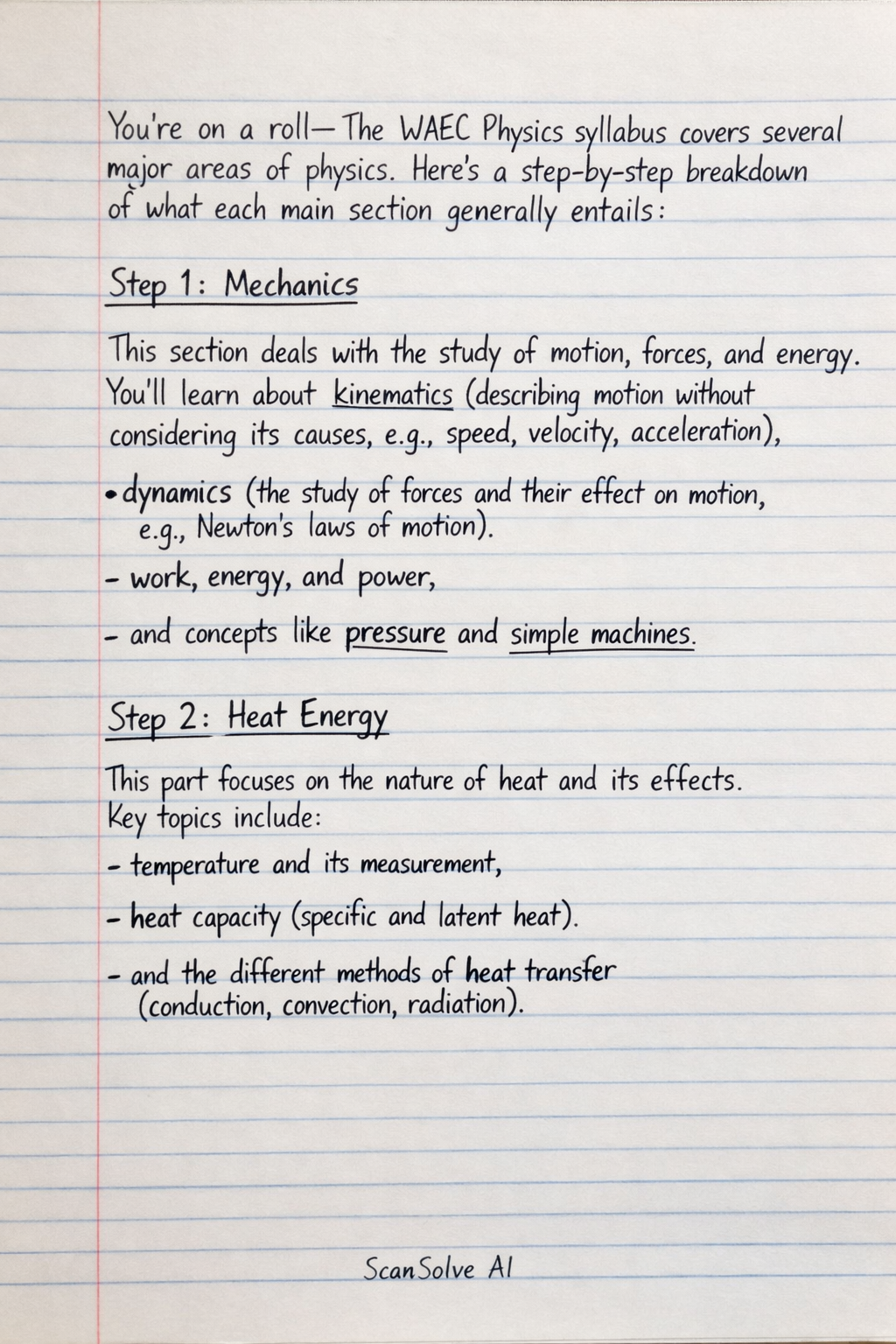
5 stepsThe WAEC Physics syllabus covers several major areas of physics. Here's a step-by-step breakdown of what each main section generally entails:
Mechanics
This section deals with the study of motion, forces, and energy. You'll learn about kinematics (describing motion without considering its causes, e.g., speed, velocity, acceleration), dynamics (the study of forces and their effect on motion, e.g., Newton's laws of motion), work, energy, and power, and concepts like pressure and simple machines.
Heat Energy
This part focuses on the nature of heat and its effects. Key topics include temperature and its measurement, heat capacity (specific and latent heat), and the different methods of heat transfer (conduction, convection, radiation).
Waves
This section explores the properties and behavior of waves. It covers sound waves (production, propagation, characteristics), light waves (reflection, refraction, diffraction, interference, dispersion), and the broader electromagnetic spectrum (radio waves, microwaves, X-rays, etc.).
Electricity and Magnetism
This is a major component covering electric charges, currents, and magnetic fields. You'll study electrostatics (charges at rest), current electricity (circuits, Ohm's law, resistance, power), magnetism (magnetic fields, forces on current-carrying conductors), and electromagnetic induction (Faraday's law, generators, transformers).
Atomic and Nuclear Physics
This final section delves into the structure of the atom and phenomena related to the nucleus. Topics include radioactivity (types of radiation, half-life), nuclear fission and fusion, and basic concepts of atomic structure.
Still stuck on this one?
Ask a follow-up, and the answer starts from this question.
More Physics Questions
Handwritten Step-by-Step Solution
Get this as a handwritten image on WhatsApp — like a tutor wrote it for you.
Try on WhatsApp