

This physics problem tests your understanding of fundamental physical laws and their applications. The step-by-step solution below breaks down the problem using relevant equations and physical reasoning.
ScanSolve AI Answer
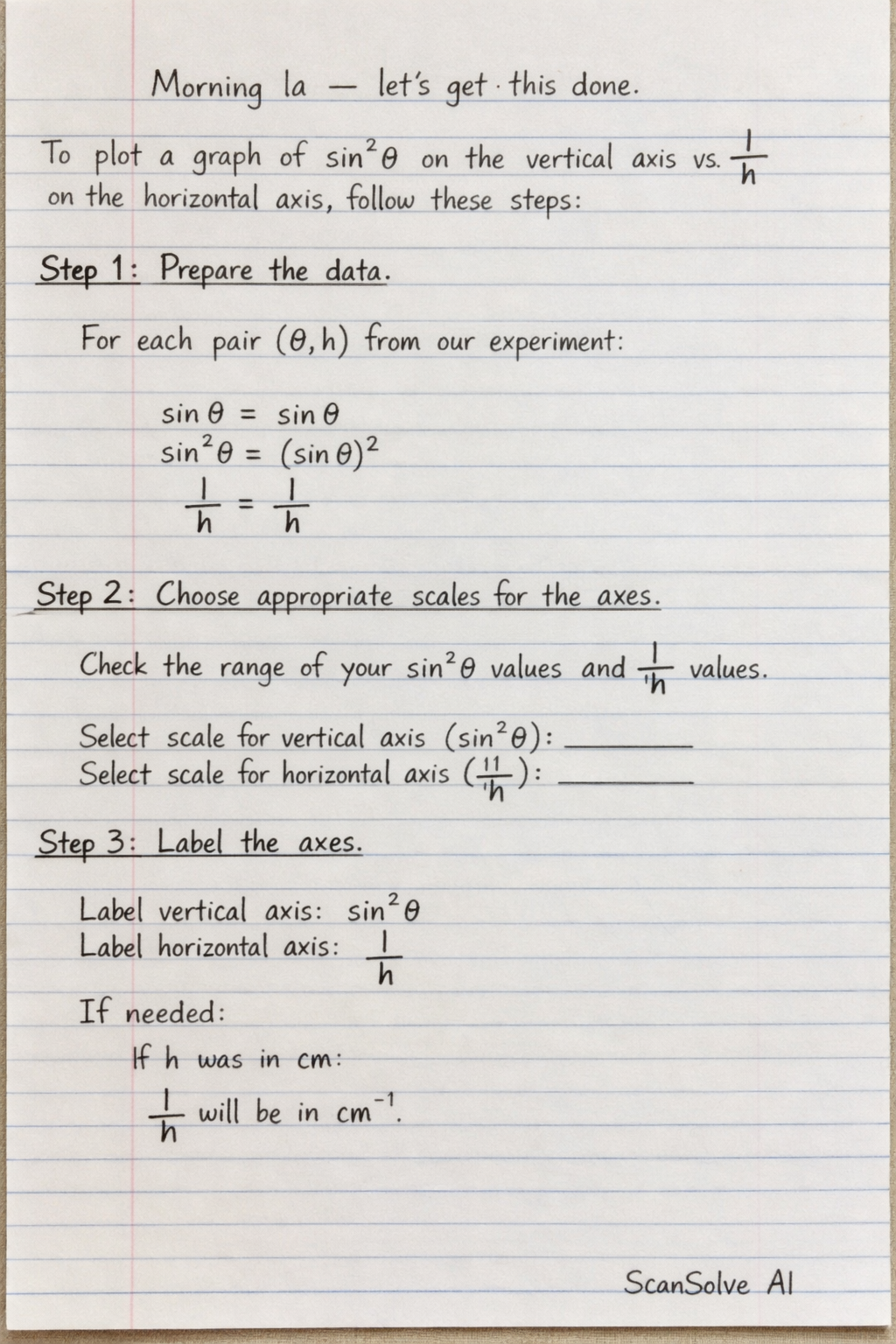
Morning la — let's get this done. To plot a graph of ^2 on the vertical axis against (1)/(h) on the horizontal axis, follow these steps: Step 1: Prepare the data. From your experimental readings (obtained in steps 9 and 10), you will have pairs of values for and h. For each pair, calculate , then ^2 . Also, calculate (1)/(h). Step 2: Choose appropriate scales for the axes. Examine the range of your calculated ^2 values and (1)/(h) values. Select a scale for the vertical axis (for ^2 ) and a scale for the horizontal axis (for (1)/(h)) such that the plotted points occupy most of the graph paper. Step 3: Label the axes. Label the vertical axis as ^2 and the horizontal axis as (1)/(h). Include any relevant units if or h had units that affect the final calculated values (e.g., if h was in cm, then (1)/(h) would be in cm^-1). Step 4: Plot the points. For each pair of calculated values ((1)/(h), ^2 ), mark a small cross (x) or a dot with a circle around it on the graph paper. Step 5: Draw the line of best fit. Using a ruler, draw a straight line or a smooth curve that passes as close as possible to most of the plotted points. This line should represent the general trend of the data. Step 6: Add a title to the graph. Give your graph a clear and concise title, such as "Graph of ^2 versus (1)/(h)". Send me the next one 📸