
We read your photo as:
State I. the two characteristics of oscillatory motion. II. two examples of bodies exhibiting oscillatory motion. A body of mass 0.5 kg is suspended vertically on a spiral spring. If the extension produced is 0.2 m, calculate the force constant of the spring.
Physics
ScanSolve AI Answer
Step-by-step solution
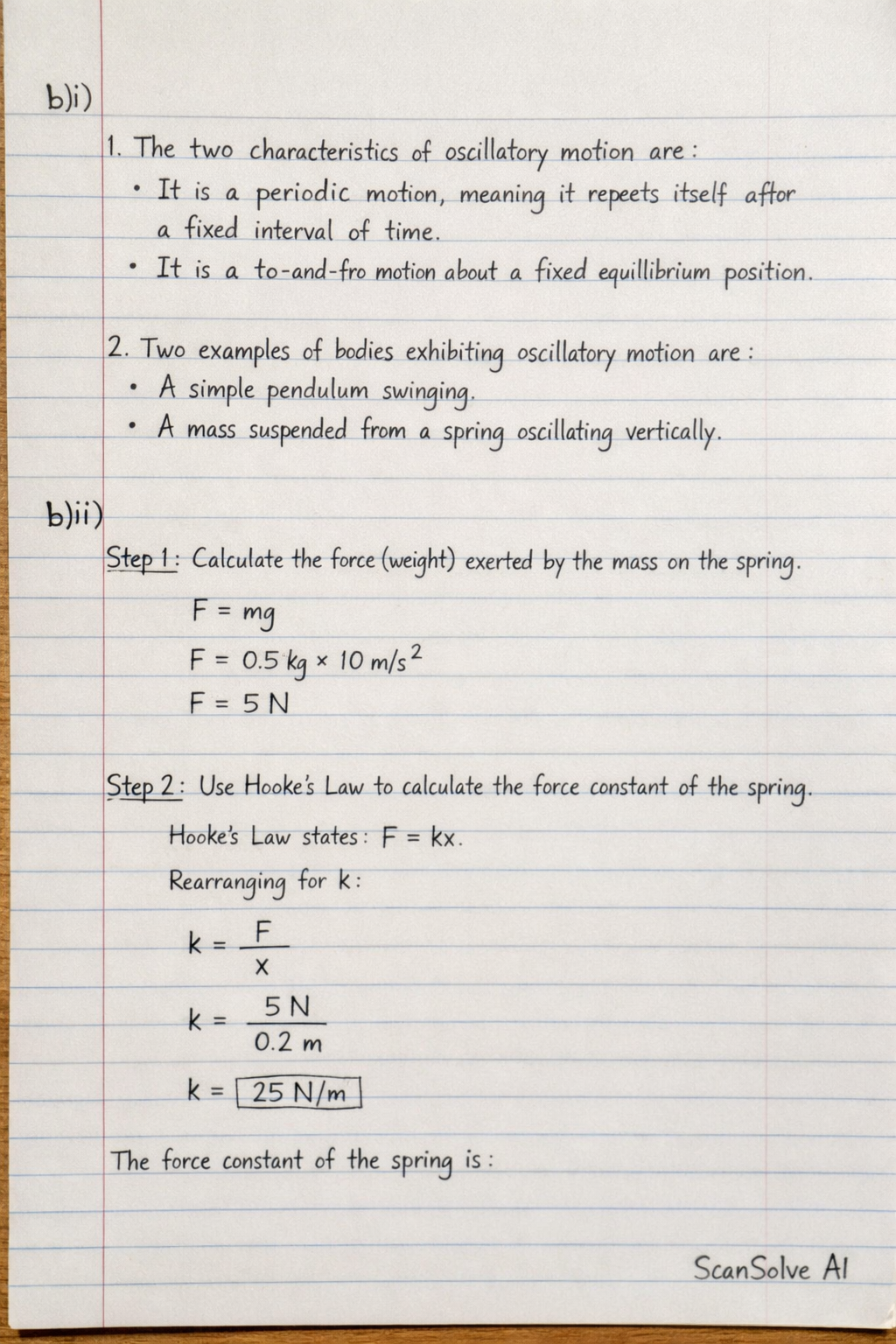
2 stepsb)i)
I. The two characteristics of oscillatory motion are:
- It is a periodic motion, meaning it repeats itself after a fixed interval of time.
- It is a to-and-fro motion about a fixed equilibrium position.
II. Two examples of bodies exhibiting oscillatory motion are:
- A simple pendulum swinging.
- A mass suspended from a spring oscillating vertically.
b)ii)
Calculate the force (weight) exerted by the mass on the spring.
The force is equal to the weight of the mass, which is given by .
Use Hooke's Law to calculate the force constant of the spring.
Hooke's Law states , where is the force, is the force constant, and is the extension.
Rearranging for :Substitute the values:
The force constant of the spring is:
Was this helpful?
Still stuck on this one?
Ask a follow-up, and the answer starts from this question.
Got a different question?Ask your own question
More Physics Questions
QDescribe simple examples of free oscillations such as the simple pendulum, spring-mass system and…Q1 A certain mass is attached to a mass of 0.500kg. If it has a spring constant of 25.0 N/m and…QDefine Simple Harmonic Motion. Give four examples of systems that undergo SHM. A 10kg mass attached…QWhat is oscillatory motionQPart b) Name three examples of simple harmonic motion. State Hooke's Law and calculate the length of…
Browse by topic:Mechanics
Handwritten Step-by-Step Solution
Get this as a handwritten image on WhatsApp — like a tutor wrote it for you.
Try on WhatsApp