
We read your photo as:
I) Two equal forces acting on a stationary object in opposite directions result in a net force of zero. According to Newton's First Law, an object at rest will remain at rest if the net force acting
ScanSolve AI Answer
Answer
Step-by-step solution
3 stepsHere are the solutions to the questions:
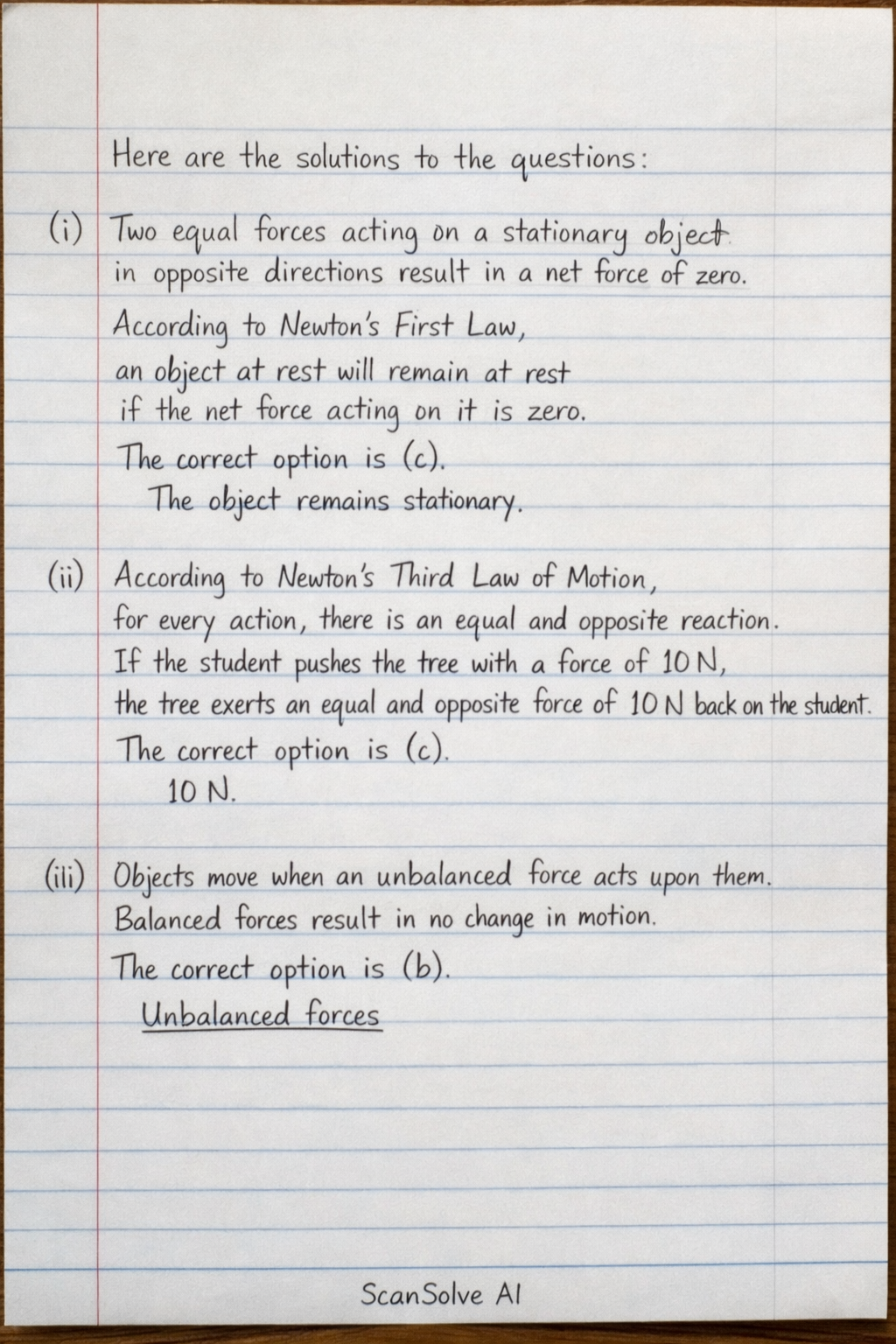
i) Two equal forces acting on a stationary object in opposite directions result in a net force of zero. According to Newton's First Law, an object at rest will remain at rest if the net force acting on it is zero.
The correct option is (c).
The object remains stationary.
ii) According to Newton's Third Law of Motion, for every action, there is an equal and opposite reaction. If the student pushes the tree with a force of 10 N, the tree exerts an equal and opposite force of 10 N back on the student.
The correct option is (c).
10 N
Part iii
Objects move when an unbalanced force acts upon them. Balanced forces result in no change in motion.
The correct option is (b).
Unbalanced forces
iv) The pressure at the bottom of a liquid tank is given by the formula , where is the density of the liquid (nature of the liquid), is the acceleration due to gravity, and is the height of the liquid column. This formula shows that pressure does not depend on the area of the bottom surface.
The correct option is (a).
area of the bottom surface
Part v
The SI unit of pressure is the Pascal (Pa), which is equivalent to one Newton per square meter ().
The correct option is (c).
pascal
Part vi
Pressure is defined as force per unit area (). If the same amount of force () is applied, a smaller area () will result in a higher pressure ().
The correct option is (c).
high pressure on small area
Part vii· 3 steps
Step 1: Identify the given values for force and area.
Use the formula for pressure, .
Calculate the pressure.
Convert Pascals to kilopascals (1 kPa = 1000 Pa).
The correct option is (b).
Part viii
Atmospheric pressure decreases with increasing altitude because there is less air above you. Hills are at a higher altitude than sea level, so people on hills experience less atmospheric pressure.
The correct option is (b).
less than that at the sea level
Part ix
As altitude increases (going up in the air), the column of air above decreases, leading to a decrease in atmospheric pressure.
The correct option is (b).
atmospheric pressure decreases
Try one yourself
A new problem that tests the same skill.
Still stuck on this one?
Ask a follow-up, and the answer starts from this question.
More Physics Questions
Handwritten Step-by-Step Solution
Get this as a handwritten image on WhatsApp — like a tutor wrote it for you.
Try on WhatsApp