This physics problem tests your understanding of fundamental physical laws and their applications. The step-by-step solution below breaks down the problem using relevant equations and physical reasoning.
ScanSolve AI Answer
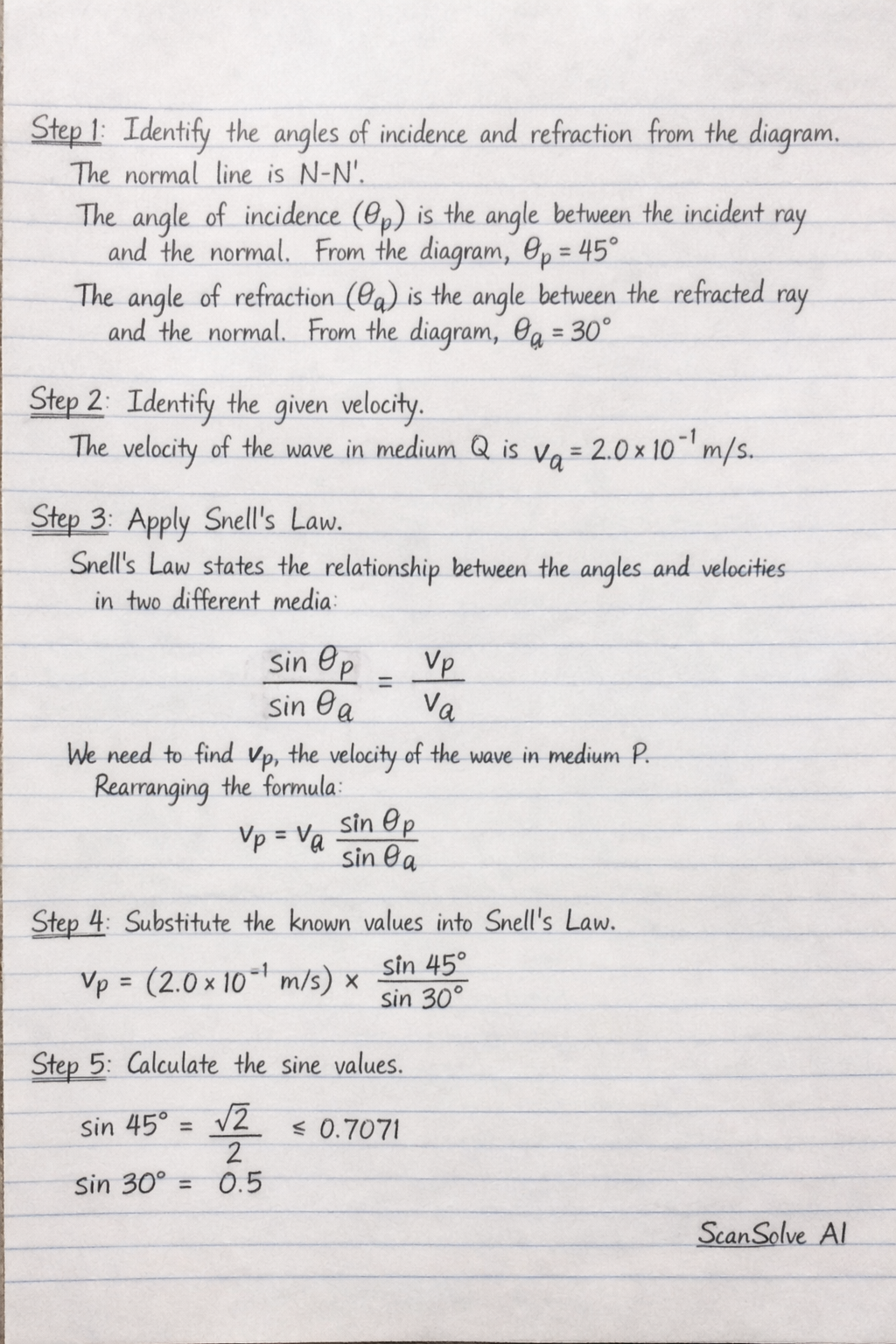
Step 1: Identify the angles of incidence and refraction from the diagram.
The normal line is N-N'.
The angle of incidence ($\theta_P$) is the angle between the incident ray (in medium P) and the normal. From the diagram, $\theta_P = 45^\circ$.
The angle of refraction ($\theta_Q$) is the angle between the refracted ray (in medium Q) and the normal. From the diagram, $\theta_Q = 30^\circ$.
Step 2: Identify the given velocity.
The velocity of the wave in medium Q is $v_Q = 2.0 \times 10^{-1} \text{ m s}^{-1}$.
Step 3: Apply Snell's Law.
Snell's Law states the relationship between the angles and velocities in two different media:
$$\frac{\sin \theta_P}{\sin \theta_Q} = \frac{v_P}{v_Q}$$
We need to find $v_P$, the velocity of the wave in medium P. Rearranging the formula:
$$v_P = v_Q \frac{\sin \theta_P}{\sin \theta_Q}$$
Step 4: Substitute the known values into Snell's Law.
$$v_P = (2.0 \times 10^{-1} \text{ m s}^{-1}) \times \frac{\sin 45^\circ}{\sin 30^\circ}$$
Step 5: Calculate the sine values.
$$\sin 45^\circ = \frac{\sqrt{2}}{2} \approx 0.7071$$
$$\sin 30^\circ = 0.5$$
Step 6: Perform the calculation.
$$v_P = (2.0 \times 10^{-1}) \times \frac{0.7071}{0.5}$$
$$v_P = (0.2) \times 1.4142$$
$$v_P = 0.28284 \text{ m s}^{-1}$$
Step 7: Express the answer in scientific notation and compare with the given options.
$$v_P \approx 2.8 \times 10^{-1} \text{ m s}^{-1}$$
This matches option D.
The final answer is $\boxed{\text{D: } 2.8 \times 10^{-1} \text{ m s}^{-1}}$.
Identify the angles of incidence and refraction from the diagram.
|Physics
Identify the angles of incidence and refraction from the diagram.
ScanSolve AI Answer
Step 1: Identify the angles of incidence and refraction from the diagram.
The normal line is N-N'.
The angle of incidence (θP) is the angle between the incident ray (in medium P) and the normal. From the diagram, θP=45∘.
The angle of refraction (θQ) is the angle between the refracted ray (in medium Q) and the normal. From the diagram, θQ=30∘.
Step 2: Identify the given velocity.
The velocity of the wave in medium Q is vQ=2.0×10⁻¹ms−1.
Step 3: Apply Snell's Law.
Snell's Law states the relationship between the angles and velocities in two different media:
sinθQsinθP=vQvP
We need to find vP, the velocity of the wave in medium P. Rearranging the formula:
vP=vQsinθQsinθP
Step 4: Substitute the known values into Snell's Law.
vP=(2.0×10⁻¹ms−1)×sin30∘sin45∘
Step 5: Calculate the sine values.
sin45∘=22≈0.7071sin30∘=0.5
Step 6: Perform the calculation.
vP=(2.0×10−1)×0.50.7071vP=(0.2)×1.4142vP=0.28284ms−1
Step 7: Express the answer in scientific notation and compare with the given options.
vP≈2.8×10⁻¹ms−1
This matches option D.
The final answer is D:2.8×10⁻¹ms−1.
Need help with your own homework?
Get instant step-by-step solutions to any question. Free to start.