
We read your photo as:
Identify the circuit configuration when K is closed.
ScanSolve AI Answer
Step-by-step solution
9 steps3. (c)
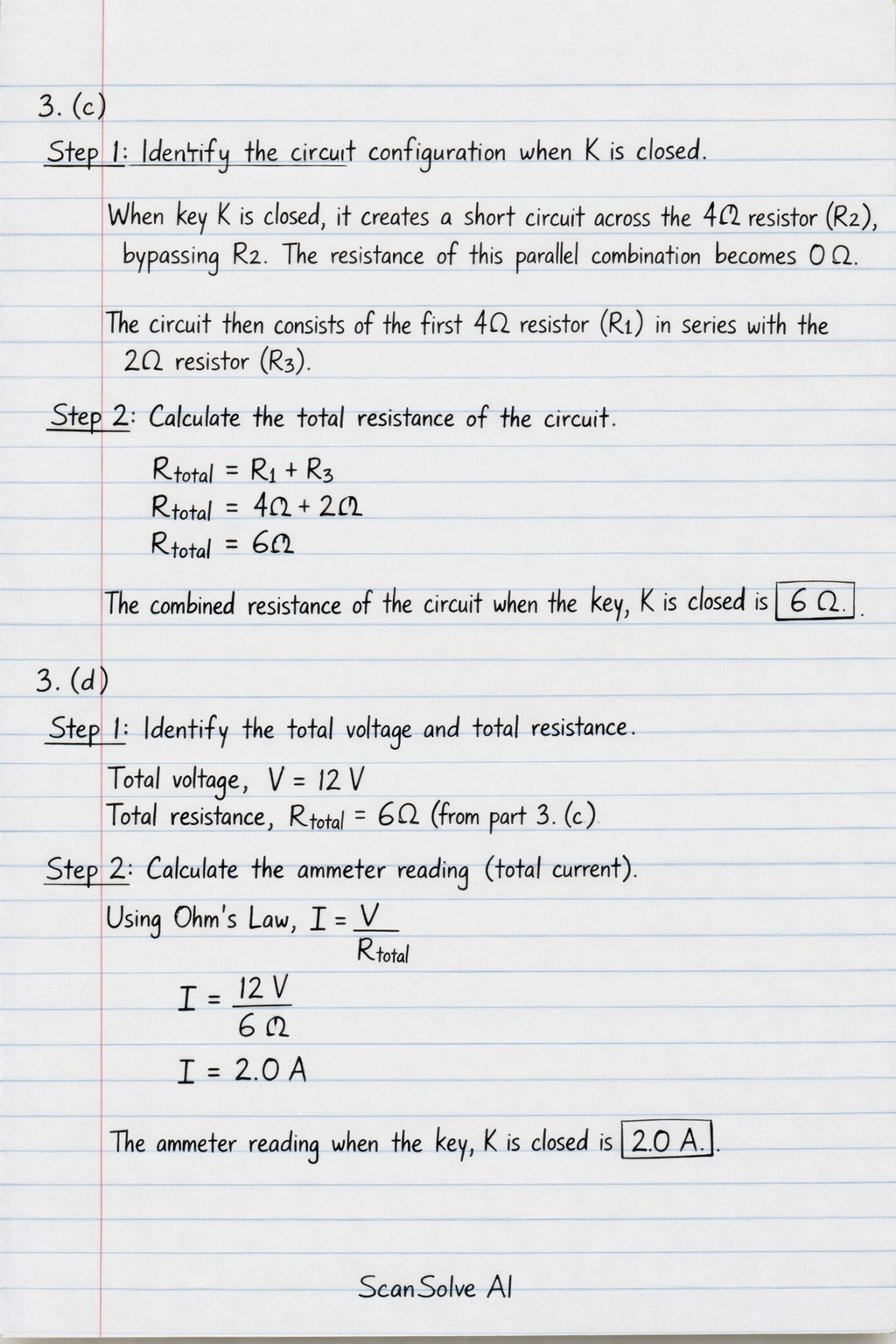
Identify the circuit configuration when K is closed.
When key K is closed, it creates a short circuit across the resistor (R2) that is in parallel with it. This means current will flow through the closed key K, effectively bypassing R2. The resistance of this parallel combination becomes .
The circuit then consists of the first resistor (R1) in series with the resistor (R3).Calculate the total resistance of the circuit.
The combined resistance of the circuit when the key, K is closed is .
3. (d)
Identify the total voltage and total resistance.
Total voltage,
Total resistance, (from part 3. (c))Calculate the ammeter reading (total current).
Using Ohm's Law, .
The ammeter reading when the key, K is closed is .
3. (e)
i)
State the equivalence of 1 KWh in joules.
The equivalence of 1 KWh in joules is .
ii)
Calculate the total power consumption.
Power of electric cooker =
Power of immersion heater =
Total power,Convert total power to kilowatts.
Calculate the total energy consumed in KWh.
Time,
Energy consumed,Calculate the cost of electricity.
Cost per KWh =
Total cost = Energy consumed Cost per KWhThe cost of electricity used is .
4. (a)
i)
Two properties of plastics that make them useful as engineering materials are:- Lightweight: Plastics have a low density, making them suitable for applications where weight reduction is crucial, such as in aerospace and automotive industries.
- Corrosion resistance: Many plastics are highly resistant to chemical corrosion, making them ideal for pipes, containers, and components exposed to harsh environments.
ii)
- Thermoplastics: These plastics can be repeatedly softened by heating and hardened by cooling. Their polymer chains are held together by weak intermolecular forces, allowing them to be reshaped multiple times. Examples include polyethylene and PVC.
- Thermosetting plastics: These plastics undergo an irreversible chemical change when heated, forming a rigid, cross-linked structure. Once set, they cannot be softened or reshaped by further heating without degrading. Examples include epoxy resins and bakelite.
iii)
Thermoplastics can be recycled because their polymer chains are linear or branched and held together by relatively weak intermolecular forces. When heated, these forces weaken, allowing the material to melt and be reshaped without significant chemical degradation. Thermosetting plastics, however, form strong, permanent covalent cross-links between their polymer chains during curing. This rigid, three-dimensional network prevents them from melting or being reshaped upon heating; instead, they char or burn, making them difficult to recycle.
Still stuck on this one?
Ask a follow-up, and the answer starts from this question.
More Physics Questions
Handwritten Step-by-Step Solution
Get this as a handwritten image on WhatsApp — like a tutor wrote it for you.
Try on WhatsApp