
We read your photo as:
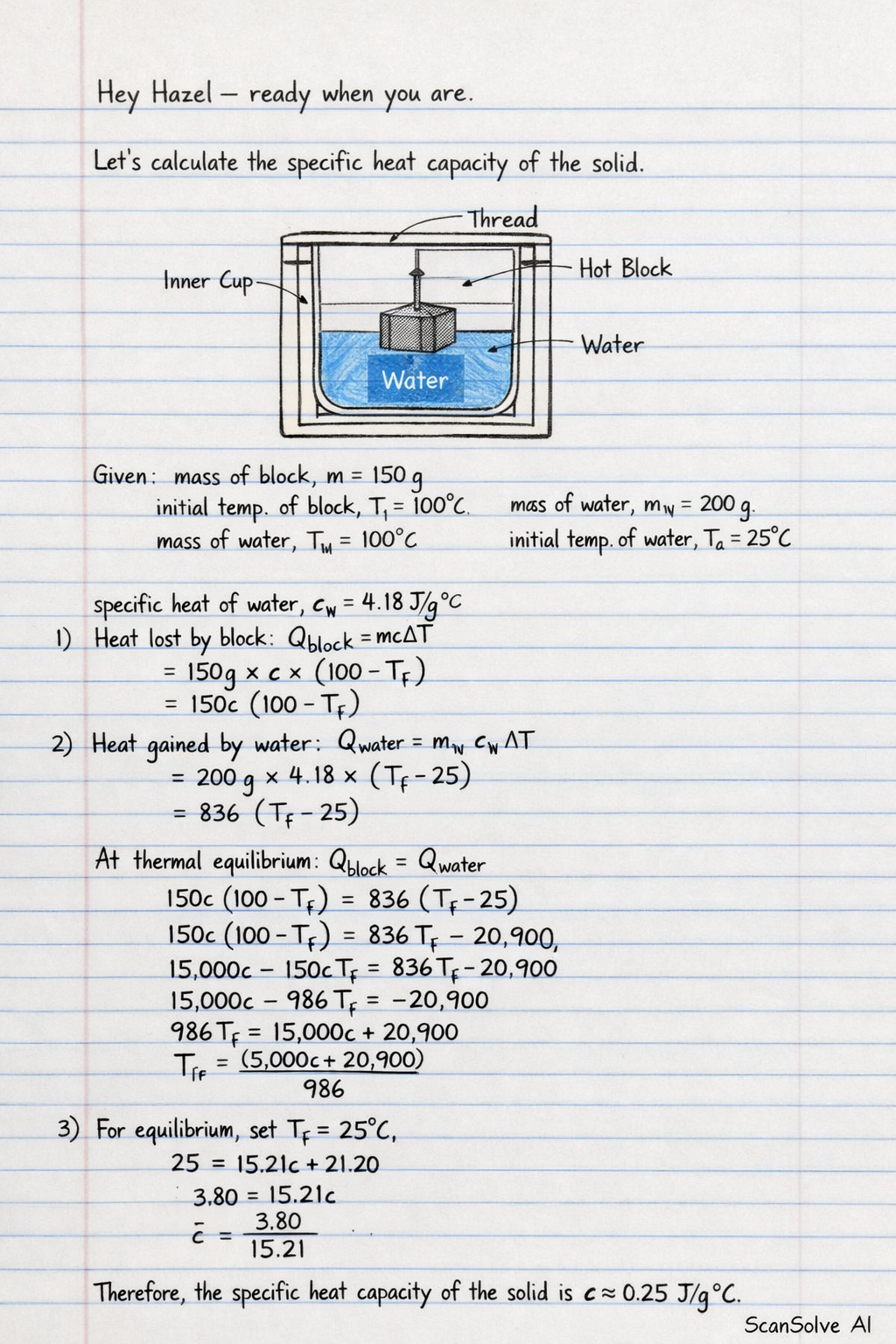
Illustrate the setup for determining the specific heat capacity of a solid by the method of mixtures.
Physics
ScanSolve AI Answer
Here is a diagram illustrating the setup for determining the specific heat capacity of a solid by the method of mixtures:
\begin{tikzpicture}[scale=0.8]
    % Calorimeter outer jacket
    \draw[thick] (-2, -3) rectangle (2, 2);
    \draw[thick] (-2.2, 2) -- (2.2, 2);
    \draw[thick] (-2.2, 2.2) -- (2.2, 2.2);
    \draw[thick] (-2.2, 2.2) -- (-2.2, 2);
    \draw[thick] (2.2, 2.2) -- (2.2, 2);

    % Calorimeter inner cup
    \draw[thick] (-1.5, -2.5) rectangle (1.5, 1.5);
    \draw[thick] (-1.7, 1.5) -- (1.7, 1.5);
    \draw[thick] (-1.7, 1.7) -- (1.7, 1.7);
    \draw[thick] (-1.7, 1.7) -- (-1.7, 1.5);
    \draw[thick] (1.7, 1.7) -- (1.7, 1.5);

    % Water
    \fill[blue!20] (-1.4, -2.4) rectangle (1.4, 0.5);
    \draw[thick, blue!50!black] (-1.4, 0.5) -- (1.4, 0.5);
    \node at (0, -1) {Water};

    % Metal block
    \draw[fill=gray!50, thick] (-0.5, -1.5) rectangle (0.5, -0.5);
    \node at (0, -1) {Block};

    % Thread
    \draw[thick] (0, 0.5) -- (0, 1.7);
    \draw[thick] (0, 1.7) -- (0.5, 2.2); % Thread held by hand/stand

    % Thermometer
    \draw[thick] (0.8, 0.5) -- (0.8, 3.5);
    \draw[fill=red!80] (0.8, 0.5) rectangle (1, 0.7);
    \draw[thick] (0.9, 0.7) -- (0.9, 3.5);
    \node[right] at (1.2, 2) {Thermometer};

    % Stirrer
    \draw[thick] (-1, 0.5) -- (-1, 2.5);
    \draw[thick] (-1.2, 0.7) -- (-0.8, 0.7);
    \node[left] at (-1.4, 1.5) {Stirrer};

    % Labels
    \node[below] at (0, -3) {Calorimeter};
\end{tikzpicture}
This diagram shows the hot metal block submerged in water inside an insulated calorimeter. A thermometer measures the water's temperature, and a stirrer ensures even heat distribution.
Was this helpful?
Still stuck on this one?
Ask a follow-up, and the answer starts from this question.
Got a different question?Ask your own question
More Physics Questions
QDescribe the transfer of heat and calculate the specific heat capacity of a solid.QDefine specific heat capacity, explain why metals are good conductors of heat, and describe the…QSolve the following specific heat capacity and calorimetry problems.QDesign an experiment to determine the specific heat capacity of an unknown metal.QDefine specific heat capacity and describe an experiment to determine the specific heat capacity of…
Browse by topic:Thermodynamics
Handwritten Step-by-Step Solution
Get this as a handwritten image on WhatsApp — like a tutor wrote it for you.
Try on WhatsApp