
We read your photo as:
Define specific heat capacity, explain why metals are good conductors of heat, and describe the method of mixtures for determining specific heat capacity.
ScanSolve AI Answer
Task 1.1:
Specific heat capacity () is the heat energy needed to raise the temperature of 1 kilogram of a substance by 1 Kelvin, measured in J kg K. It indicates a substance's resistance to temperature change; materials with high specific heat capacity require more energy to change temperature.
Metals are typically good heat conductors because their free electrons efficiently transfer thermal energy throughout the material. Metals like copper exhibit high thermal conductivity. Materials lacking these free electrons, such as non-metals, are poor conductors or insulators. While some metals conduct better than others, all metals are relatively good conductors compared to non-metallic insulators.
The method of mixtures uses the principle of energy conservation to determine specific heat capacity. A hot object of known mass and initial temperature is placed into a cooler liquid (e.g., water) of known mass and temperature in a calorimeter. Heat transfers until thermal equilibrium is reached. By measuring the final temperature and knowing the specific heat capacities of the liquid and calorimeter, the heat lost by the object is equated to the heat gained by the liquid and calorimeter. This allows calculation of the unknown specific heat capacity using the formula .
Task 1.2:
Still stuck on this one?
Ask a follow-up, and the answer starts from this question.
More Physics Questions
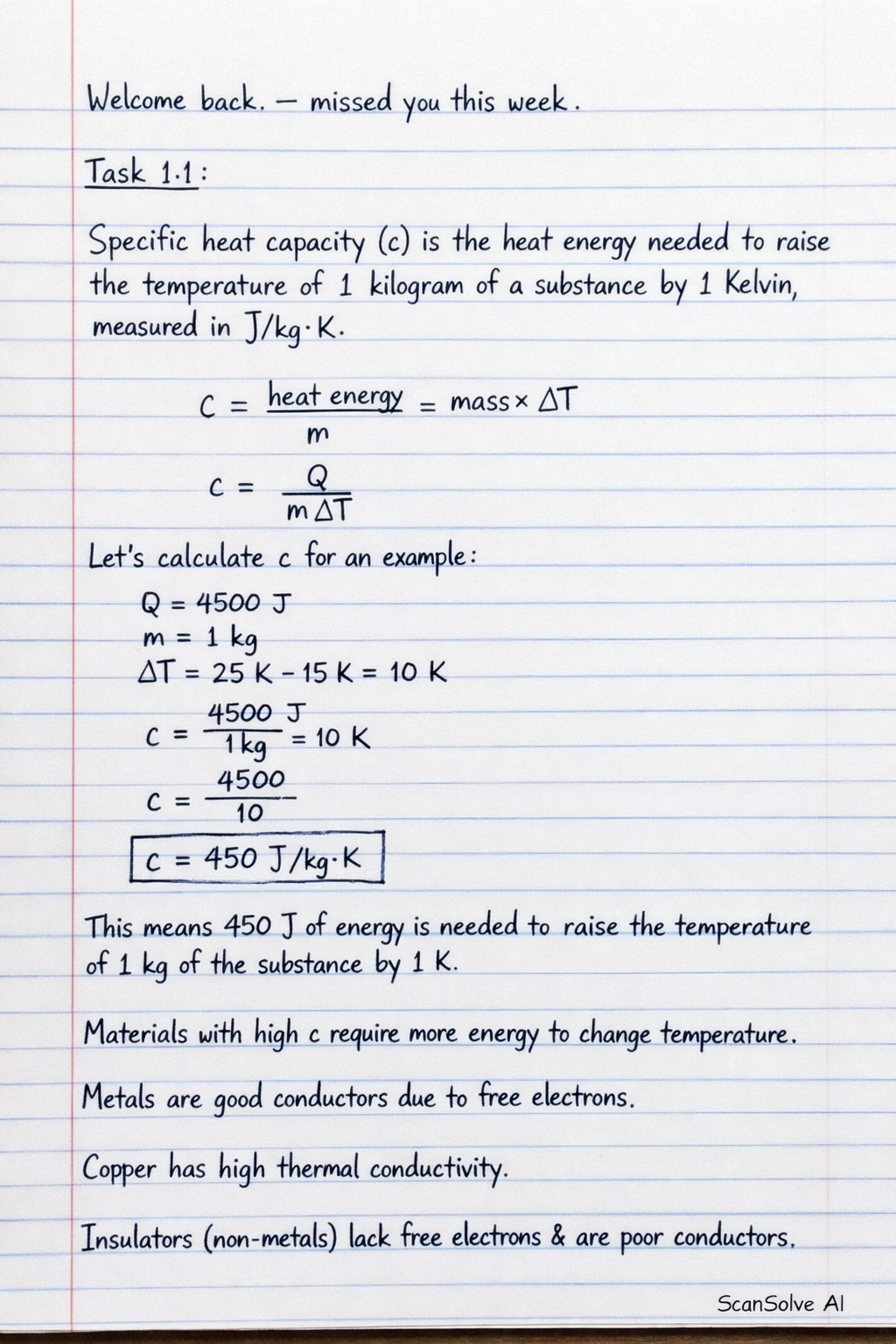
Handwritten Step-by-Step Solution
Get this as a handwritten image on WhatsApp — like a tutor wrote it for you.
Try on WhatsApp