
State Important points about Momentum and impulse
Physics
ScanSolve AI Answer
Answer
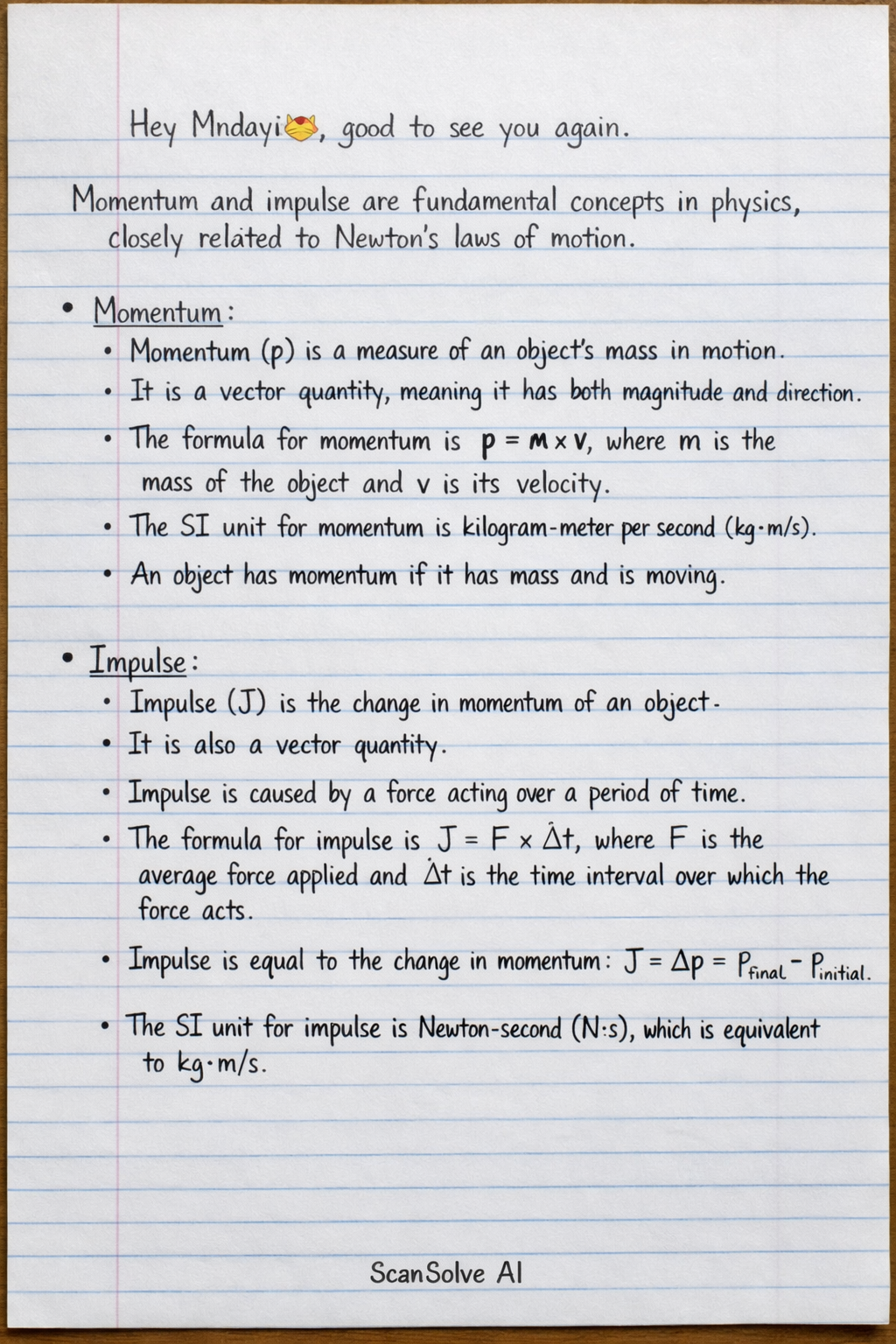
Momentum and impulse are fundamental concepts in physics, closely related to Newton's laws of motion.
-
Momentum:
- Momentum () is a measure of an object's mass in motion.
- It is a vector quantity, meaning it has both magnitude and direction.
- The formula for momentum is , where is the mass of the object and is its velocity.
- The SI unit for momentum is kilogram-meter per second (kg·m/s).
- An object has momentum if it has mass and is moving.
-
Impulse:
- Impulse () is the change in momentum of an object.
- It is also a vector quantity.
- Impulse is caused by a force acting over a period of time.
- The formula for impulse is , where is the average force applied and is the time interval over which the force acts.
- Impulse is equal to the change in momentum: .
- The SI unit for impulse is Newton-second (N·s), which is equivalent to kg·m/s.
-
Relationship between Momentum and Impulse:
- Impulse is the cause of a change in momentum. A larger impulse results in a larger change in momentum.
- This relationship is often referred to as the impulse-momentum theorem.
Was this helpful?
Still stuck on this one?
Ask a follow-up, and the answer starts from this question.
Got a different question?Ask your own question
More Physics Questions
QChange in momentum important pointsQState the law of conservation of momentum.QDefine the term momentum.
Browse by topic:Mechanics
Handwritten Step-by-Step Solution
Get this as a handwritten image on WhatsApp — like a tutor wrote it for you.
Try on WhatsApp