
We read your photo as:
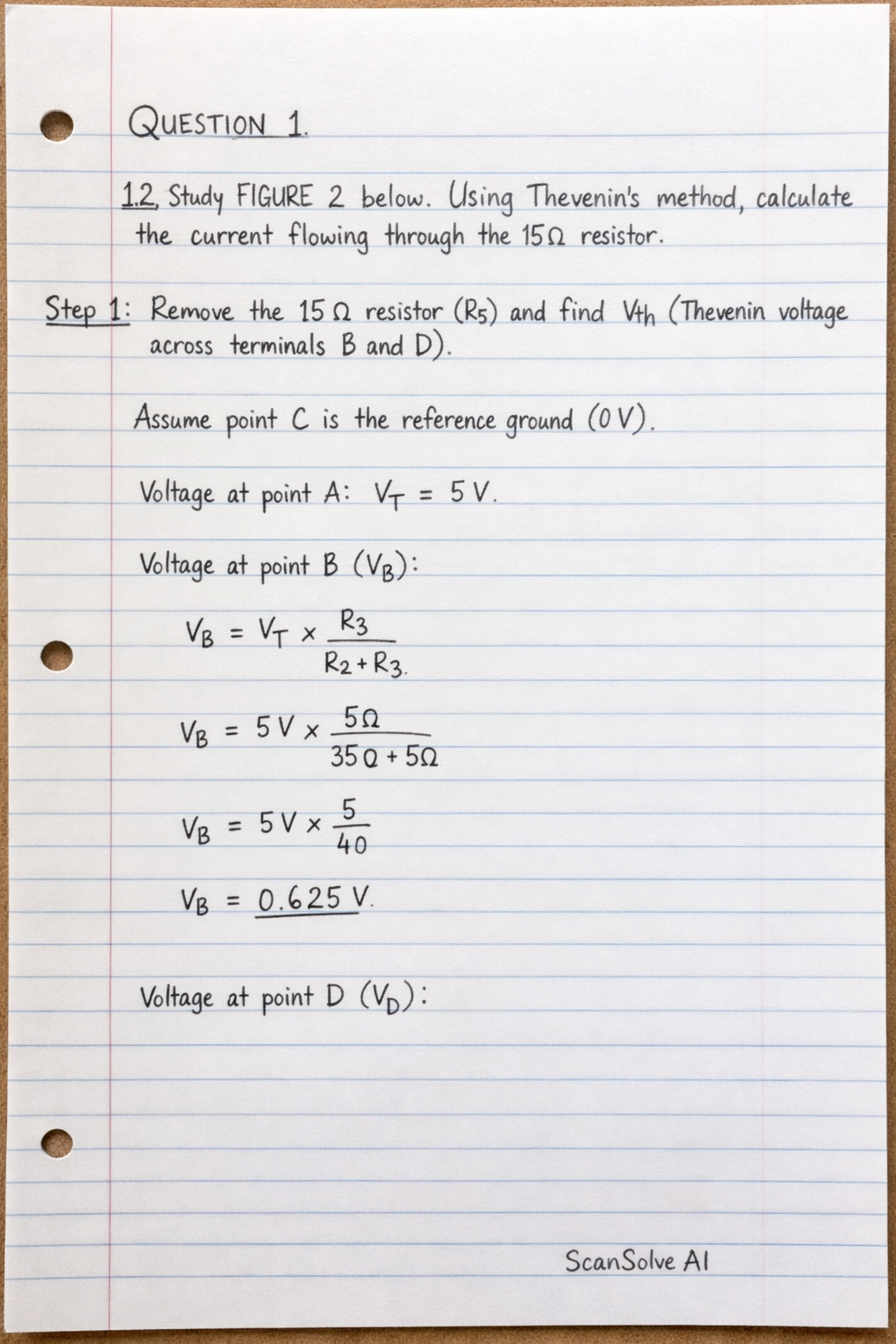
Study FIGURE 2 below. Using Thevenin's method, calculate the current flowing through the 15 ",u2126" resistor.
Physics
ScanSolve AI Answer
Answer
Step-by-step solution
3 stepslet's re-examine the calculation for question 1.2. The previous solution was correct, but I'll present it again with all the steps for clarity.
Part 1
Part 1.2
Study FIGURE 2 below. Using Thevenin's method, calculate the current flowing through the resistor.
Remove the resistor () and find (Thevenin voltage across terminals B and D).
- We need to find the potential difference between points B and D. Let's assume point C is the reference ground ().
- The voltage at point A is .
- The voltage at point B () can be found using the voltage divider rule for the series combination of and connected across :
- The voltage at point D () can be found using the voltage divider rule for the series combination of and connected across :
- The Thevenin voltage is the potential difference between D and B:
Find (Thevenin resistance looking into terminals B and D).
- To find , we turn off the independent voltage source (), which means we replace it with a short circuit. This connects points A and C together.
- Now, looking into terminals B and D:
- From terminal B, resistors () and () are connected between B and the shorted A-C line. Therefore, and are in parallel:
- From terminal D, resistors () and () are connected between D and the shorted A-C line. Therefore, and are in parallel:
- The Thevenin resistance is the series combination of and because they are connected end-to-end between terminals B and D:
Calculate the current flowing through the resistor ().
- Now, we connect the resistor () to the Thevenin equivalent circuit (a voltage source in series with ).
- The current flowing through is given by Ohm's Law:
The current flowing through the resistor is .
Was this helpful?
Try one yourself
A new problem that tests the same skill.
Still stuck on this one?
Ask a follow-up, and the answer starts from this question.
Got a different question?Ask your own question
More Physics Questions
QUse the superposition method to calculate the current flowing through the 25 Ω resistor shown in…QStudy the circuit diagram below and apply the Thevenin's theorem to calculate the current through…QUse simple diagram to explain Thevenin's theorem. For the network shown in fig. Q3b below, calculate…QUsing Norton's theorem, calculate the current flowing through the 11.2 Ω resistor in FIGURE 2. Also…QApply Kirchhoffs law to FIGURE 1 below, and determine the value of the current in each branch of the…
Browse by topic:Electrical Engineering
Handwritten Step-by-Step Solution
Get this as a handwritten image on WhatsApp — like a tutor wrote it for you.
Try on WhatsApp