
We read your photo as:
Use the superposition method to calculate the current flowing through the 25 Ω resistor shown in FIGURE 1 below:
ScanSolve AI Answer
Answers
2 partsStep-by-step solution
6 stepshere are the solutions to the circuit analysis problems.
Part 1
Part 1.1
Use the superposition method to calculate the current flowing through the resistor shown in FIGURE 1.
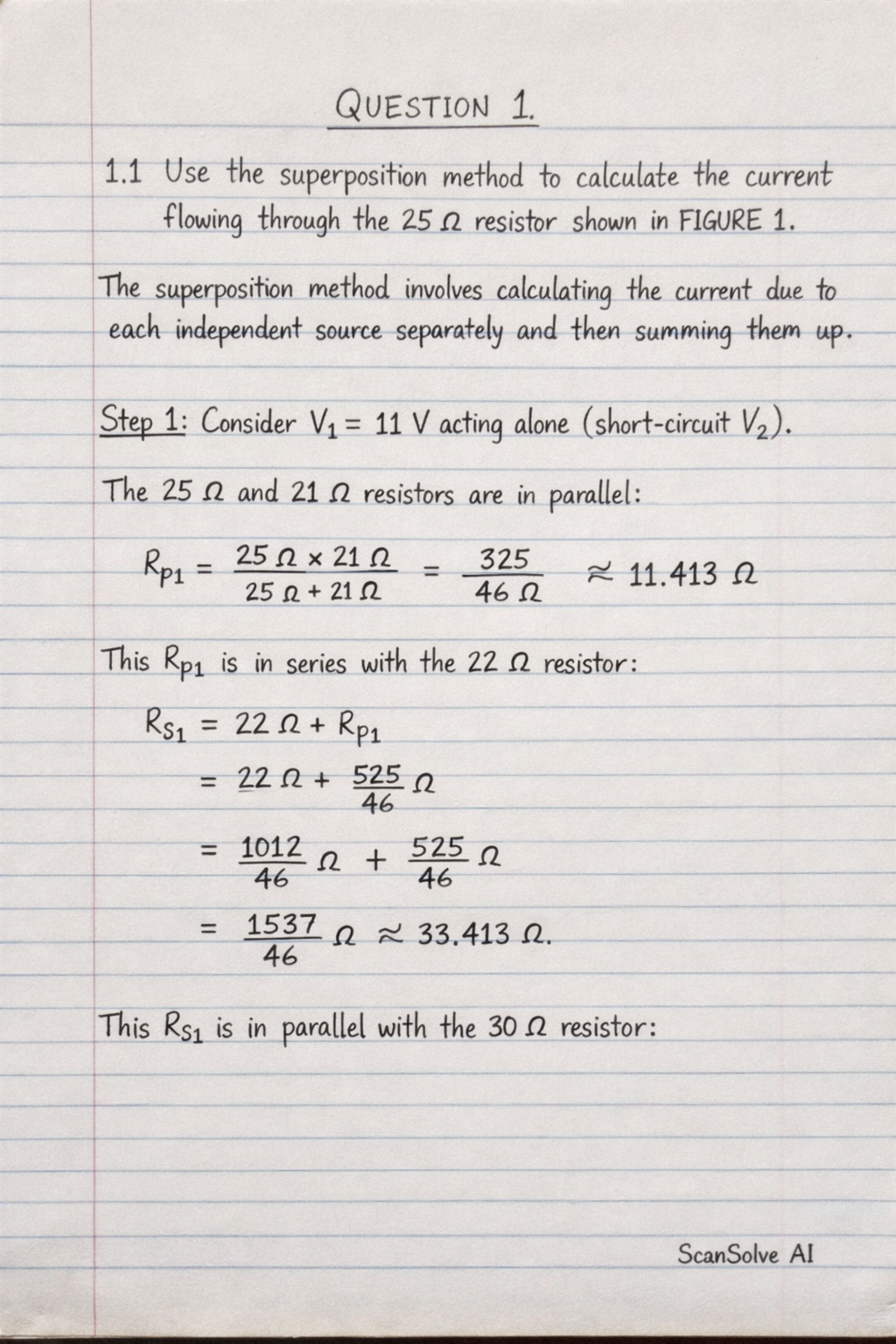
The superposition method involves calculating the current due to each independent source separately and then summing them up.
Consider acting alone (short-circuit ).
- The and resistors are in parallel:
- This is in series with the resistor:
- This is in parallel with the resistor:
- The total resistance seen by is in series with :
- The total current from is:
- Using current division, the current flowing through the branch containing (which includes the resistor) is:
- This current then splits between and . The current through the resistor is: The direction of this current is downwards.
Consider acting alone (short-circuit ).
- The and resistors are in parallel:
- This is in series with the resistor:
- This is in parallel with the resistor:
- The total resistance seen by is in series with :
- The total current from is:
- Using current division, the current flowing through the resistor is: The direction of this current is downwards.
Sum the currents.
Both currents and flow in the same direction (downwards) through the resistor.
The current flowing through the resistor is .
Part 1.2
Study FIGURE 2 below. Using Thevenin's method, calculate the current flowing through the resistor.
Remove the resistor () and find (Thevenin voltage across terminals B and D).
- Assume the bottom wire (connected to C and D) is ground (). Then .
- For the path A-B-C, the voltage at B is found using the voltage divider rule:
- For the path A-D-C, the voltage at D is found using the voltage divider rule:
- The Thevenin voltage is the potential difference between B and D. Let's define it as (since ).
Find (Thevenin resistance looking into terminals B and D).
- Short-circuit the voltage source . This means points A and C are now electrically connected.
- Looking from terminal B, is connected to A and is connected to C. Since A and C are shorted, and are in parallel:
- Looking from terminal D, is connected to A and is connected to C. Since A and C are shorted, and are in parallel:
- The Thevenin resistance is the sum of these two parallel combinations, as they are effectively in series between B and D:
Calculate the current flowing through the resistor ().
- Now, connect the resistor () to the Thevenin equivalent circuit. The current is given by:
The current flowing through the resistor is .
Try one yourself
A new problem that tests the same skill.
Still stuck on this one?
Ask a follow-up, and the answer starts from this question.
More Physics Questions
Handwritten Step-by-Step Solution
Get this as a handwritten image on WhatsApp — like a tutor wrote it for you.
Try on WhatsApp