
We read your photo as:
Define inertia and explain three different directions of forces with diagrams. Sketch the Free Body Diagram for a loaded beam with pin and roller supports.
ScanSolve AI Answer
Step-by-step solution
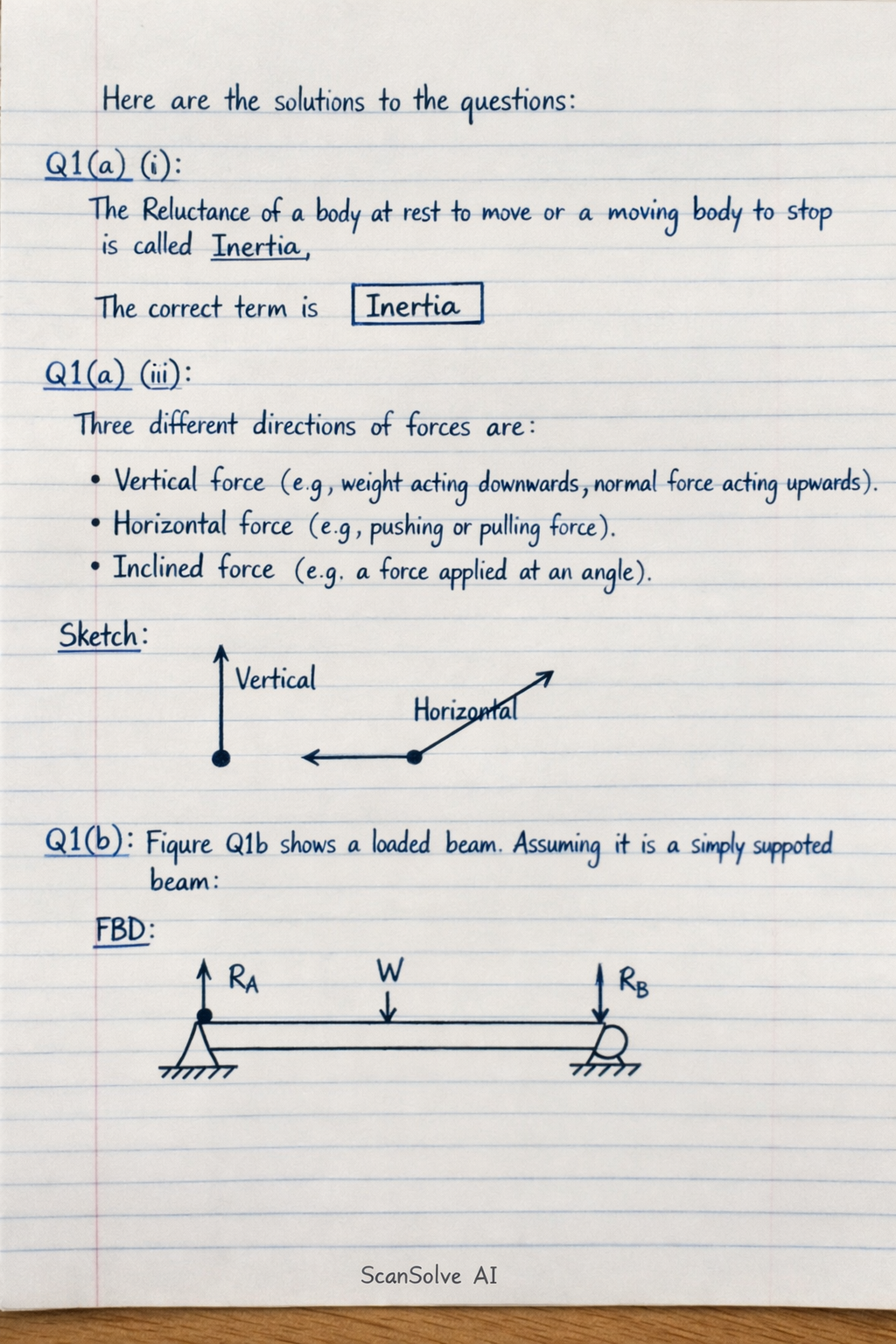
6 stepsHere are the solutions to the questions:
Q1(a) (i):
The Reluctance of a body at rest to move or a moving body to stop is called Inertia.
The correct term is .
Q1(a) (ii):
Three different directions of forces are:
- Vertical force (e.g., weight acting downwards, normal force acting upwards).
- Horizontal force (e.g., pushing or pulling force).
- Inclined force (e.g., a force applied at an angle to the horizontal or vertical).
Sketch:
\begin{tikzpicture}[scale=0.8]
\draw[->, thick] (0,0) -- (0,2) node[above] {Vertical};
\draw[->, thick] (0,0) -- (2,0) node[right] {Horizontal};
\draw[->, thick] (0,0) -- (1.5,1.5) node[above right] {Inclined};
\fill (0,0) circle (1.5pt);
\end{tikzpicture}
Q1(b):
Figure Q1b shows a loaded beam. Assuming it is a simply supported beam with a pin support at the left end and a roller support at the right end, its Free Body Diagram (FBD) would be:
\begin{tikzpicture}[scale=0.8]
% Beam
\draw[thick] (0,0) -- (10,0);

% Pin support at A
\draw[fill=black] (0,0) circle (2pt);
\draw (0,-0.2) -- (-0.5,-0.7) -- (0.5,-0.7) -- cycle;
\draw[dashed] (-0.7,-0.7) -- (0.7,-0.7);
\node at (-0.5, 0.5) {$R_{Ay}$};
\draw[->, thick] (0,0) -- (0,0.8);
\node at (0.5, -0.5) {$R_{Ax}$};
\draw[->, thick] (0,0) -- (0.8,0);

% Roller support at B (assuming it's at the end of the beam for simplicity, as no specific location is given for supports in the original sketch)
\draw[fill=black] (10,0) circle (2pt);
\draw (9.5,-0.2) circle (0.2);
\draw (10.5,-0.2) circle (0.2);
\draw[dashed] (9.3,-0.7) -- (10.7,-0.7);
\node at (10.5, 0.5) {$R_{By}$};
\draw[->, thick] (10,0) -- (10,0.8);

% UDL w1
\draw[decorate,decoration={snake,amplitude=2pt,segment length=10pt}] (1,0.5) -- (4,0.5);
\foreach \x in {1.2, 1.7, ..., 3.8}
    \draw[->] (\x,0.5) -- (\x,0);
\node at (2.5, 0.8) {$w_1 (\text{kN/m})$};

% Point load Rw
\draw[->, thick] (5.5,1) -- (5.5,0);
\node at (5.5, 1.2) {$R_W (\text{kN})$};

% UDL w2
\draw[decorate,decoration={snake,amplitude=2pt,segment length=10pt}] (7,0.5) -- (9,0.5);
\foreach \x in {7.2, 7.7, ..., 8.8}
    \draw[->] (\x,0.5) -- (\x,0);
\node at (8, 0.8) {$w_2 (\text{kN/m})$};

% Lengths (approximate based on original sketch)
\draw[<->] (0,-1) -- (4,-1) node[midway, below] {$L_1$};
\draw[<->] (4,-1) -- (5.5,-1) node[midway, below] {$L_2$};
\draw[<->] (5.5,-1) -- (7,-1) node[midway, below] {$L_3$};
\draw[<->] (7,-1) -- (10,-1) node[midway, below] {$L_4$};
\end{tikzpicture}
Q2(a):
Momentum is a Vector Quantity with a S.I Unit of kNm.
This statement is FALSE.
- Momentum is indeed a Vector Quantity.
- However, the S.I. unit of momentum is kilogram-meter per second () or Newton-second ().
- (kiloNewton-meter) is the unit for moment (torque) or energy (kiloJoule).
Q2(b):
Figure Q2b shows a simply supported beam. We need to determine the reaction forces.
Let be the vertical reaction at the pin support (left end) and be the vertical reaction at the roller support (at from the left end).
First, convert the uniformly distributed load (UDL) into an equivalent point load:
The UDL is over .
Equivalent point load .
This load acts at the centroid of the UDL, which is from the left support.
Now, let's apply the equilibrium equations:
Sum of horizontal forces.
Since there are no horizontal applied loads, the horizontal reaction at the pin support is zero.
Sum of moments about point A (left support).
Taking counter-clockwise moments as positive:
Sum of vertical forces.
Taking upward forces as positive:
The reaction forces are:
Q3(a) (i):
The principle of Conservation of Linear Momentum states that in an isolated system (a system where no external forces act), the total linear momentum of the system remains constant over time. This means the total momentum before an interaction is equal to the total momentum after the interaction.Q3(a) (ii):
The Velocity of a Body at rest is .Q3(b):
Given:
Mass of body A,
Mass of body B,
Initial velocity of body A,
Initial velocity of body B, (at rest)Since A and B coalesce after impact, it is an inelastic collision, and they will have a common final velocity, .
Using the principle of Conservation of Linear Momentum:Substitute the given values into the equation.
Simplify the equation.
Solve for .
The common velocity after impact is $\boxed{\text{4 m/s
Still stuck on this one?
Ask a follow-up, and the answer starts from this question.
More Physics Questions
Handwritten Step-by-Step Solution
Get this as a handwritten image on WhatsApp — like a tutor wrote it for you.
Try on WhatsApp