
We read your photo as:
List THREE practical applications of the pitch of sound in technology. Is sound a longitudinal wave or a transverse wave? Draw a diagram showing the propagation of sound in air.
ScanSolve AI Answer
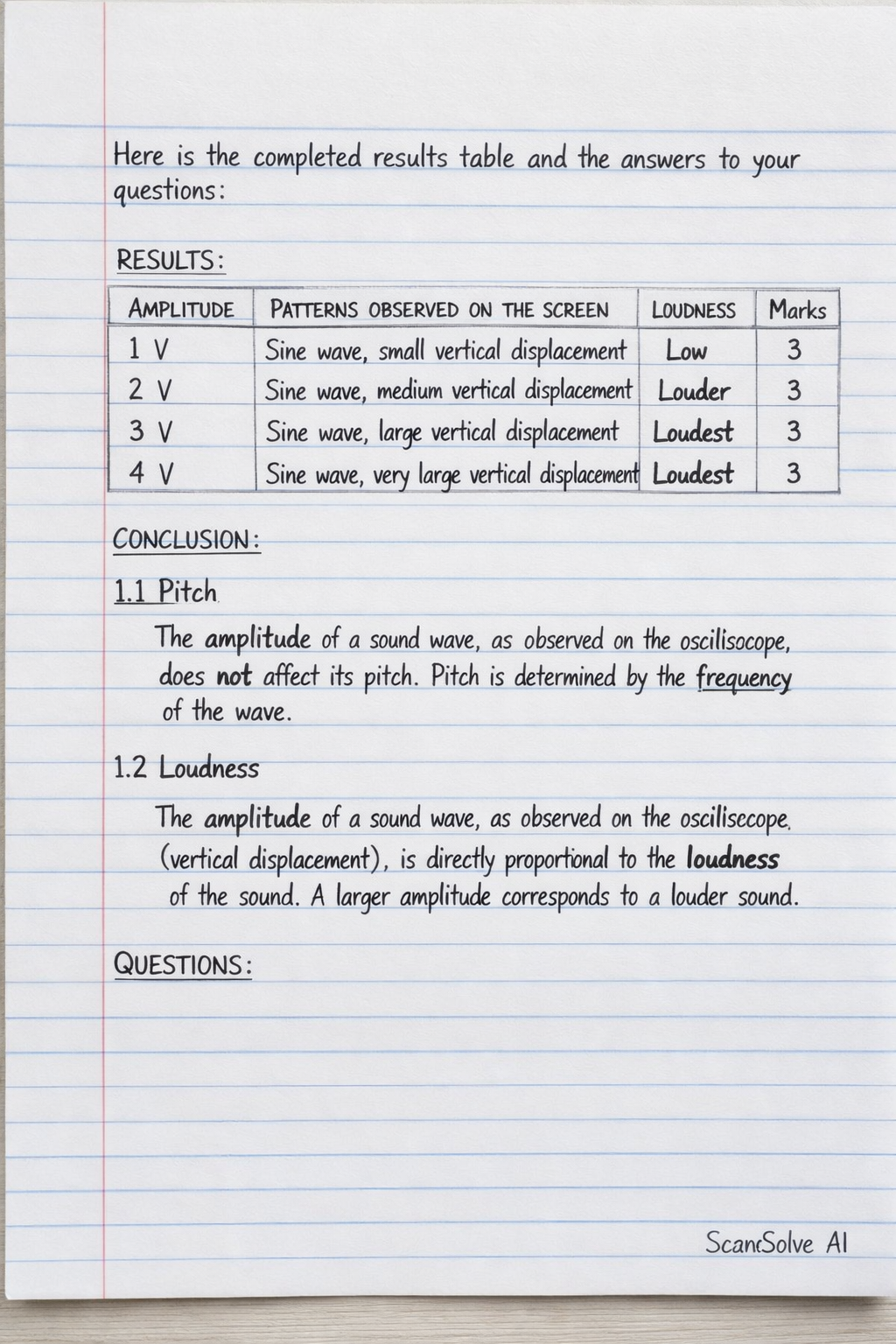
Here is the completed results table and the answers to your questions:
RESULTS:
| AMPLITUDE | PATTERNS OBSERVED ON THE SCREEN (2) | LOUDNESS (Low, Louder, Loudest) (1) | Marks |
|---|---|---|---|
| 1 V | Sine wave, small vertical displacement. | Low | 3 |
| 2 V | Sine wave, medium vertical displacement. | Louder | 3 |
| 3 V | Sine wave, large vertical displacement. | Loudest | 3 |
| 4 V | Sine wave, very large vertical displacement. | Loudest | 3 |
CONCLUSION:
1.1 Pitch
The amplitude of a sound wave, as observed on the oscilloscope, does not affect its pitch. Pitch is determined by the frequency of the wave.
1.2 Loudness
The amplitude of a sound wave, as observed on the oscilloscope (vertical displacement), is directly proportional to the loudness of the sound. A larger amplitude corresponds to a louder sound.
QUESTIONS:
1.3 List THREE practical applications of the pitch of sound in technology.
- Musical instruments: Tuning and playing instruments to produce specific notes (pitches).
- Medical imaging (ultrasound): Using high-frequency (high pitch) sound waves to create images of internal body structures.
- Sonar: Using sound waves of specific pitches to detect objects underwater.
1.4 Is sound a longitudinal wave or a transverse wave?
Sound is a longitudinal wave.
1.5 Draw a diagram showing the propagation of sound in air.
A diagram showing the propagation of sound in air should illustrate:
- Regions of compression where air particles are close together.
- Regions of rarefaction where air particles are spread apart.
- The particles oscillating parallel to the direction of wave propagation.
Still stuck on this one?
Ask a follow-up, and the answer starts from this question.
More Physics Questions
Handwritten Step-by-Step Solution
Get this as a handwritten image on WhatsApp — like a tutor wrote it for you.
Try on WhatsApp