
We read your photo as:
Define melting point, boiling point, heat conductivity. Discuss water's melting/freezing point and relate container melting point to liquid temperature.
ScanSolve AI Answer
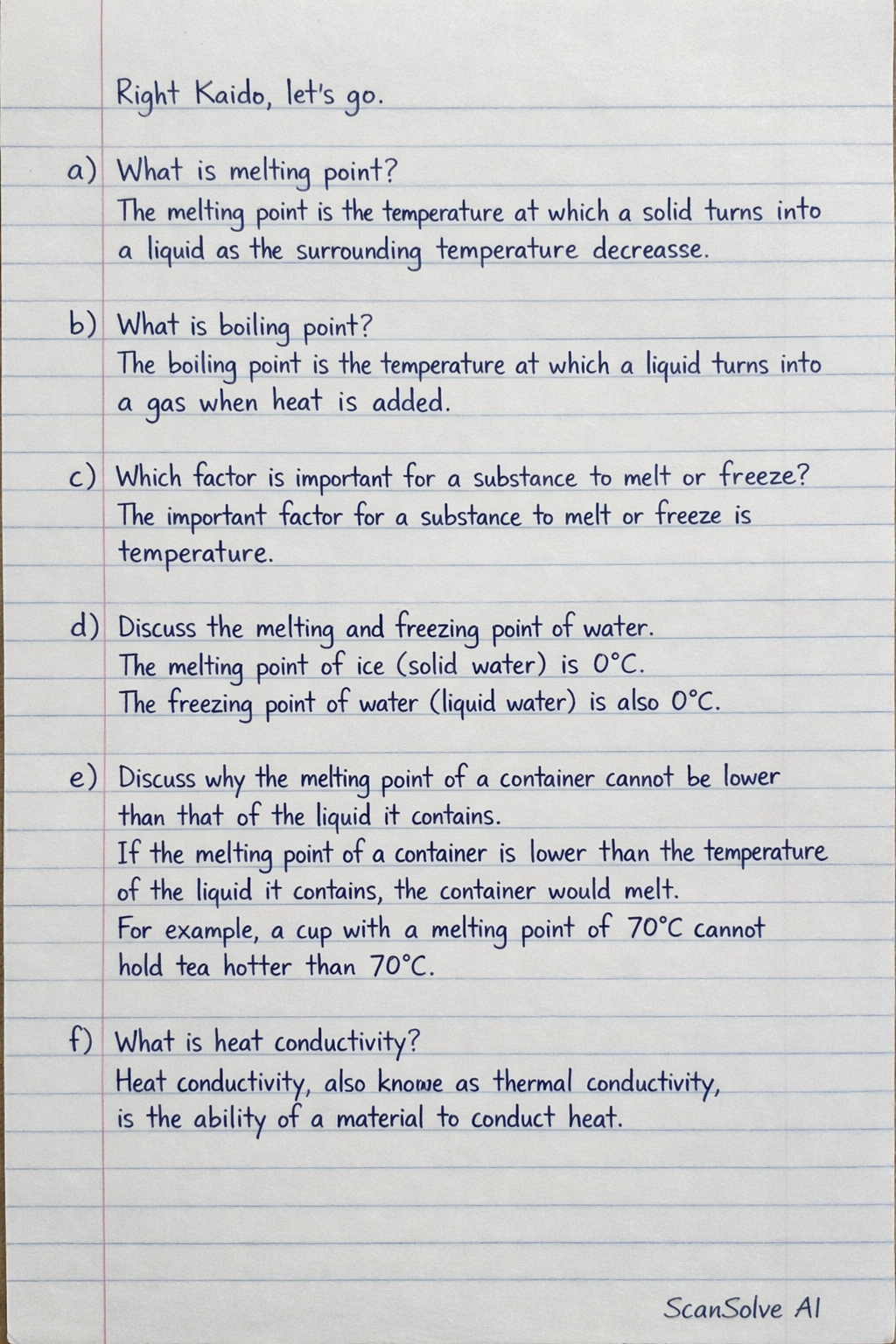
a) What is melting point?
The melting point is the temperature at which a solid turns into a liquid as the surrounding temperature decreases.
b) What is boiling point?
The boiling point is the temperature at which a liquid turns into a gas when heat is added.
c) Which factor is important for a substance to melt or freeze?
The important factor for a substance to melt or freeze is temperature.
d) Discuss the melting and freezing point of water.
The melting point of ice (solid water) is . The freezing point of water (liquid water) is also .
e) Discuss why the melting point of a container cannot be lower than that of the liquid it contains.
If the melting point of a container is lower than the temperature of the liquid it contains, the container would melt. For example, a cup with a melting point of cannot hold tea hotter than .
f) What is heat conductivity?
Heat conductivity, also known as thermal conductivity, is the ability of a material to conduct heat.
g) Discuss the difference between electrical conductivity and heat conductivity.
Electrical conductivity is the ability of a material to conduct electricity, while heat conductivity is the ability of a material to conduct heat. Metals are good conductors of both electricity and heat, but some materials like wood do not conduct electricity.
h) Explain if it is possible for a material to conduct heat but not electricity.
Yes, it is possible. Materials like glass or ceramics can conduct heat to some extent but are very poor electrical conductors (insulators).
Still stuck on this one?
Ask a follow-up, and the answer starts from this question.
More Physics Questions
Handwritten Step-by-Step Solution
Get this as a handwritten image on WhatsApp — like a tutor wrote it for you.
Try on WhatsApp