We read your photo as:

Determine the magnitudes of the reactions R₁ and R₂. (d) Calculate the magnitude and direction of the system of concurrent forces below

Physics

ScanSolve AI Answer

Answer

387.93 N387.93 \, \text{N}

150.38∘150.38^\circ

Step-by-step solution

4 steps

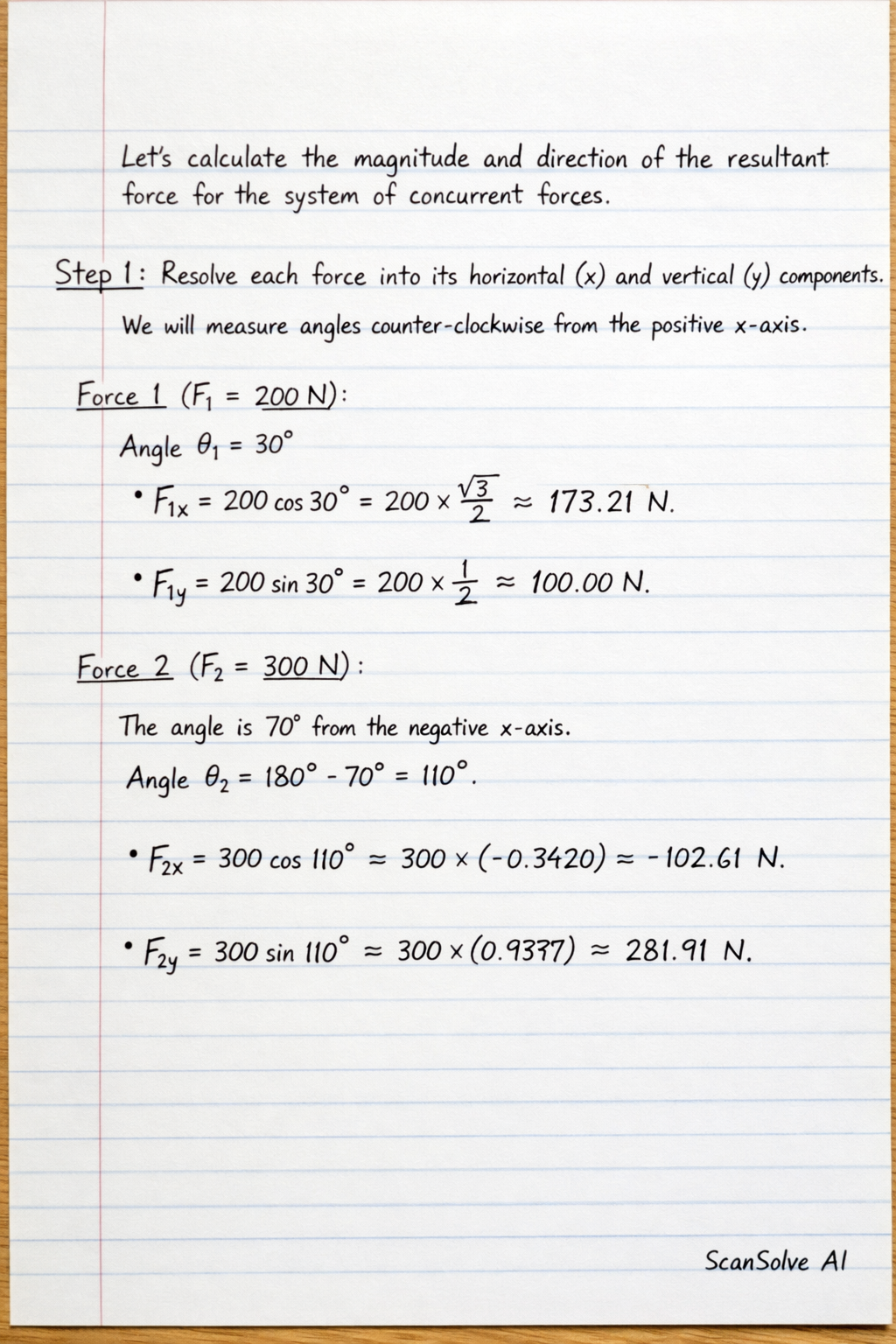
Let's calculate the magnitude and direction of the resultant force for the system of concurrent forces.

  1. Resolve each force into its horizontal (x) and vertical (y) components.

    We will measure angles counter-clockwise from the positive x-axis.

    • Force 1 (F1=200 NF_1 = 200 \, \text{N}): Angle θ1=30∘\theta_1 = 30^\circ.

      F1x=200cos⁡(30∘)=200×32≈173.21 NF_{1x} = 200 \cos(30^\circ) = 200 \times \frac{\sqrt{3}}{2} \approx 173.21 \, \text{N} F1y=200sin⁡(30∘)=200×12=100.00 NF_{1y} = 200 \sin(30^\circ) = 200 \times \frac{1}{2} = 100.00 \, \text{N}
    • Force 2 (F2=300 NF_2 = 300 \, \text{N}): The angle is 70∘70^\circ from the negative x-axis towards the positive y-axis. Angle θ2=180∘−70∘=110∘\theta_2 = 180^\circ - 70^\circ = 110^\circ.

      F2x=300cos⁡(110∘)≈300×(−0.3420)≈−102.61 NF_{2x} = 300 \cos(110^\circ) \approx 300 \times (-0.3420) \approx -102.61 \, \text{N} F2y=300sin⁡(110∘)≈300×(0.9397)≈281.91 NF_{2y} = 300 \sin(110^\circ) \approx 300 \times (0.9397) \approx 281.91 \, \text{N}
    • Force 3 (F3=450 NF_3 = 450 \, \text{N}): The angle is 65∘65^\circ from the negative y-axis towards the negative x-axis. This means it's in the third quadrant. The angle from the negative x-axis is 90∘−65∘=25∘90^\circ - 65^\circ = 25^\circ. Angle θ3=180∘+25∘=205∘\theta_3 = 180^\circ + 25^\circ = 205^\circ.

      F3x=450cos⁡(205∘)≈450×(−0.9063)≈−407.84 NF_{3x} = 450 \cos(205^\circ) \approx 450 \times (-0.9063) \approx -407.84 \, \text{N} F3y=450sin⁡(205∘)≈450×(−0.4226)≈−190.18 NF_{3y} = 450 \sin(205^\circ) \approx 450 \times (-0.4226) \approx -190.18 \, \text{N}
  2. Sum the x-components (∑Fx\sum F_x) and y-components (∑Fy\sum F_y).

    ∑Fx=F1x+F2x+F3x\sum F_x = F_{1x} + F_{2x} + F_{3x} ∑Fx=173.21 N−102.61 N−407.84 N=−337.24 N\sum F_x = 173.21 \, \text{N} - 102.61 \, \text{N} - 407.84 \, \text{N} = -337.24 \, \text{N} ∑Fy=F1y+F2y+F3y\sum F_y = F_{1y} + F_{2y} + F_{3y} ∑Fy=100.00 N+281.91 N−190.18 N=191.73 N\sum F_y = 100.00 \, \text{N} + 281.91 \, \text{N} - 190.18 \, \text{N} = 191.73 \, \text{N}
  3. Calculate the magnitude of the resultant force (RR).

    R=(∑Fx)2+(∑Fy)2R = \sqrt{(\sum F_x)^2 + (\sum F_y)^2} R=(−337.24)2+(191.73)2R = \sqrt{(-337.24)^2 + (191.73)^2} R=113731.8+36760.4R = \sqrt{113731.8 + 36760.4} R=150492.2R = \sqrt{150492.2} R≈387.93 NR \approx 387.93 \, \text{N}
  4. Calculate the direction of the resultant force (θ\theta).

    First, find the reference angle α\alpha:

    tan⁡α=∣∑Fy∑Fx∣=∣191.73−337.24∣≈0.5685\tan \alpha = \left| \frac{\sum F_y}{\sum F_x} \right| = \left| \frac{191.73}{-337.24} \right| \approx 0.5685 α=arctan⁡(0.5685)≈29.62∘\alpha = \arctan(0.5685) \approx 29.62^\circ

    Since ∑Fx\sum F_x is negative and ∑Fy\sum F_y is positive, the resultant force is in the second quadrant.
    The angle θ\theta measured counter-clockwise from the positive x-axis is:

    θ=180∘−α\theta = 180^\circ - \alpha θ=180∘−29.62∘=150.38∘\theta = 180^\circ - 29.62^\circ = 150.38^\circ

    The magnitude of the resultant force is 387.93 N\boxed{387.93 \, \text{N}} and its direction is 150.38∘\boxed{150.38^\circ} counter-clockwise from the positive x-axis.

Was this helpful?

Try one yourself

A new problem that tests the same skill.

Still stuck on this one?

Ask a follow-up, and the answer starts from this question.

Got a different question?Ask your own question
Handwritten step-by-step solution preview

Handwritten Step-by-Step Solution

Get this as a handwritten image on WhatsApp — like a tutor wrote it for you.

Try on WhatsApp