
We read your photo as:
Mention the different ways of increasing the number of molecular collisions per unit time in a gas. By reducing the volume of a gas at a constant temperature, the pressure of the gas increases. Explai
ScanSolve AI Answer
Step-by-step solution
18 stepsHere are the answers to your questions:
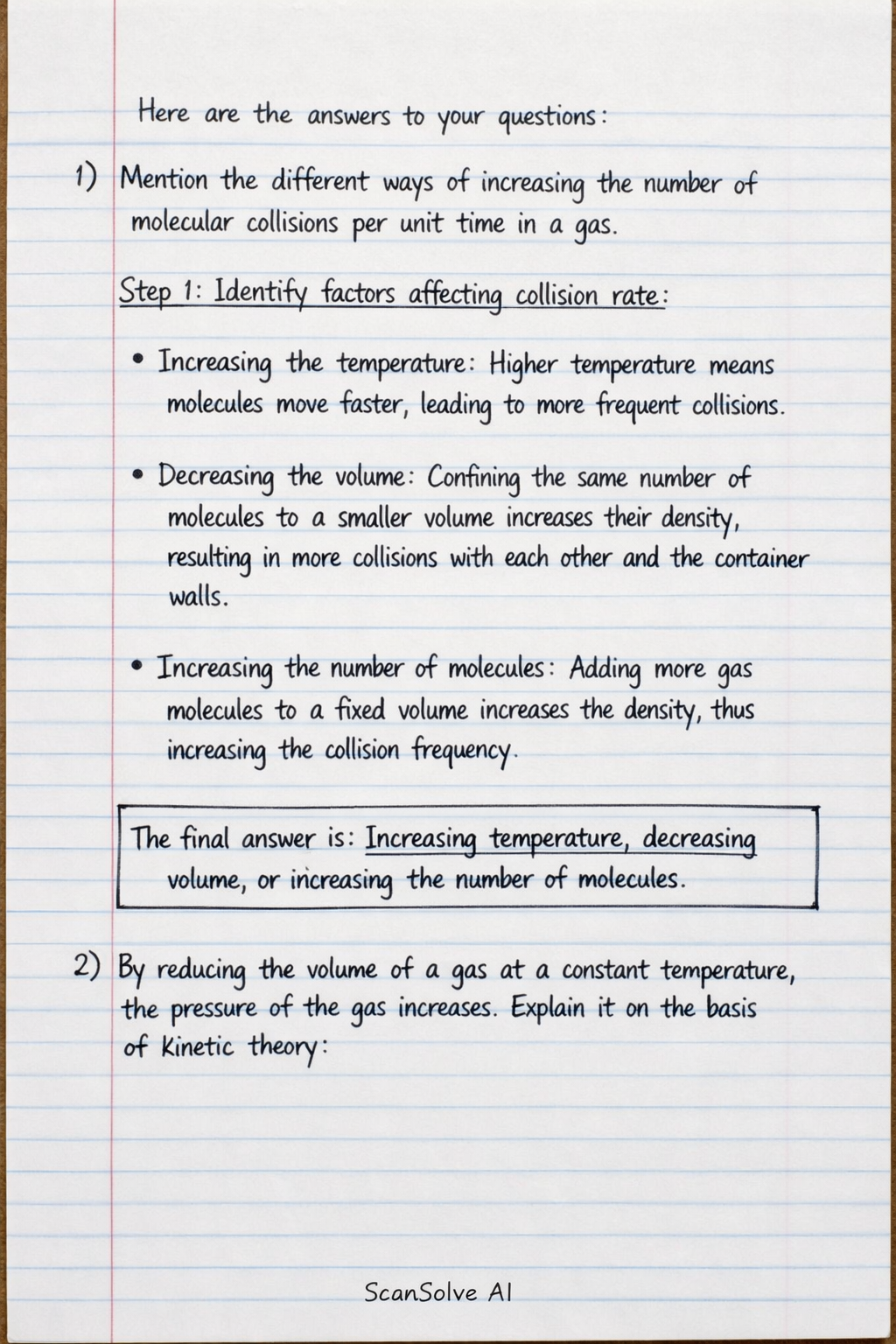
1) Mention the different ways of increasing the number of molecular collisions per unit time in a gas.
Identify factors affecting collision rate.
The number of molecular collisions per unit time in a gas can be increased by:
- Increasing the temperature: Higher temperature means molecules move faster, leading to more frequent collisions.
- Decreasing the volume: Confining the same number of molecules to a smaller volume increases their density, resulting in more collisions with each other and the container walls.
- Increasing the number of molecules: Adding more gas molecules to a fixed volume increases the density, thus increasing the collision frequency.
The final answer is
2) By reducing the volume of a gas at a constant temperature, the pressure of the gas increases. Explain it on the basis of kinetic theory.
Relate pressure to molecular collisions.
According to the kinetic theory of gases, the pressure exerted by a gas is due to the force of its molecules colliding with the walls of the container.
Explain the effect of reducing volume.
When the volume of a gas is reduced at a constant temperature, the gas molecules are confined to a smaller space. This increases the number density of the molecules.
Conclude the effect on pressure.
With more molecules per unit volume, the frequency of collisions between the molecules and the container walls increases. Since the temperature is constant, the average kinetic energy (and thus the average speed) of the molecules remains the same. Therefore, more frequent collisions with the same force per collision result in a greater total force per unit area, leading to an increase in pressure.
The final answer is
3) What do you mean by the root mean square speed of the molecules of a gas? Is the root mean square speed the same as the average speed?
Define root mean square speed.
The root mean square (RMS) speed () of gas molecules is a measure of the typical speed of particles in a gas. It is defined as the square root of the average of the squares of the speeds of all the individual molecules in the gas.
Compare RMS speed with average speed.
No, the root mean square speed is not the same as the average speed. Because the speeds are squared before averaging, higher speeds contribute more significantly to the RMS value. Consequently, the RMS speed is always greater than or equal to the average speed for a distribution of speeds.
The final answer is
4) Why is the temperature below absolute zero not possible?
Define absolute zero.
Absolute zero (0 K or ) is the theoretical lowest possible temperature at which particles in a substance possess the minimum possible kinetic energy.
Relate temperature to kinetic energy.
Temperature is a direct measure of the average translational kinetic energy of the particles in a system.
Explain the impossibility.
If a temperature below absolute zero were possible, it would imply that the particles have less than this minimum possible kinetic energy, which is physically impossible. It would mean they have negative kinetic energy, which is not allowed by the laws of physics.
The final answer is
5) Estimate the average kinetic energy of a helium atom at the temperature on the surface of the sun (6000 K).
State the formula for average kinetic energy.
The average translational kinetic energy () of an atom in an ideal gas is given by the formula:
where is the Boltzmann constant () and is the absolute temperature in Kelvin.
Substitute the given values.
Given temperature .
Calculate the average kinetic energy.
The final answer is .
6) Show that the ratio of the root mean square speeds of molecules of two different gases at a certain temperature is equal to the square root of the inverse ratio of their masses.
State the formula for RMS speed.
The root mean square speed () of gas molecules is given by:
where is the ideal gas constant, is the absolute temperature, and is the molar mass of the gas.
Write the RMS speeds for two different gases.
For two different gases, Gas 1 and Gas 2, at the same temperature :
Calculate the ratio of their RMS speeds.
This shows that the ratio of the root mean square speeds is equal to the square root of the inverse ratio of their molar masses.
The final answer is .
7) Differentiate between the formations of white dwarfs and neutron stars.
Describe white dwarf formation.
White dwarfs form from the remnants of low-to-medium mass stars (up to about 8 times the mass of our Sun) after they have exhausted their nuclear fuel. The star sheds its outer layers, leaving behind a dense core primarily composed of carbon and oxygen. This core is supported against gravitational collapse by electron degeneracy pressure.
Describe neutron star formation.
Neutron stars form from the core collapse of much more massive stars (typically 8 to 20 times the mass of the Sun) after they undergo a supernova explosion. During the collapse, the immense gravitational forces overcome electron degeneracy pressure, forcing electrons and protons to combine into neutrons. The resulting extremely dense core is then supported by neutron degeneracy pressure.
The final answer is
8) Why do the gases at low temperatures and high pressure show large deviations from ideal behaviour?
Recall ideal gas assumptions.
Ideal gases are theoretical gases that follow two main assumptions
Still stuck on this one?
Ask a follow-up, and the answer starts from this question.
More Physics Questions
Handwritten Step-by-Step Solution
Get this as a handwritten image on WhatsApp — like a tutor wrote it for you.
Try on WhatsApp