
We read your photo as:
Determine the molar mass of copper and Faraday's constant.
ScanSolve AI Answer
Answer
Step-by-step solution
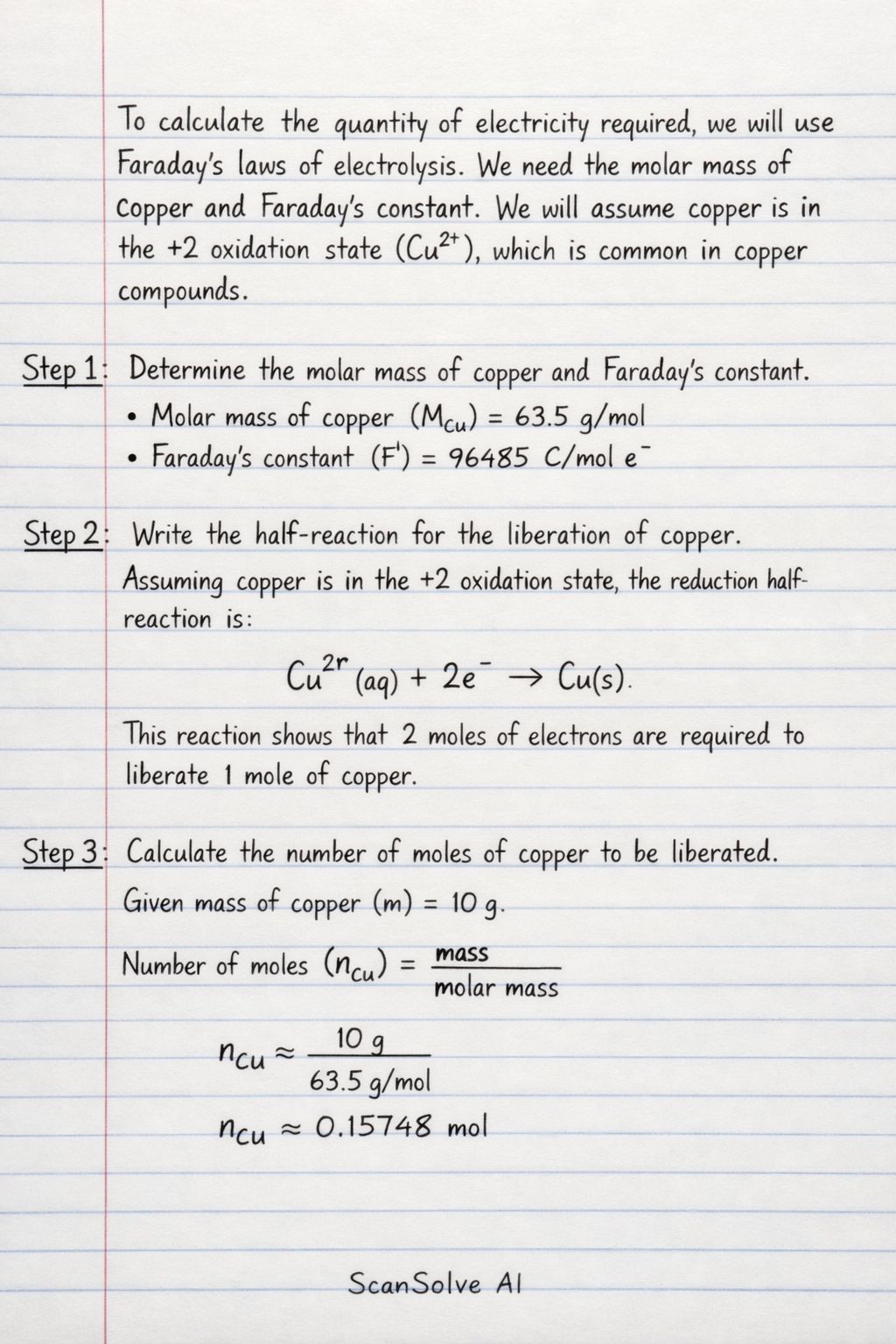
5 stepsTo calculate the quantity of electricity required, we will use Faraday's laws of electrolysis. We need the molar mass of copper and Faraday's constant. We will assume copper is in the +2 oxidation state (Cu²⁺), which is common in copper compounds.
Determine the molar mass of copper and Faraday's constant.
- Molar mass of copper () =
- Faraday's constant () =
Write the half-reaction for the liberation of copper.
Assuming copper is in the +2 oxidation state, the reduction half-reaction is:
This reaction shows that 2 moles of electrons are required to liberate 1 mole of copper.
Calculate the number of moles of copper to be liberated.
Given mass of copper () = .
Number of moles () =Calculate the total moles of electrons required.
From the half-reaction, 2 moles of electrons are needed per mole of copper.
Moles of electrons () =Calculate the quantity of electricity (charge) in coulombs.
Quantity of electricity () =
Rounding to three significant figures:
The quantity of electricity required is:
Try one yourself
A new problem that tests the same skill.
Still stuck on this one?
Ask a follow-up, and the answer starts from this question.
More Physics Questions
Handwritten Step-by-Step Solution
Get this as a handwritten image on WhatsApp — like a tutor wrote it for you.
Try on WhatsApp