
We read your photo as:
Name one phenomenon that demonstrates that light behaves as a: (i) wave; (ii) particle.
ScanSolve AI Answer
here are the answers to your questions.
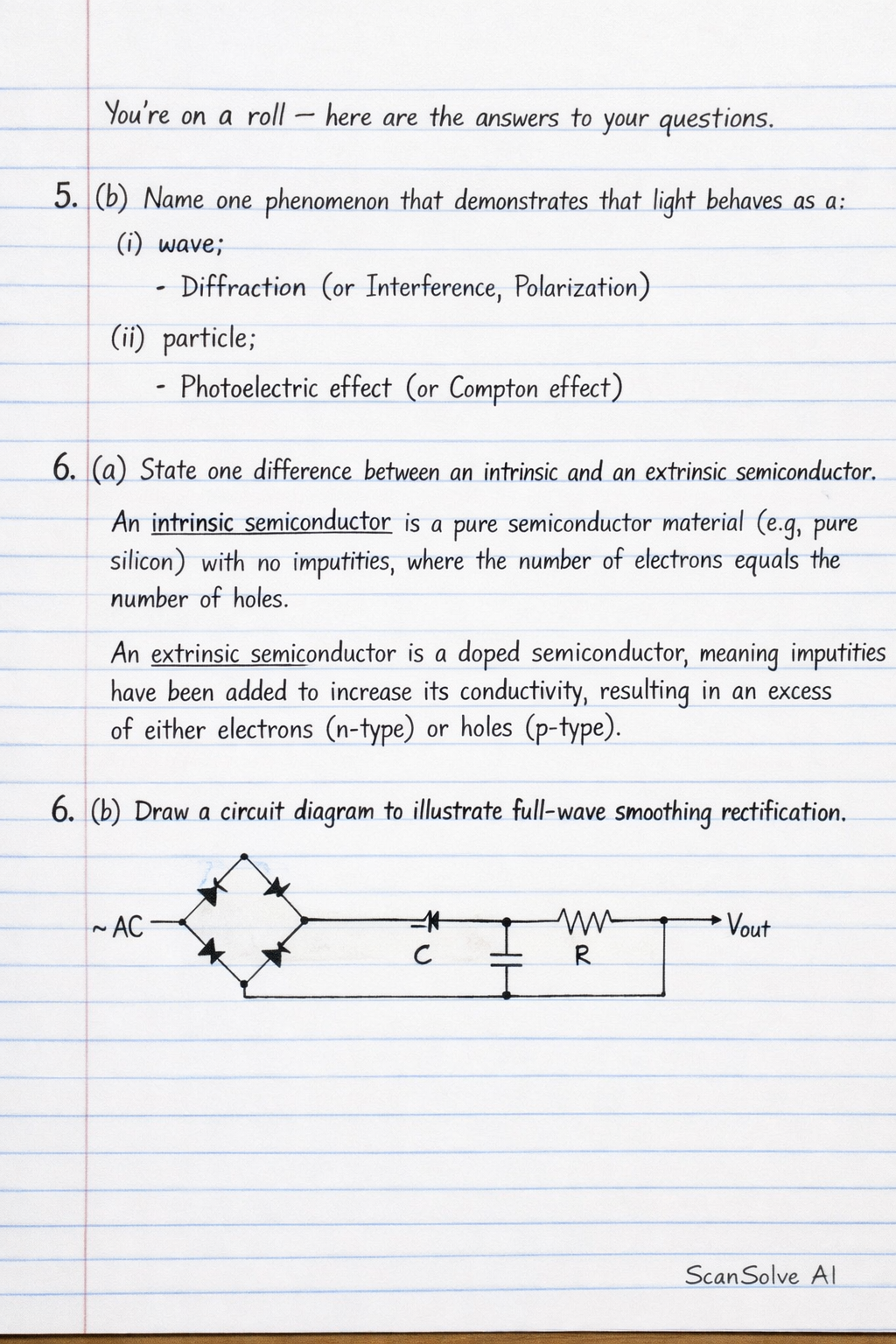
5. (b) Name one phenomenon that demonstrates that light behaves as a:
(i) wave;
- Diffraction (or Interference, Polarization)
(ii) particle.
- Photoelectric effect (or Compton effect)
6. (a) State one difference between an intrinsic and an extrinsic semiconductor.
An intrinsic semiconductor is a pure semiconductor material (e.g., pure silicon) with no impurities, where the number of electrons equals the number of holes. An extrinsic semiconductor is a doped semiconductor, meaning impurities have been added to increase its conductivity, resulting in an excess of either electrons (n-type) or holes (p-type).
6. (b) Draw a circuit diagram to illustrate full-wave smoothing rectification.
A full-wave smoothing rectification circuit typically uses a bridge rectifier with a capacitor in parallel with the load resistor to smooth the output.
\begin{tikzpicture}[
    diode/.style={
        diode,
        fill=white,
        font=\small,
        label distance=2pt,
        label=#1
    },
    transformer/.style={
        transform,
        font=\small,
        label distance=2pt,
        label=#1
    },
    capacitor/.style={
        capacitor,
        font=\small,
        label distance=2pt,
        label=#1
    },
    resistor/.style={
        resistor,
        font=\small,
        label distance=2pt,
        label=#1
    }
]
    % Input AC source
    \draw (0,0) to[sV, l_=$V_{in}$] (0,2);

    % Transformer
    \draw (0,2) to[transformer] (2,2);
    \draw (0,0) to[short] (2,0);

    % Bridge Rectifier
    \node (D1) at (3,2) [diode, rotate=90] {};
    \node (D2) at (3,0) [diode, rotate=-90] {};
    \node (D3) at (5,2) [diode, rotate=-90] {};
    \node (D4) at (5,0) [diode, rotate=90] {};

    \draw (2,2) -- (D1.west);
    \draw (D1.east) -- (4,2);
    \draw (2,0) -- (D2.west);
    \draw (D2.east) -- (4,0);

    \draw (4,2) -- (D3.west);
    \draw (D3.east) -- (6,2);
    \draw (4,0) -- (D4.west);
    \draw (D4.east) -- (6,0);

    \draw (2,2) -- (D4.west);
    \draw (2,0) -- (D3.west);

    % Smoothing Capacitor and Load Resistor
    \draw (4,2) -- (4,1.5);
    \draw (4,0) -- (4,0.5);
    \draw (4,1.5) to[capacitor, l_=$C$] (4,0.5);

    \draw (4,1.5) -- (5,1.5);
    \draw (4,0.5) -- (5,0.5);
    \draw (5,1.5) to[resistor, l_=$R_L$] (5,0.5);

    % Output
    \draw (5,1.5) -- (6,1.5) node[right] {$V_{out}$};
    \draw (5,0.5) -- (6,0.5);

\end{tikzpicture}
7. (a) What is fibre optics?
Fibre optics is a technology that uses thin strands of glass or plastic, called optical fibers, to transmit light signals over long distances. It works on the principle of total internal reflection, allowing light to travel through the fiber with minimal loss.
7. (b) State two reasons why optical fibres are preferred to copper cables in the telecommunication industry.
- Optical fibers have a much higher bandwidth than copper cables, meaning they can transmit significantly more data at faster speeds.
- Optical fibers are immune to electromagnetic interference and crosstalk, which can degrade signals in copper cables, leading to clearer and more reliable communication. (Other valid reasons include lower signal attenuation, lighter weight, and better security).
Still stuck on this one?
Ask a follow-up, and the answer starts from this question.
More Physics Questions
Handwritten Step-by-Step Solution
Get this as a handwritten image on WhatsApp — like a tutor wrote it for you.
Try on WhatsApp